

Managing rental properties brings constant financial juggling: tracking rent payments, logging expenses, chasing receipts, and preparing tax returns. Many UK landlords still rely on spreadsheets or paper records, believing digital bookkeeping is complicated or unnecessary. However, with Making Tax Digital regulations now requiring digital record keeping and quarterly updates for landlords earning over £50,000 from April 2026, understanding digital bookkeeping has become essential for stress-free compliance and financial control.
Table of Contents
- Key Takeaways
- Understanding MTD requirements for UK landlords
- How digital bookkeeping simplifies rental income management
- Digital bookkeeping versus manual methods: a practical comparison
- Getting started with digital bookkeeping: tips for UK landlords
- Streamline your landlord accounting with VoxaMTD software
- Frequently asked questions about digital bookkeeping for landlords
Key Takeaways
| Point | Details |
|---|---|
| MTD thresholds expand | From April 2026 landlords earning over £50,000 must keep digital records and submit quarterly updates, with the threshold reducing to £30,000 in 2027 and £20,000 in 2028. |
| Digital bookkeeping benefits | It streamlines tax compliance, cuts errors and saves time by automating transaction imports and expense categorisation. |
| Software plus accountant | Combining digital tools with an accountant's support helps manage complex portfolios including joint ownership and HMO reporting. |
| Easements simplify reporting | Easements allow joint owners to report for all owners and treat HMOs as a single property business. |
| Early adoption benefits | Getting set up early gives better financial clarity and tax accuracy. |
Understanding MTD requirements for UK landlords
MTD for Income Tax mandates digital records and quarterly updates for UK landlords with property income over £50,000 from April 2026, lowering to £30,000 in 2027 and £20,000 in 2028. This phased rollout means more landlords will fall under MTD obligations each year. The regulations require you to maintain digital records of all rental income and allowable expenses, then submit quarterly summary updates to HMRC through compatible software.
Under MTD, landlords must keep digital records covering rent received, maintenance costs, mortgage interest, agent fees, insurance, and other allowable expenses. You'll submit four quarterly updates throughout the tax year, followed by a final declaration and any balancing payment. This replaces the traditional annual self-assessment process for property income, though you'll still file a final return.
Key MTD obligations for landlords include:
- Maintaining digital records using MTD-compliant software from the start of each tax year
- Submitting quarterly updates within one month of each quarter end
- Filing an end-of-period statement and final declaration after the tax year closes
- Paying any tax owed by the 31st January deadline following the tax year
HMRC introduced easements to address practical challenges landlords face. MTD easements for joint property ownership allow one joint owner to submit updates on behalf of all owners, simplifying reporting for couples or business partners. Similarly, easements for houses in multiple occupation treat the entire HMO as one property business rather than requiring separate tracking for each room or tenant.
"MTD phases reduce errors via frequent checks; easements simplify joint/HMO reporting; hybrid software+accountant ideal for London/multi-prop complexities." — MTD Digital
Non-compliance carries consequences. Missing quarterly deadlines or maintaining inadequate records can trigger penalties starting at £200, escalating for repeated failures. Beyond financial penalties, poor record keeping creates stress during tax season and increases the risk of incorrect tax calculations. Understanding these requirements now, well before your threshold triggers MTD obligations, gives you time to implement proper systems and avoid rushed, error-prone transitions.
The good news? MTD obligations for landlords become manageable with the right digital tools and preparation.
How digital bookkeeping simplifies rental income management
Digital bookkeeping transforms how landlords track finances. Instead of manually entering figures into spreadsheets or keeping shoe boxes of receipts, software automatically records transactions, categorises expenses, and maintains compliant digital records that meet HMRC standards. This automation saves hours each month whilst reducing the error risk that comes with manual data entry.
Modern digital bookkeeping platforms connect directly to your bank accounts through open banking technology. When rent payments arrive or you pay for property repairs, the software captures these transactions automatically. You simply review and confirm the categorisation, perhaps attaching a photo of the receipt using your phone. The system maintains a complete, searchable record of every financial transaction related to your rental properties.
Core features that help landlords include:
- Automated transaction imports from connected bank accounts
- AI-powered expense categorisation that learns your patterns
- Receipt capture through mobile apps, eliminating paper storage
- Real-time profit and loss statements showing current financial position
- Compliance alerts reminding you of upcoming quarterly deadlines
- Multi-property tracking when managing several rental units
Digital bookkeeping provides real-time visibility into your rental business finances. Rather than waiting until year end to discover your tax liability, you see updated profit figures throughout the year. This enables better financial planning, helping you set aside appropriate funds for tax payments and make informed decisions about property improvements or portfolio expansion.

MTD easements simplify joint/HMO reporting complexities when software is used correctly. Digital platforms can handle joint ownership scenarios where multiple people share rental income, allocating income and expenses according to ownership percentages. For HMO landlords, software treats the property as a single business entity, avoiding the complexity of tracking individual room rentals separately.
Pro Tip: Combining digital bookkeeping software features with professional accountant support creates the ideal approach for complex portfolios. Software handles day-to-day record keeping and compliance, whilst accountants provide strategic tax planning advice and review submissions before filing to catch any issues.
Digital bookkeeping versus manual methods: a practical comparison
The difference between digital and manual bookkeeping becomes stark when you examine efficiency, accuracy, and compliance capabilities side by side. Manual methods rely on spreadsheets, paper receipts, and memory, creating multiple points where errors creep in. Digital solutions automate repetitive tasks, validate data, and maintain audit trails that manual systems simply cannot match.
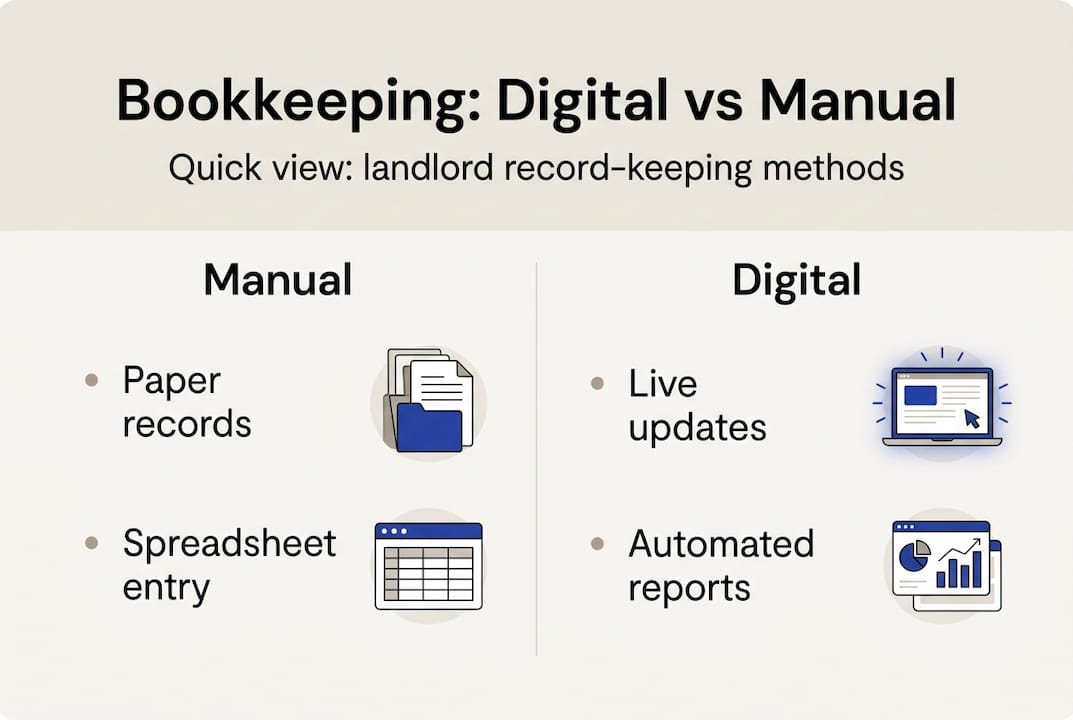
| Aspect | Manual bookkeeping | Digital bookkeeping |
|---|---|---|
| Time investment | 4-8 hours monthly entering data, reconciling accounts, filing receipts | 1-2 hours monthly reviewing automated transactions, confirming categories |
| Error rate | High risk from manual entry mistakes, lost receipts, calculation errors | Low risk with automated imports, built-in validation, digital storage |
| MTD compliance | Difficult to meet quarterly deadlines, requires reformatting for HMRC | Native MTD compatibility, one-click quarterly submissions |
| Financial visibility | Delayed insights, often only clear at year end | Real-time profit/loss, instant financial position updates |
| Receipt management | Physical storage, prone to fading or loss | Digital capture and cloud storage, searchable and permanent |
| Scalability | Becomes overwhelming with multiple properties | Handles portfolios easily with multi-property tracking |
Manual bookkeeping struggles particularly with MTD's quarterly update requirement. MTD for Income Tax mandates digital records and quarterly updates for UK landlords with property income over £50,000 from April 2026. Preparing four quarterly submissions manually means repeatedly reformatting spreadsheet data into HMRC's required format, a tedious process that invites mistakes.
Digital solutions eliminate this friction entirely. Your records already exist in MTD-compliant format, so quarterly submissions become a simple review-and-submit process taking minutes rather than hours.
Steps to transition from manual to digital bookkeeping:
- Choose MTD-compliant software suited to landlords, checking it handles your specific needs like joint ownership or HMOs
- Connect your business bank accounts through secure open banking to enable automatic transaction imports
- Upload or enter your opening balances and any transactions from the current tax year
- Spend a week reviewing how the software categorises transactions, training it to recognise your regular income and expenses
- Establish a weekly routine reviewing new transactions, attaching receipts, and confirming categorisation
- Set calendar reminders for quarterly update deadlines and end-of-year filing requirements
Pro Tip: Start your digital transition at the beginning of a tax year (6th April) if possible. This gives you clean opening balances and a full year to become comfortable with the system before your first MTD submission deadline.
The stress reduction alone justifies switching to digital methods. Instead of dreading tax season and scrambling to reconstruct financial records, you maintain continuous compliance. Your records stay current, your tax position remains clear, and you avoid the panic of missing receipts or unclear deductions.
Landlords managing multiple properties or complex arrangements particularly benefit. Free MTD software for landlords often includes features specifically designed for property portfolios, tracking income and expenses separately for each property whilst rolling up consolidated reports for tax purposes.
Getting started with digital bookkeeping: tips for UK landlords
Implementing digital bookkeeping successfully requires choosing the right tools and establishing good habits from day one. The software market offers numerous options, from basic free platforms to comprehensive paid solutions. Focus on finding MTD-compliant software specifically designed for UK landlords rather than generic accounting packages that may lack property-specific features.
Essential steps for successful implementation:
- Evaluate software options based on your portfolio complexity, checking for features like multi-property tracking, joint ownership support, and HMO easement handling
- Verify the software carries official HMRC MTD recognition, ensuring your quarterly submissions will be accepted
- Set up your chart of accounts correctly, using HMRC's approved expense categories for rental property income
- Configure bank feeds carefully, connecting only accounts used for your rental business to avoid mixing personal transactions
- Establish a consistent routine for reviewing transactions, ideally weekly, preventing backlogs that create errors
- Create a digital filing system for receipts and documents, using the software's attachment features or a complementary cloud storage solution
- Schedule quarterly reviews with your accountant if using professional support, giving them access to review your records before submissions
Regular reconciliation proves essential for maintaining accurate records. At least monthly, compare your software's bank balances against actual bank statements, investigating any discrepancies immediately. This catches errors early, whether from missed transactions, incorrect categorisation, or duplicate entries.
For landlords managing joint properties or HMOs, understanding how MTD easements simplify reporting helps you configure software correctly. Joint ownership easements mean you can submit one set of updates covering all owners' shares, but you must set up the ownership split accurately in your software. HMO easements allow treating the entire property as one business, so configure your software to track the HMO as a single unit rather than creating separate records for each tenant.
Pro Tip: Consider the role of bookkeepers in financial success when your portfolio grows beyond simple single-property ownership. A professional bookkeeper can handle monthly reconciliation and transaction review, whilst you focus on property management and strategic decisions. They work within your digital system, maintaining records that your accountant then reviews for tax planning and compliance.
Staying updated on MTD changes ensures you benefit from new easements and avoid surprise rule changes. HMRC periodically updates guidance, particularly around threshold changes and easement expansions. Subscribe to updates from your software provider and relevant landlord associations to receive timely notifications about regulatory changes affecting your obligations.
The digital bookkeeping setup guide approach should prioritise simplicity initially. Start with core income and expense tracking, ensuring accuracy before adding advanced features. As you become comfortable with daily operations, gradually incorporate additional capabilities like mileage tracking, capital allowances calculations, or profit forecasting tools.
Streamline your landlord accounting with VoxaMTD software
Transitioning to digital bookkeeping becomes straightforward with purpose-built tools designed specifically for UK landlords facing MTD compliance. VoxaMTD offers free, MTD-compliant software that handles everything from daily transaction tracking to quarterly HMRC submissions, eliminating the complexity and cost barriers that prevent many landlords from going digital.
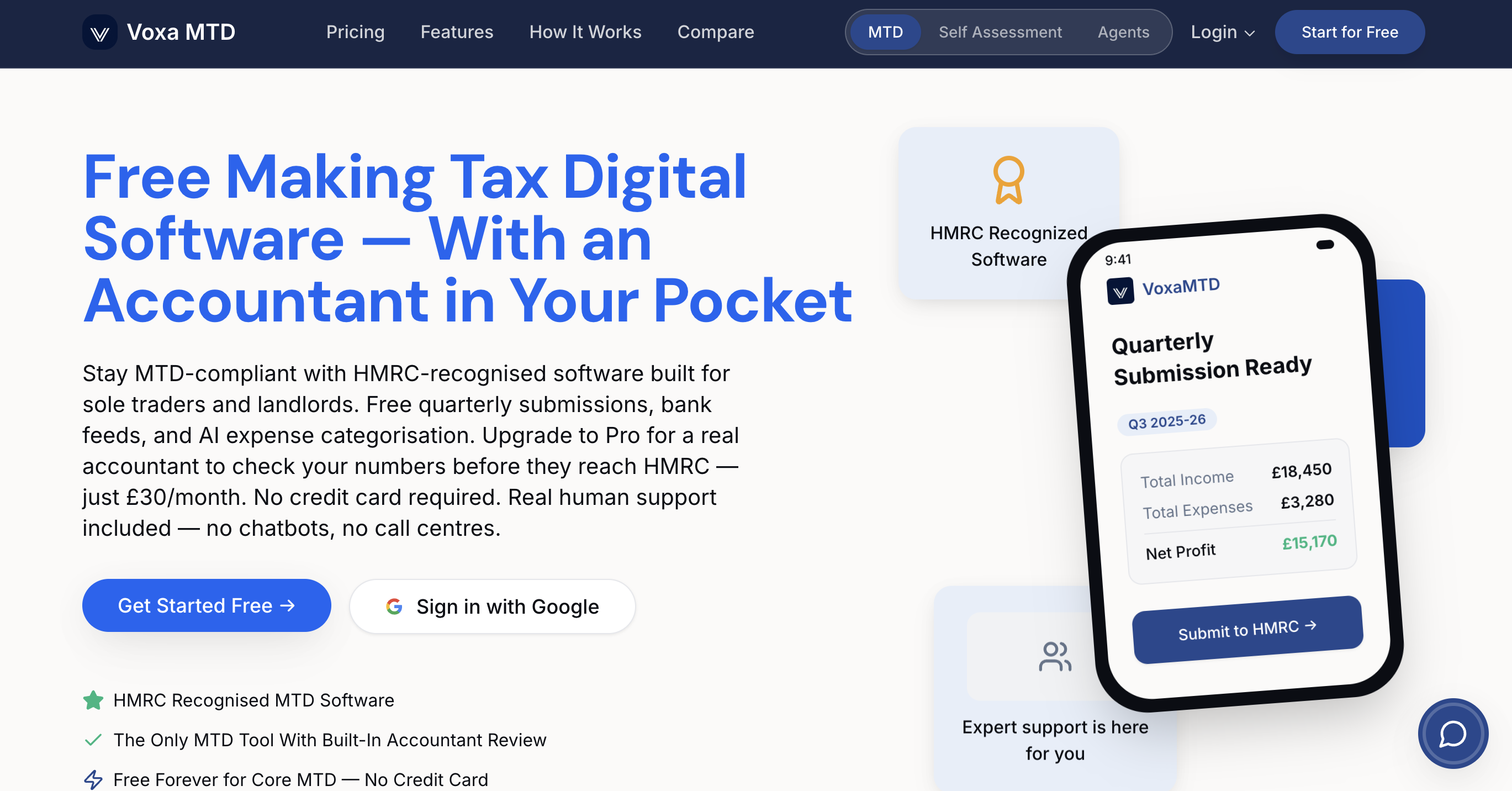
The platform simplifies digital record keeping through automated bank connections, intelligent expense categorisation, and built-in compliance alerts that ensure you never miss a quarterly deadline. Whether you manage a single buy-to-let property or a diverse portfolio spanning joint ownerships and HMOs, VoxaMTD scales to your needs whilst maintaining the simplicity that makes daily bookkeeping manageable.
Integrating VoxaMTD MTD software for landlords with expert accountant support creates the ideal compliance solution. The software maintains your digital records throughout the year, whilst professional accountants review your submissions before filing, catching potential issues and optimising your tax position. This hybrid approach combines automation's efficiency with professional expertise's accuracy, giving you confidence in your compliance whilst freeing your time to focus on growing your rental business rather than wrestling with paperwork.
Frequently asked questions about digital bookkeeping for landlords
What does digital bookkeeping mean under MTD for landlords?
Digital bookkeeping under MTD means maintaining your rental income and expense records using HMRC-approved software rather than paper ledgers or basic spreadsheets. The software must preserve records digitally, enable quarterly summary updates to HMRC, and maintain an audit trail of all transactions. This ensures compliance with MTD regulations whilst providing real-time financial visibility.
When do MTD thresholds apply to landlords?
MTD applies to landlords with gross rental income exceeding £50,000 from April 2026, reducing to £30,000 in April 2027 and £20,000 in April 2028. These thresholds apply to your total property income before expenses. Once you exceed the threshold, you must maintain digital records and submit quarterly updates for all subsequent tax years, even if your income later drops below the threshold.
How can landlords start digital bookkeeping affordably?
Many MTD-compliant platforms offer free tiers specifically for sole traders and landlords, providing essential features without monthly fees. Start by choosing free software that meets HMRC's MTD requirements, connect your bank accounts for automated transaction imports, and establish a weekly routine reviewing transactions. This approach requires minimal financial investment whilst building compliant digital records from day one.
Should landlords combine software with accounting professionals?
Combining digital bookkeeping software with professional accountant support proves ideal for complex scenarios like multiple properties, joint ownership arrangements, or mixed income sources. Software handles daily record keeping and compliance automation, whilst accountants provide strategic tax planning, review submissions for accuracy, and optimise deductions. This partnership maximises both efficiency and tax effectiveness.
How do MTD rules handle joint ownership and HMOs?
HMRC introduced easements specifically for joint properties and HMOs to simplify reporting. Joint ownership easements allow one owner to submit quarterly updates covering all owners' shares, avoiding duplicate submissions. HMO easements treat the entire property as one rental business rather than requiring separate tracking for each room, significantly reducing administrative complexity for landlords managing houses in multiple occupation.