
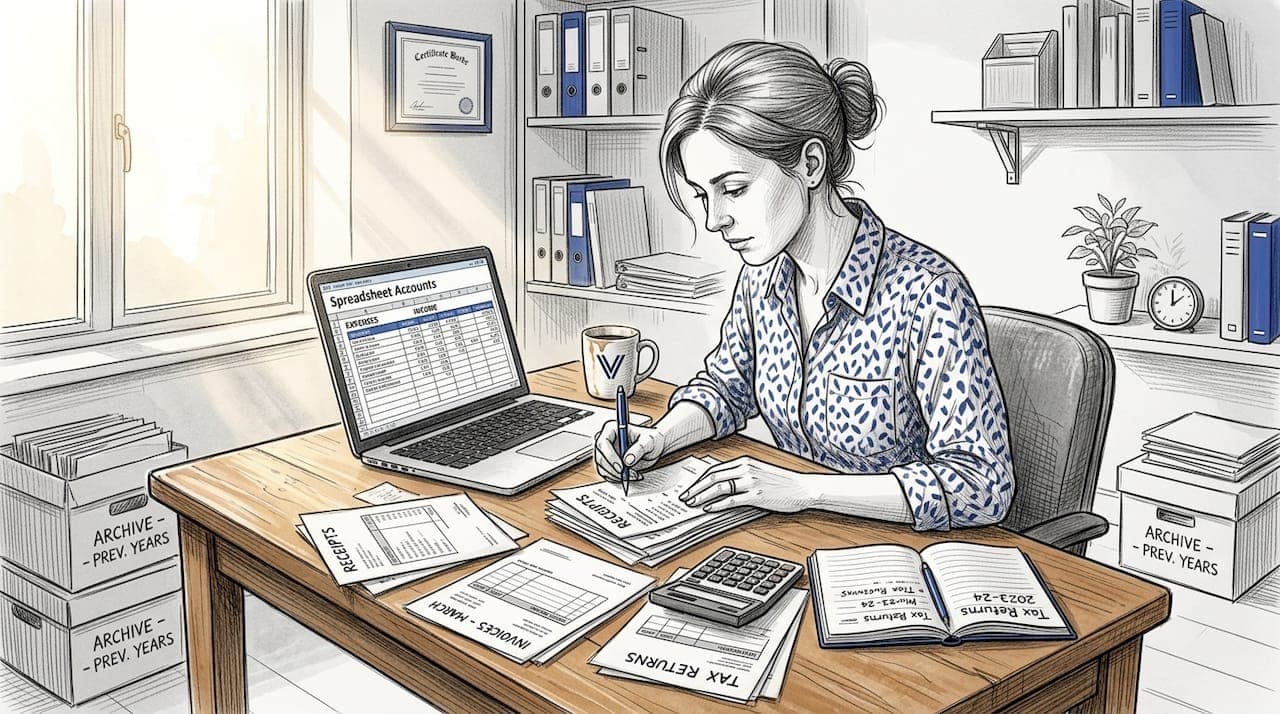
Navigating tax deductions as a self-employed individual in the UK has become more complex with Making Tax Digital requirements. With numerous allowable expenses and multiple accounting methods available, choosing the right deductions can significantly impact your tax liability. This article provides a structured framework to help you evaluate deduction types, compare accounting methods, and select the optimal approach to maximise your tax relief while maintaining full MTD compliance.
Table of Contents
- Key Takeaways
- How to evaluate tax deductions under MTD: criteria to consider
- Common tax deductions available to self-employed individuals
- Comparing deduction methods: cash basis versus actual expenses
- Choosing the best tax deductions for your business scenario
- Discover VoxaMTD: your free MTD software for sole traders
- What are allowable expenses for self-employed tax deductions?
Key Takeaways
| Point | Details |
|---|---|
| Actual expenses preferred | Experts consistently advise using actual expense accounting to optimise tax relief under Making Tax Digital. |
| MTD compliance basics | Record keeping must be digital and returns filed through HMRC recognised software via the production API. |
| Compare deduction schemes | Understanding the available deduction types and how simplified schemes compare to actual expenses helps determine the best fit. |
| Quarterly expense review | Review expense categories quarterly to capture all eligible deductions and adjust methods when appropriate. |
How to evaluate tax deductions under MTD: criteria to consider
Selecting the right tax deductions requires a systematic evaluation framework that balances compliance, potential savings, and administrative burden. Understanding these criteria helps you make informed decisions about which deductions to claim and which accounting method to adopt.
First, ensure any deduction you claim meets Making Tax Digital compliance standards. MTD mandates digital record keeping and quarterly submissions, which affects how you document and report expenses. Your chosen accounting software must be HMRC-recognised and capable of submitting returns directly through the production API.
The fundamental choice between cash basis and actual expense accounting shapes your entire deduction strategy. Cash basis accounting aligns with MTD reporting, but experts consistently recommend actual expenses for optimisation. Cash basis records income when received and expenses when paid, whilst actual expenses track transactions when they occur regardless of payment timing.
Consider the relevance and eligibility of each expense category. HMRC permits deductions only for costs wholly and exclusively incurred for business purposes. Mixed-use expenses like home office costs or vehicle expenses require apportionment between business and personal use. Simplified expense schemes offer flat rate deductions for these categories, but may not maximise your relief.
Record keeping requirements under MTD extend beyond traditional bookkeeping. You must maintain digital records of all transactions, store receipts electronically, and categorise expenses accurately for quarterly submissions. The administrative burden varies significantly between simplified schemes and actual expense tracking, particularly if you have high volumes of transactions.
Assess the potential tax savings from each deduction type. Capital allowances on equipment purchases can generate substantial relief through annual investment allowance, whilst simplified expenses for home office use may undervalue your actual costs. Running calculations for both methods reveals which approach delivers greater tax savings for your specific circumstances.
Pro tip: Review your expense categories quarterly rather than annually. This practice ensures you capture all eligible deductions throughout the year and identify patterns that might justify switching from simplified to actual expense accounting.
Common tax deductions available to self-employed individuals
Self-employed individuals in the UK can claim numerous deduction types, each with specific rules and documentation requirements. Understanding these categories helps you identify opportunities to reduce your taxable profit.
Allowable business expenses form the largest deduction category. These include:
- Office costs such as stationery, postage, and telephone bills used exclusively for business
- Travel expenses including public transport, accommodation, and meals during business trips
- Stock and raw materials purchased for resale or production
- Marketing and advertising costs for promoting your services
- Professional fees for accountants, solicitors, and industry memberships
- Insurance premiums for professional indemnity, public liability, and business equipment
- Bank charges and interest on business loans
- Training courses that maintain or update skills directly relevant to your current business
Simplified expense schemes offer flat rate deductions for three specific categories. Home office expenses can be claimed at £10 per month for 25 to 50 hours of business use, £18 per month for 51 to 100 hours, or £26 per month for over 100 hours. Vehicle expenses use a mileage rate of 45p per mile for the first 10,000 business miles and 25p per mile thereafter. Living accommodation costs for business premises in your home follow similar flat rate structures.
Capital allowances provide relief for equipment, machinery, and vehicles used in your business. The annual investment allowance permits 100% deduction of qualifying expenditure up to £1 million in the year of purchase. Writing down allowances at 18% per year apply to items exceeding the annual limit or purchased in prior years.
Documenting claims under MTD requires digital record keeping through HMRC-recognised software. Store receipts electronically using scanning apps or photograph them with your smartphone. Categorise each transaction according to HMRC expense codes to streamline quarterly submissions. Bank statement imports through open banking connections automate much of this process, reducing manual data entry.
Pro tip: Conduct a quarterly expense review to identify categories where actual costs exceed simplified expense rates. This analysis reveals whether switching accounting methods would increase your tax relief and justifies the additional record keeping effort.
Comparing deduction methods: cash basis versus actual expenses
The choice between cash basis and actual expense accounting fundamentally affects how much tax relief you claim. Each method has distinct advantages and limitations that suit different business profiles.
Cash basis accounting records income when money enters your bank account and expenses when you pay them. This approach simplifies bookkeeping by eliminating accruals, prepayments, and stock valuations. You claim relief for expenses in the tax year you pay them, regardless of which period they relate to. Cash basis aligns naturally with MTD quarterly reporting cycles, making it popular among sole traders with straightforward finances.
Actual expense accounting tracks transactions when they occur, matching income and costs to the periods they relate to. This accruals basis requires more sophisticated record keeping but typically generates higher deductions. You claim relief for expenses when incurred, even if payment occurs in a different tax year. Capital expenditure follows specific allowance rules rather than immediate deduction.

| Feature | Cash basis | Actual expenses |
|---|---|---|
| Record keeping | Simpler, payment focused | More detailed, transaction focused |
| Income recognition | When received | When earned |
| Expense deduction | When paid | When incurred |
| Stock valuation | Not required | Required at year end |
| Capital items | Deducted when purchased | Claimed via capital allowances |
| Turnover limit | Must be under £150,000 | No limit |
| Tax optimisation | Generally lower relief | Generally higher relief |
Cash basis advantages include reduced administrative burden, no stock valuations, and immediate relief for capital purchases under £1,000. You avoid complex accruals calculations and focus purely on money movements. This method suits service-based businesses with minimal stock and equipment.
Actual expense advantages centre on maximising deductions through precise cost matching and capital allowance optimisation. You claim relief for all business expenses when incurred, capture year-end stock valuations as deductions, and benefit from enhanced capital allowances on equipment purchases. Experts consistently recommend actual expenses for optimising tax relief whilst maintaining MTD compliance.
Cash basis limitations include the £150,000 turnover threshold, restricted relief for capital items over £1,000, and inability to claim losses against other income. Actual expense limitations involve higher administrative costs, mandatory stock valuations, and more complex record keeping requirements.
"The actual expense method typically delivers 15 to 25% more tax relief than cash basis for businesses with significant capital investment or stock holdings, making the additional record keeping worthwhile for most sole traders."
Pro tip: Calculate your potential deductions under both methods for a recent tax year. If actual expenses exceed cash basis relief by more than £500, the switch justifies the extra administrative effort and any accounting software subscription costs.
Choosing the best tax deductions for your business scenario
Selecting optimal deductions requires matching your business characteristics to the most suitable accounting method and expense categories. Different self-employment profiles benefit from tailored approaches.
| Business scenario | Recommended method | Key deductions | Rationale |
|---|---|---|---|
| Service-based, low expenses | Cash basis | Simplified home office, mileage | Minimal admin burden, adequate relief |
| Trading business with stock | Actual expenses | Stock valuations, actual costs | Maximises relief through precise matching |
| Equipment-intensive business | Actual expenses | Capital allowances, depreciation | Optimises relief on major purchases |
| High mileage business | Actual expenses | Actual vehicle costs | Exceeds simplified mileage rates |
| Home-based with dedicated office | Actual expenses | Proportionate home costs | Captures full relief beyond flat rates |
Follow this decision-making process to select your deduction approach:
- Calculate your annual turnover to confirm eligibility for cash basis if considering that option
- List all expense categories you incur regularly throughout the year
- Estimate annual totals for each category using bank statements and receipts from recent months
- Calculate potential deductions under simplified expense schemes for home office, vehicle, and accommodation costs
- Compare simplified rates against actual costs to identify which categories deliver greater relief
- Project capital expenditure for equipment, machinery, or vehicles you plan to purchase
- Run parallel calculations for cash basis and actual expenses using your figures
- Factor in administrative time required for each method and whether MTD software can automate the difference
- Select the method delivering highest net benefit after considering both tax relief and compliance costs
Record keeping integration with MTD reporting remains essential regardless of your chosen method. Digital bookkeeping software eliminates much of the administrative burden that previously made actual expenses prohibitive for small businesses. Automatic bank imports, receipt scanning, and AI-powered expense categorisation reduce manual data entry to minutes per week.
For complex situations involving multiple income streams, significant capital investment, or international transactions, consult a qualified tax professional. Expert guidance ensures you claim all eligible relief whilst avoiding common errors that trigger HMRC enquiries. The cost of professional advice typically pays for itself through additional deductions identified and compliance confidence gained.
Discover VoxaMTD: your free MTD software for sole traders
Managing tax deductions and MTD compliance becomes straightforward with the right tools. VoxaMTD offers a free, HMRC-recognised platform specifically designed for UK sole traders and landlords facing the April 2026 MTD mandate.
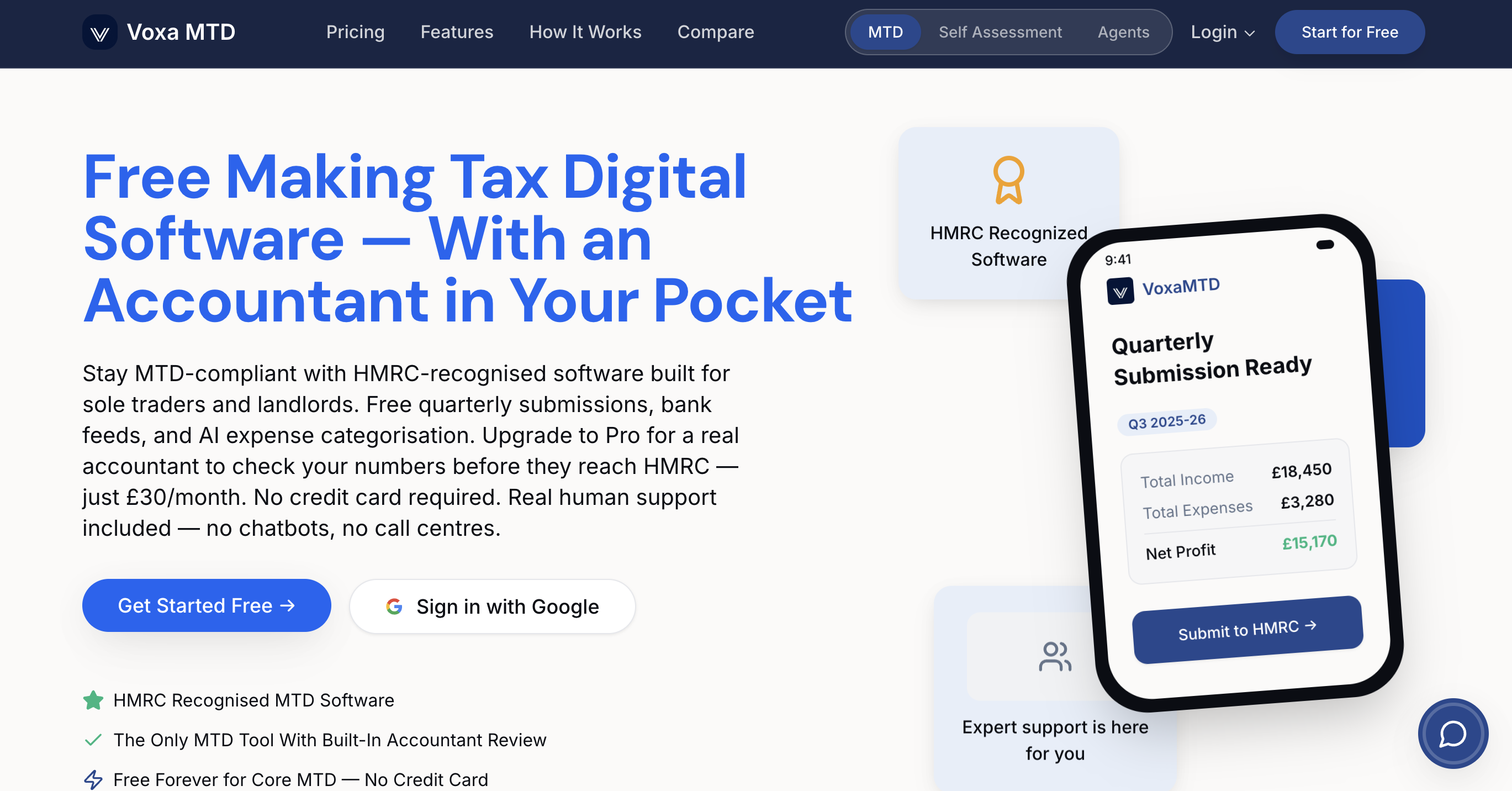
The platform handles quarterly MTD submissions directly to HMRC through production API integration, eliminating manual data entry and submission errors. Automatic bank transaction imports via Finexer open banking connect your business accounts, categorising expenses using AI-powered recognition that learns your spending patterns. Claude Vision OCR scans receipts instantly, extracting amounts, dates, and vendors to populate your digital records.
Alex AI Accountant provides conversational tax guidance 24/7 through ElevenLabs voice technology, answering questions about allowable expenses, deduction eligibility, and optimal accounting methods. Premium tiers unlock the full AI assistant, whilst the Professional tier at £30 monthly includes quarterly reviews with a real human accountant. VoxaMTD's comprehensive feature set makes professional-grade tax compliance accessible to millions of self-employed individuals navigating MTD requirements.
What are allowable expenses for self-employed tax deductions?
Allowable expenses include any costs incurred wholly and exclusively for business purposes. HMRC permits deductions for office supplies, travel, stock, marketing, professional fees, insurance, and bank charges when directly related to earning business income. Mixed-use expenses like home office or vehicle costs require apportionment between business and personal use, either through actual cost calculations or simplified expense flat rates.
Making Tax Digital requires digital record keeping but does not restrict which expense types you can claim. The same allowable expense rules apply whether you use cash basis or actual expense accounting. MTD compliance software helps categorise expenses correctly and maintain the digital records HMRC requires for quarterly submissions.
How does Making Tax Digital affect claiming tax deductions?
MTD mandates digital record keeping and quarterly reporting for VAT-registered businesses and will extend to income tax from April 2026. You must maintain electronic records of all transactions, store receipts digitally, and submit returns through HMRC-recognised software. These requirements affect the administrative process for claiming deductions but do not change which expenses qualify for relief.
Proper digital bookkeeping ensures compliance whilst capturing all eligible deductions throughout the year. Quarterly submission deadlines create natural review points to assess your expense categories and verify you are claiming optimal relief under your chosen accounting method.
Is the cash basis or actual expenses method better for my business?
Cash basis simplifies record keeping by tracking money movements rather than transaction timing, making it suitable for service businesses with minimal stock and equipment. You avoid complex accruals calculations and can immediately deduct capital purchases under £1,000. However, the £150,000 turnover limit and restricted capital relief may constrain growing businesses.
Actual expenses typically deliver higher deductions through precise cost matching and capital allowance optimisation. Experts recommend actual expense accounting for maximising tax relief whilst maintaining MTD compliance. Calculate potential deductions under both methods to determine which approach benefits your specific circumstances.
Can I claim home office expenses as a self-employed individual?
Home office expenses are claimable if you use part of your home regularly and exclusively for business purposes. You can deduct a proportion of mortgage interest, rent, council tax, utilities, and maintenance costs based on the business-use percentage of your home. Calculate this proportion using floor area or number of rooms dedicated to business activity.
Simplified expenses offer an alternative through flat rate deductions of £10 to £26 monthly depending on hours of business use. This approach eliminates detailed calculations and record keeping but may undervalue your actual costs if you maintain a dedicated home office. Compare both methods annually to ensure you claim maximum relief.