

Managing your bookkeeping as a UK sole trader can feel overwhelming, especially with Making Tax Digital regulations now requiring quarterly digital submissions from April 2026. Many sole traders struggle with keeping accurate records, often mixing personal and business transactions, which creates stress during tax season and risks compliance issues. This comprehensive guide walks you through everything you need to know, from understanding your MTD obligations to setting up compliant systems, executing quarterly updates, and submitting your year-end declaration with confidence. You’ll discover practical steps to simplify your bookkeeping, save valuable time, and ensure full HMRC compliance.
Table of Contents
-
Understanding Making Tax Digital and your bookkeeping responsibilities
-
Executing quarterly bookkeeping updates and staying organised throughout the year
-
Verifying your records and submitting your year-end declaration
-
Frequently asked questions about UK sole trader bookkeeping and MTD
Key takeaways
| Point | Details |
| MTD compliance starts April 2026 | Sole traders earning over £50,000 must keep digital records and submit quarterly updates through compatible software |
| Accurate bookkeeping reduces stress | Monthly reviews and proper record keeping prevent last-minute panic and catch errors early |
| Compatible software is essential | HMRC-recognised MTD software automates submissions and can save 26-40 hours yearly on record keeping |
| Quarterly updates replace annual returns | Four quarterly submissions plus a year-end declaration are now required instead of traditional annual self-assessment |
| Early preparation prevents problems | Setting up proper systems now ensures a smooth transition when MTD becomes mandatory |
Understanding Making Tax Digital and your bookkeeping responsibilities
Making Tax Digital represents the most significant change to sole trader tax obligations in decades. MTD for Income Tax becomes mandatory from 6 April 2026 for individuals with business or property income exceeding £50,000 annually. This digital transformation fundamentally changes how you maintain records and interact with HMRC throughout the tax year.
The core requirement involves keeping digital records of all your business income and expenses using compatible software. Paper records and spreadsheets no longer suffice for MTD compliance. Sole traders must submit four quarterly updates plus a year-end declaration each tax year, replacing the traditional single annual self-assessment return. These quarterly updates provide HMRC with regular snapshots of your business performance, allowing them to track your tax position throughout the year rather than waiting until January.
The £50,000 income threshold applies to combined self-employment and property income starting April 2026, with plans to lower this threshold in future years. If your total annual income from these sources exceeds £50,000, you must comply with MTD rules. This means no more filing through HMRC’s online portal or submitting paper returns for eligible traders.
Your bookkeeping responsibilities under MTD include:
-
Recording all business income within the software as transactions occur
-
Categorising and documenting every business expense with supporting evidence
-
Maintaining digital copies of invoices, receipts, and financial records
-
Reconciling bank statements monthly to ensure accuracy
-
Submitting quarterly updates to HMRC within required deadlines
-
Completing a final year-end declaration summarising your annual position
These obligations might seem daunting initially, but proper preparation and the right software transform them into manageable routine tasks. The overview of MTD rules for sole traders provides additional context on how these requirements affect your specific situation and what steps you need to take now.
Preparing your bookkeeping system for MTD compliance
Successful MTD compliance starts with proper preparation of your bookkeeping infrastructure. Digital record-keeping requires compatible software and quarterly submissions to HMRC, making your software choice critical. Fully functional MTD-compatible software connects directly with HMRC’s systems, enabling seamless quarterly updates and year-end declarations whilst maintaining compliant digital records.

Many sole traders face significant challenges because they mix personal and business transactions, creating stress during tax season and potential compliance issues. Separating these finances is essential for MTD success. Open a dedicated business bank account if you haven’t already, and use it exclusively for business transactions. This simple step dramatically simplifies record keeping and provides clear audit trails.
Your preparation checklist should include:
-
Researching and selecting MTD-compatible software that suits your business needs and budget
-
Opening a separate business bank account to isolate business transactions
-
Gathering historical records and entering opening balances into your new system
-
Connecting your business bank account to the software through secure open banking
-
Setting up expense categories that align with HMRC requirements
-
Creating a filing system for digital receipts and supporting documentation
-
Scheduling regular bookkeeping sessions in your calendar
Choosing the right software involves evaluating features, pricing, and ease of use. The table below compares key features of popular MTD-compatible options:
| Software Feature | Basic Solutions | Premium Solutions | Free MTD Compatible Software |
| MTD quarterly submissions | Yes | Yes | Yes |
| Automatic expense categorisation | Limited | Yes | AI-powered |
| Bank feed integration | Manual | Automatic | Automatic via open banking |
| Accountant review service | No | Paid add-on | Integrated |
| Annual cost | £50-150 | £200-400 | Free |
Record accuracy and timeliness matter more under MTD than traditional annual returns. Quarterly submissions mean errors compound if left uncorrected, and late submissions trigger penalties. Establishing robust processes now prevents future headaches.
Pro Tip: Reconcile your bank statements weekly rather than monthly during your first three months with new software. This frequent checking helps you catch categorisation errors early, understand your software’s features thoroughly, and build confidence in your system before MTD compliance becomes mandatory.
Executing quarterly bookkeeping updates and staying organised throughout the year
MTD transforms bookkeeping from an annual ordeal into a manageable quarterly routine. Four quarterly updates plus a year-end declaration are required each tax year, with specific deadlines following the end of each quarter. Understanding and executing these updates correctly ensures compliance whilst reducing year-end stress.
Your quarterly update process follows these steps:
-
Review all income and expenses recorded during the quarter for completeness and accuracy
-
Reconcile your bank statements to ensure every transaction is captured and correctly categorised
-
Verify that supporting documentation exists for all significant expenses
-
Use your MTD-compatible software to generate the quarterly update summary
-
Review the summary for any unusual patterns or potential errors
-
Submit the update to HMRC through your software’s direct connection
-
Save confirmation of submission and note the submission date for your records
-
Schedule your next quarterly review immediately to maintain momentum
Maintaining monthly bookkeeping reviews dramatically improves accuracy and reduces workload during quarterly submissions. Monthly reviews keep finances healthy and help spot potential issues before they become problems. Set aside dedicated time each month to complete essential tasks rather than scrambling quarterly.
Common pitfalls during quarterly bookkeeping include incomplete record keeping, mixing personal and business expenses, forgetting to record cash transactions, miscategorising expenses, and missing quarterly deadlines. Each mistake creates compliance risks and potential penalties. Vigilance and consistent processes prevent these issues.
Pro Tip: Designate the first Monday of each month as your bookkeeping day. Block this time in your calendar as non-negotiable, treating it like an important client meeting. Consistency builds habit, and monthly reviews take 2-3 hours compared to 8-10 hours if left quarterly. Set phone reminders the week before each quarterly deadline to ensure you never miss a submission.
Modern software features transform time-consuming manual tasks into automated processes. Auto-categorisation learns from your patterns and suggests appropriate expense categories, saving hours annually. Bank feeds automatically import transactions, eliminating manual data entry. Receipt scanning through mobile apps captures documentation instantly, preventing lost receipts and missing deductions.
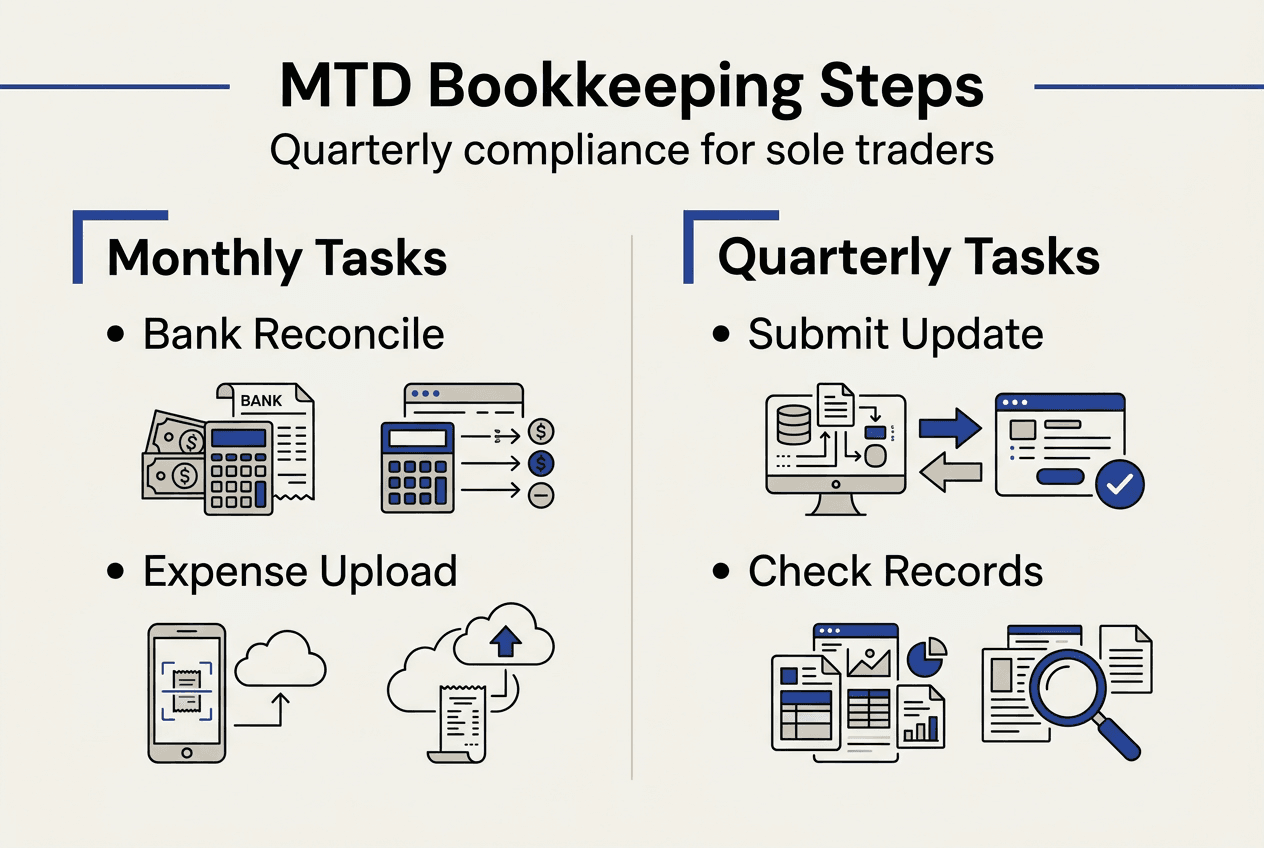
The monthly bookkeeping tasks with MTD approach ensures you stay organised year-round rather than facing quarterly panic. Regular attention to your finances also provides valuable business insights, helping you identify profitable activities, control costs, and make informed decisions about your sole trader business.
Verifying your records and submitting your year-end declaration
Your year-end declaration represents the final step in the MTD compliance cycle, summarising your annual business performance and confirming your tax position. Unlike quarterly updates that report income and expenses, the year-end declaration includes adjustments, allowances, and final calculations determining your tax liability. Thorough verification before submission prevents costly errors and potential HMRC investigations.
Verifying quarterly data accuracy throughout the year makes year-end preparation significantly easier. Review each quarter’s submission to ensure consistency and completeness. Your reconciliation steps should include:
-
Cross-checking total income against bank deposits and sales invoices
-
Verifying all business expenses have supporting documentation
-
Confirming expense categories align with HMRC guidelines
-
Reviewing any unusual or large transactions for accuracy
-
Ensuring personal expenses haven’t been incorrectly included
-
Checking that all quarterly submissions were accepted by HMRC
-
Reconciling your software totals with actual bank balances
The shift from traditional annual returns to MTD quarterly updates with year-end declarations offers substantial advantages:
| Aspect | Traditional Annual Return | MTD Year-End Declaration |
| Record keeping | Manual, often incomplete | Digital, continuous throughout year |
| Time investment | 15-20 hours concentrated in January | 8-12 hours spread across year |
| Error detection | Discovered at year-end | Caught during quarterly reviews |
| Tax planning | Reactive, limited options | Proactive, ongoing visibility |
| HMRC interaction | Single annual submission | Regular quarterly engagement |
| Compliance confidence | Uncertain until filed | Verified quarterly |
Businesses using fully functional MTD-compatible software saved between 26 and 40 hours yearly on record keeping and tax processes according to HMRC’s evaluation. These time savings result from automation, reduced manual data entry, and catching errors early rather than correcting them retrospectively.
Consequences of errors or late filing under MTD can be severe. HMRC imposes penalties for missed quarterly deadlines, with amounts increasing for repeated failures. Inaccurate submissions may trigger compliance checks or full investigations. Deliberate errors or fraud result in substantial penalties and potential prosecution. The stakes are higher under MTD because HMRC receives regular updates and can identify discrepancies more quickly.
Your year-end declaration includes finalising capital allowances, claiming annual investment allowance, adjusting for any non-business use of assets, and confirming your basis period. These adjustments require careful consideration and often benefit from professional review. Many sole traders use accountant services for year-end declarations even when handling quarterly updates independently.
The year-end declaration software options available today integrate seamlessly with quarterly processes, automatically carrying forward data and highlighting areas requiring attention. This integration ensures consistency between quarterly updates and final declarations, reducing error risk and simplifying the verification process.
Streamline your UK sole trader bookkeeping with VoxaMTD
Navigating Making Tax Digital requirements doesn’t have to be complicated or expensive. VoxaMTD offers free MTD software for sole traders specifically designed to simplify compliance whilst saving you valuable time on bookkeeping and tax submissions.
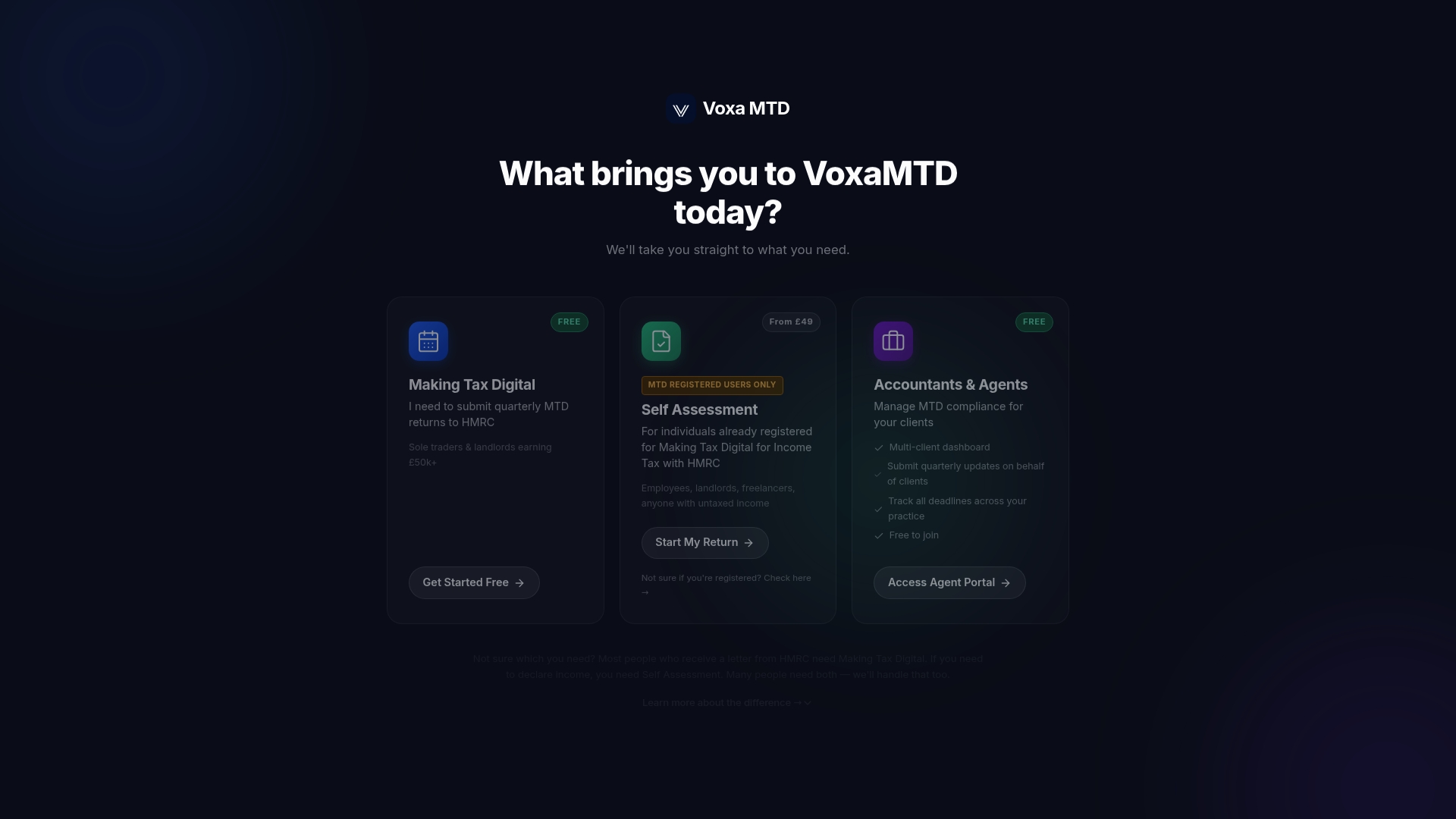
Our intuitive platform handles everything from automatic record keeping to quarterly submission support and easy year-end declaration preparation. The AI-powered expense categorisation learns your business patterns, whilst secure open banking connections automatically import transactions from your UK bank accounts. You’ll benefit from the same time savings HMRC documented in their MTD evaluation, reclaiming 26-40 hours annually that you can reinvest in growing your business.
Key features that make VoxaMTD the smart choice:
-
Fully MTD-compatible software recognised by HMRC for compliant submissions
-
Automatic expense categorisation using artificial intelligence
-
Secure bank feed integration through open banking technology
-
Integrated accountant review service for year-end confidence
-
Deadline tracking and reminders so you never miss a submission
-
Free tier available with premium options for advanced needs
Pro Tip: Sign up for VoxaMTD now, even if MTD doesn’t apply to you until 2026 or later. Getting familiar with the software and building your digital records early means you’ll transition smoothly when compliance becomes mandatory, avoiding the last-minute rush that causes stress and errors.
Thousands of UK sole traders trust VoxaMTD to handle their bookkeeping and MTD compliance. The platform’s user-friendly design means you don’t need accounting expertise to maintain compliant records and submit accurate returns. Start your free account today and experience how modern software transforms bookkeeping from a dreaded chore into a simple routine task.
Frequently asked questions about UK sole trader bookkeeping and MTD
What is the income threshold for mandatory MTD compliance in 2026?
From 6 April 2026, sole traders and landlords with combined business and property income exceeding £50,000 annually must comply with Making Tax Digital requirements. This threshold applies to your total gross income from self-employment and property sources before expenses. HMRC plans to lower this threshold in future years, eventually bringing most sole traders into the MTD system.
Can I still file my sole trader tax return on paper after April 2026?
No, if your income exceeds the £50,000 threshold, you cannot use paper returns or HMRC’s online self-assessment portal after April 2026. You must maintain digital records using MTD-compatible software and submit quarterly updates plus a year-end declaration through that software. Sole traders below the threshold can continue using traditional methods until MTD extends to lower income levels.
How often do I need to submit updates to HMRC under MTD?
You must submit four quarterly updates during each tax year, covering periods ending July, October, January, and April. Each update is due within one month of the quarter end. Additionally, you’ll submit a final year-end declaration by 31 January following the tax year, similar to current self-assessment deadlines but based on your quarterly submissions.
What software options are available that meet MTD requirements?
Numerous software providers offer MTD-compatible solutions, ranging from basic free options to comprehensive premium packages. Essential features include digital record keeping, direct HMRC submission capability, and bank feed integration. VoxaMTD provides free MTD-compliant software with AI-powered categorisation, open banking connections, and integrated accountant review, making it an excellent choice for sole traders seeking robust functionality without subscription costs.
Will MTD save me time on bookkeeping and tax filing?
Yes, HMRC’s evaluation found that businesses using fully functional MTD-compatible software saved 26-40 hours annually on record keeping and tax processes. These savings come from automated data entry, reduced manual work, early error detection, and spreading the workload throughout the year rather than concentrating it in January. The initial setup requires time investment, but ongoing maintenance becomes significantly more efficient than traditional annual returns.
Do I need an accountant to comply with Making Tax Digital?
MTD doesn’t legally require accountant involvement, and many sole traders successfully manage compliance independently using quality software. However, accountants provide valuable expertise for complex situations, year-end optimisation, and peace of mind. Some software platforms, including VoxaMTD, offer integrated accountant review services, giving you professional oversight when needed without requiring full accountancy engagement for routine quarterly submissions.