

TL;DR:
- 'Simple MTD' refers to using basic, free tools and simplified accounting methods, not a separate scheme.
- Most sole traders and landlords can meet 2026 MTD requirements with HMRC-recognised free software.
- Free tools reduce compliance time and mental workload, making digital tax simpler and more accessible.
The April 2026 deadline for Making Tax Digital is fast approaching, and if you're a sole trader or landlord, the pressure to get compliant is real. But here's what trips most people up: the phrase 'simple MTD' gets thrown around constantly, yet nobody explains what it actually means. Is it a specific product? A stripped-back HMRC scheme? Or just a way of saying 'the free, no-fuss option'? This guide cuts through that confusion. We'll define what simple MTD compliance actually looks like, show you how to choose the right free tool, and compare the best options so you can make a confident decision before the 864,000 affected self-employed people hit the 2026 wall.
Table of Contents
- What is 'simple MTD'? Defining compliance and the 2026 mandate
- Selection criteria: What makes an MTD tool 'simple' for you?
- Top free 'simple MTD' software options for 2026
- Quick comparison: Which MTD tool is best for whom?
- Why 'simple MTD' is still a game-changer for sole traders and landlords
- Stay compliant in 2026 with free MTD solutions
- Frequently asked questions
Key Takeaways
| Point | Details |
|---|---|
| Simple MTD means easy tools | There’s no special 'simple MTD' scheme—just streamlined, free options that cover basic digital tax rules. |
| Free tools are enough for many | If you have a straightforward business or rental income, HMRC-recognised free MTD tools keep you compliant. |
| 2026 compliance matters | The new MTD rules require qualifying sole traders and landlords to go digital from April 2026—start early to avoid last-minute stress. |
| Pick by your situation | Choose the simple MTD tool that matches your business size and complexity, and upgrade only if your needs grow. |
What is 'simple MTD'? Defining compliance and the 2026 mandate
Let's get one thing straight from the start. There is no separate HMRC scheme called 'Simple MTD'. According to MTD ITSA guidance, the phrase most likely refers to using basic simplifications, such as 3-line accounts, simplified expenses, or free software, rather than a distinct product category. It's shorthand for the most straightforward path through MTD compliance.
So what does that compliance actually involve? MTD ITSA mandates that UK sole traders and landlords keep digital records and submit quarterly updates to HMRC using compatible software. It replaces the old annual Self Assessment approach with four quarterly updates plus a final declaration each year.
The rollout is phased by income:
- April 2026: Qualifying gross income over £50,000 in 2024/25
- April 2027: Qualifying gross income over £30,000
- April 2028: Qualifying gross income over £20,000
For most people caught in the first wave, their situation is genuinely simple. One business, one income stream, modest transaction volumes. That's exactly the profile where free, basic MTD tools shine. You don't need enterprise-grade accounting software. You need something that meets the digital tax requirements without costing you £40 a month.
Key stat: HMRC estimates MTD will reduce the tax gap by cutting errors in self-reported income, with real-time quarterly reporting replacing the error-prone annual scramble.
The simplifications available to you are worth knowing:
- 3-line accounts: Just report turnover, allowable expenses, and profit. No full breakdown needed.
- Simplified expenses: Flat rates for mileage, home office use, and vehicles instead of detailed receipts.
- Free HMRC-recognised software: Several tools meet full compliance at zero cost.
For sole trader tax compliance in 2026, understanding these simplifications is the difference between dreading MTD and breezing through it.
Selection criteria: What makes an MTD tool 'simple' for you?
Not every free MTD tool is built the same way. Choosing the wrong one means either paying for features you'll never use or hitting a wall when the software can't handle your needs. Here's how to evaluate your options properly.
First, confirm the basics. Any tool you consider must be HMRC-recognised, meaning it connects directly to HMRC's systems for quarterly submissions. Without that, you're not compliant, full stop. Check the HMRC-approved software list before committing to anything.
Second, match the tool to your actual situation. Qualifying income is your combined gross turnover from self-employment and UK property before expenses. The trading allowance does not reduce this threshold. So if you earn £52,000 gross from freelancing and a rental property combined, you're in scope from April 2026.
For most people in that position, the ideal tool should tick these boxes:
- Free at its core with no mandatory paid tier for basic MTD submissions
- Digital record-keeping that captures income and expenses in HMRC-approved categories
- Quarterly update submission directly to HMRC without manual workarounds
- Simple onboarding that takes minutes, not hours
- Mobile access so you can log expenses on the go
Features like invoicing, payroll, or multi-currency support are irrelevant if you're a part-time landlord with one property. They add complexity without adding value. Consider 2026 digital tax trends only if your business is genuinely growing in complexity.
For landlords specifically, look for tools that handle rental income separately and support landlord MTD guidance around mortgage interest and allowable expenses. Section 24 rules have changed how landlords calculate tax, and your software should reflect that.
Pro Tip: Don't be swayed by a long feature list. The best tool for simple MTD is the one you'll actually use consistently every quarter, not the one with the most impressive dashboard.
Top free 'simple MTD' software options for 2026
Here are the leading free MTD tools worth considering if your needs are straightforward. Each has been assessed for HMRC recognition, ease of use, and suitability for sole traders and landlords.
VoxaMTD Free, HMRC-recognised, and built specifically for sole traders and landlords. Handles quarterly MTD submissions via HMRC's production API, with FCA-regulated open banking through Finexer for automatic bank feeds. AI-powered categorisation sits at 95% accuracy. The Alex AI Accountant answers tax questions by voice, SMS, or WhatsApp, 24/7. Landlords get Section 24 calculations and capital allowances tracking. Sole traders get mileage tracking and home office calculators. A native iOS app gives full feature parity on mobile. Upgrade paths exist at £30 and £40 per month for those wanting a dedicated human accountant.
FreeAgent (free via certain banks) Fully MTD-compliant and well-regarded for freelancers. Free if you bank with NatWest, Royal Bank of Scotland, or Ulster Bank. Covers invoicing, expense tracking, and quarterly submissions. Limitation: not free if you don't hold one of those bank accounts.
QuickBooks Self-Employed (free trial only) Popular and polished, but the free tier is time-limited. Good for mileage tracking and basic self-employment records. Not ideal as a long-term free solution.
Countingup Combines a business current account with built-in MTD-ready bookkeeping. Free plan available with limited features. Works well for sole traders who want banking and tax in one place.
As TechRadar notes, free software is entirely sufficient for sole traders and landlords with few transactions and one income source. The moment your volume grows significantly, upgrading for efficiency makes sense. But for the majority entering MTD compliance in 2026, free tools are genuinely fit for purpose.
For landlord digital tax reporting, VoxaMTD stands out because it was designed with landlords in mind from day one, rather than adapted from small business accounting software.
Pro Tip: Sign up and run your chosen tool for one month before the mandate kicks in. A dry run with real data reveals any gaps before they become compliance problems.
Quick comparison: Which MTD tool is best for whom?
Here's a side-by-side view of the main free options:
| Tool | Free tier | HMRC-recognised | Bank feeds | Landlord support | Sole trader support |
|---|---|---|---|---|---|
| VoxaMTD | Yes, fully free | Yes | Yes (open banking) | Yes, dedicated | Yes, full features |
| FreeAgent | Bank-dependent | Yes | Yes | Limited | Strong |
| QuickBooks SE | Trial only | Yes | Yes | Limited | Strong |
| Countingup | Limited | Yes | Built-in account | Basic | Good |
Now, three scenarios to help you decide:
- Part-time landlord with one property: VoxaMTD or FreeAgent (if you bank with a qualifying provider). Both handle rental income cleanly and submit quarterly updates without fuss.
- Freelance sole trader, low volume: Any of the four options work. VoxaMTD wins on long-term cost since it stays free without a bank account condition.
- Growing business needing invoicing and payroll: Start free, then upgrade. VoxaMTD's Professional tier at £30/month adds a dedicated accountant when complexity increases.
The evidence supports going free first. As reported by The Independent Landlord, users of digital MTD tools claim up to 90% reduction in data entry time compared to manual record-keeping. That's not a marginal gain. That's hours back every quarter.
"Free, recognised tools level the playing field for small operators who previously couldn't afford professional-grade compliance support."
The key insight from how landlords submit digitally is that the submission process itself is simple once your records are in order. The software does the heavy lifting.
Why 'simple MTD' is still a game-changer for sole traders and landlords
Most guides focus purely on the compliance angle: meet the deadline, avoid penalties, tick the box. That framing misses something important.
For part-time landlords and sole traders juggling a day job alongside their income streams, the real win from simple MTD isn't just avoiding fines. It's reducing the mental drag of tax admin. When your records update automatically and your quarterly submission takes fifteen minutes rather than a frantic weekend in January, you get headspace back. That matters.
The conventional wisdom says free tools are a compromise. We'd push back on that. For most people entering the 2026 mandate, free tools are not the budget option. They are the right option. Paying £40 a month for features you'll never use isn't sophistication. It's waste.
Choosing mastering sole trader compliance through a simple, free, recognised tool is an active, informed decision. It means you've assessed your needs honestly and matched the tool to the reality of your business. That's not settling. That's smart.
Stay compliant in 2026 with free MTD solutions
If this guide has clarified one thing, it's that you don't need to spend a penny to be fully MTD-compliant in 2026. VoxaMTD is free, HMRC-recognised, and built from the ground up for UK sole traders and landlords. No hidden costs, no mandatory upgrades for basic compliance, and no complicated setup.
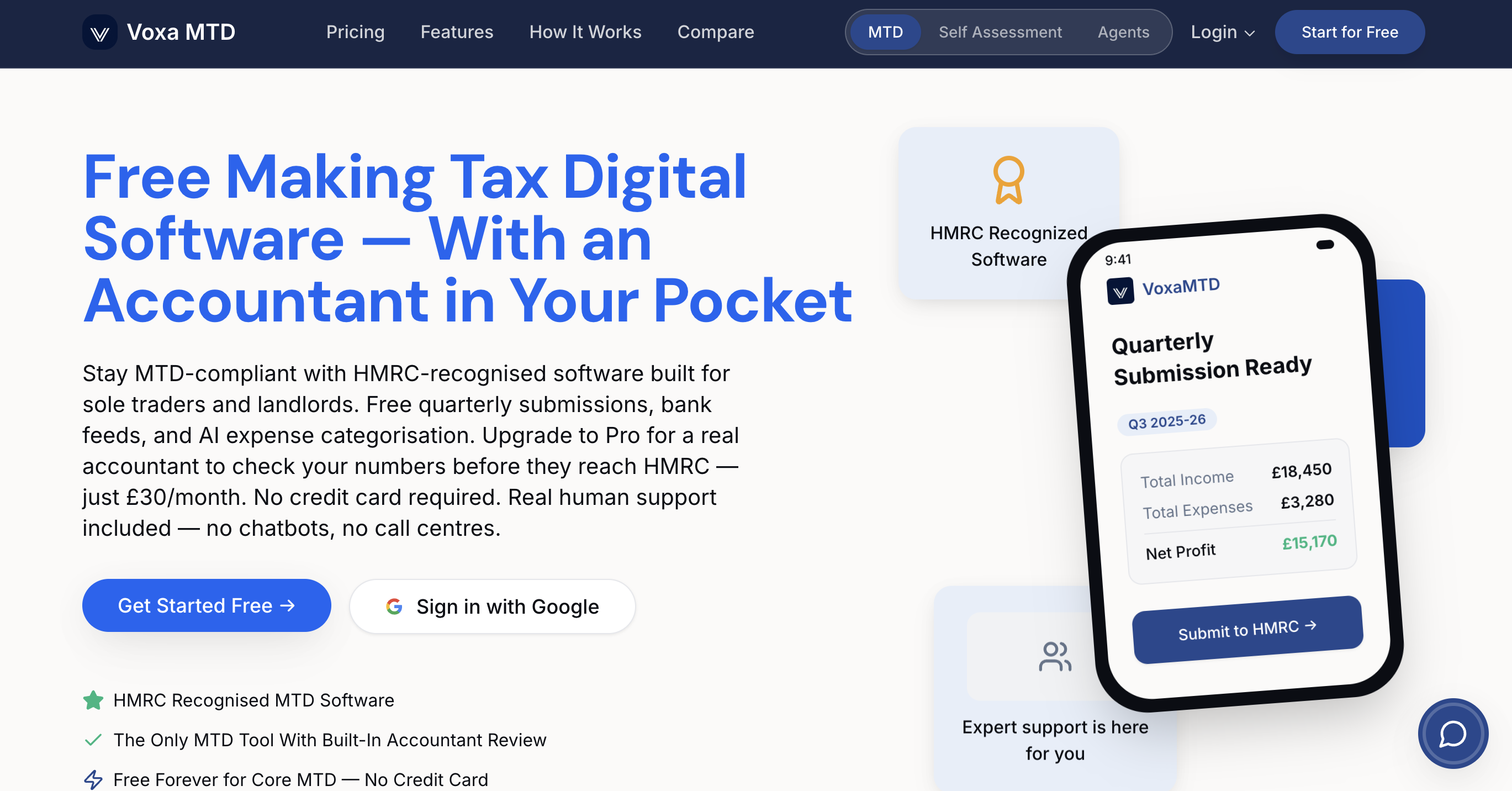
Whether you're a landlord managing rental income or a sole trader tracking self-employment, VoxaMTD handles your quarterly submissions, categorises your transactions automatically, and keeps you on the right side of HMRC. Sign up in minutes and have your MTD compliance sorted well before the April 2026 deadline.
Frequently asked questions
What counts as 'qualifying income' for MTD ITSA in 2026?
Qualifying income is your gross turnover from self-employment plus UK property income, combined and measured before expenses. The trading allowance does not reduce this figure.
Does every landlord or sole trader need MTD-compatible software from 2026?
No. Only those with qualifying gross income over £50,000 in 2024/25 must comply from April 2026. The threshold drops to £30,000 in 2027 and £20,000 in 2028.
Is 'simple MTD' a different HMRC scheme or a type of software?
'Simple MTD' is not a separate HMRC scheme. It refers informally to using basic, free, or easy tools with simplifications like 3-line accounts to meet standard MTD rules.
What's the biggest benefit of free simple MTD software?
Free MTD tools let you meet HMRC compliance at zero cost, and users report up to 90% less time spent on data entry compared to manual record-keeping.