

TL;DR:
- VAT Making Tax Digital requires all VAT-registered UK businesses to use compatible software for digital records and submissions.
- Compliance involves maintaining digital records with automatic data transfer to HMRC and timely submission of VAT returns.
- Penalties include points-based system for late submissions and penalties for non-compliance with digital link requirements.
Thousands of UK sole traders and landlords are still unsure whether VAT Making Tax Digital applies to them, what software they need, and what happens if they get it wrong. The confusion is understandable. MTD has rolled out in phases over several years, and now the April 2026 deadline for income tax is creating fresh anxiety that is often mixed up with VAT rules that are already live. This guide cuts through that confusion. It explains exactly what VAT MTD means, who must comply, how submissions work, which software to choose, and what penalties look like if you miss the mark.
Table of Contents
- What is VAT MTD and who must comply?
- How VAT MTD works: Digital records and submissions
- Choosing the right digital compliance solution
- VAT MTD penalties and pitfalls to avoid
- Why digital MTD is easier and fairer than you think
- Take the next step with digital VAT MTD solutions
- Frequently asked questions
Key Takeaways
| Point | Details |
|---|---|
| VAT MTD is mandatory | All VAT-registered UK sole traders and landlords must follow digital VAT rules now. |
| Choose compatible software | HMRC-recognised tools make digital record-keeping and VAT submissions much easier. |
| Avoid penalty pitfalls | Timely digital submissions and up-to-date software are critical to steer clear of fines. |
| April 2026 adds MTD ITSA | From April 2026, many sole traders and landlords face double MTD obligations—VAT and Income Tax. |
What is VAT MTD and who must comply?
VAT Making Tax Digital is HMRC's requirement for all VAT-registered businesses to keep their VAT records in digital form and submit VAT returns using HMRC-compatible software. It is not a new system coming in 2026. VAT MTD has been mandatory for businesses above the VAT registration threshold (currently £90,000 in annual turnover) since April 2019, and extended to all VAT-registered businesses regardless of turnover in April 2022.
If you are a sole trader or landlord who is VAT-registered, you are already required to comply with VAT MTD. There is no opt-out. You must file through compatible software, not through HMRC's old online portal.
So where does April 2026 fit in? That deadline relates to a separate mandate: MTD for Income Tax (also called MTD ITSA), which requires sole traders and landlords with income above £50,000 to submit quarterly income and expense updates to HMRC digitally. This is distinct from VAT MTD but runs alongside it. Many businesses will need to comply with both.
It is worth keeping these two mandates clearly separate in your mind. VAT MTD governs how you report VAT. MTD for Income Tax governs how you report your profits and income. If you are VAT-registered and earn above the income threshold, you will be dealing with both. If you want to understand the digital tax deadlines for sole traders across both mandates, it helps to map out your obligations now rather than scrambling later.
| MTD mandate | Who it affects | Key deadline | Submission type |
|---|---|---|---|
| VAT MTD | All VAT-registered businesses | Already live (2019/2022) | VAT returns via compatible software |
| MTD for Income Tax (ITSA) | Sole traders/landlords >£50k income | April 2026 | Quarterly updates + annual return |
| MTD ITSA (lower threshold) | Sole traders/landlords >£30k income | April 2027 | Quarterly updates + annual return |
Are you affected by VAT MTD? Check these criteria:
- You are registered for VAT in the UK
- Your business is not exempted on grounds of religious belief, insolvency, or being digitally exempt
- You are a sole trader, landlord, or limited company (VAT MTD covers all entity types)
- You file quarterly or monthly VAT returns
Many VAT-registered businesses assumed they had more time. The reality is that VAT MTD compliance has been a legal requirement since 2022 for all VAT businesses, regardless of turnover. If you are still using the old HMRC portal, you are already non-compliant.
How VAT MTD works: Digital records and submissions
Once you know you need to comply, here is what VAT MTD compliance actually looks like, day to day.
The two core obligations are straightforward: keep your VAT records digitally, and submit your VAT returns through HMRC-recognised software. That is it at a high level. The detail, however, matters a great deal.

Digital records include things like VAT on sales, VAT on purchases, the time of supply, the value of supply, and the VAT rate charged. These must be held in compatible software or linked spreadsheets. You cannot keep them in a paper ledger and then key them in manually at return time.
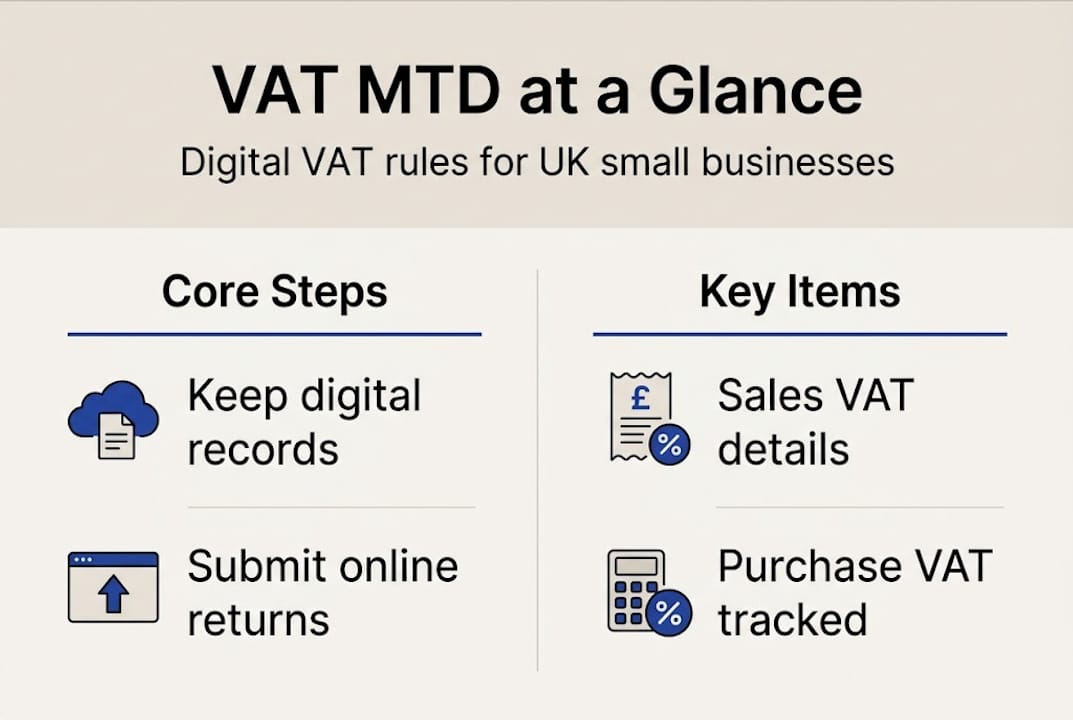
Digital links are what connect your records to your return. If you use a spreadsheet to hold your data and a bridging tool to submit it, the transfer of data between them must happen automatically, not via copy-paste. That manual step breaks the digital link requirement and puts you at risk.
Here is the step-by-step process for VAT MTD compliance:
- Register for MTD for VAT via your HMRC business tax account
- Choose and set up HMRC-compatible software
- Import or enter your VAT transactions into the software throughout the quarter
- Reconcile your records before the return deadline
- Submit your VAT return directly through the software's API connection to HMRC
- Receive confirmation from HMRC and retain your digital records for six years
Pro Tip: Start your digital record-keeping from day one of a new VAT period rather than trying to reconstruct records at the end of a quarter. Retrospective data entry is where most errors creep in, and penalty reform research shows persistent gaps in understanding the rules even among businesses aware of the changes.
For a more detailed breakdown of what records you must keep and how, the digital record-keeping guide walks through the specifics for sole traders, while the HMRC digital compliance rules article explains exactly what HMRC expects from your software setup.
Choosing the right digital compliance solution
To make digital VAT submissions easier, it helps to compare the software options available. HMRC maintains an approved list of compatible software. The main categories are full-featured accounting platforms and bridging tools.
Full-featured platforms like QuickBooks, Xero, Sage, and FreeAgent handle everything from invoicing and bank reconciliation to VAT submission. They are powerful but often expensive, typically ranging from £15 to £40 per month once introductory offers expire. Bridging tools like Capium and Swift VAT Pro are simpler and cheaper. They sit between your spreadsheets and HMRC, transmitting your VAT figures without requiring you to change your entire bookkeeping system.
| Software type | Examples | Monthly cost | Best for |
|---|---|---|---|
| Full-featured platform | QuickBooks, Xero, Sage, FreeAgent | £15 to £40+ | Businesses wanting full bookkeeping |
| Bridging tool | Capium, Swift VAT Pro | £5 to £15 | Spreadsheet users needing MTD compliance |
| Free MTD platform | VoxaMTD | Free | Sole traders and landlords needing HMRC submissions |
Features to look for in MTD-compatible software:
- HMRC-recognised and on the approved software list
- Direct API connection to HMRC (not email or manual upload)
- Digital links between records and submission
- VAT return preview before submission
- Automatic record storage for at least six years
- Support for both VAT MTD and MTD for Income Tax if you need both
Pro Tip: Always verify your software on HMRC's current approved list before committing. Software that was approved last year may have had changes, and using non-approved software can trigger penalties even if your figures are correct.
If cost is a concern, explore best free MTD software options before defaulting to expensive platforms. Dedicated tools exist for landlords and sole traders that handle the full compliance picture without the monthly subscription price tag.
VAT MTD penalties and pitfalls to avoid
Even with the right software, mistakes can lead to penalties. Here is what to watch out for and how to steer clear.
HMRC introduced a points-based penalty system for VAT in January 2023, replacing the older default surcharge regime. Under this system, each missed or late VAT return earns you one penalty point. Once you reach the threshold for your filing frequency (four points for quarterly filers), HMRC issues a £200 financial penalty. You then receive a further £200 penalty for each subsequent late return until you clear the points through compliance.
Separately, using software that does not comply with MTD digital link requirements can attract penalties of up to £400 per return. Poor record-keeping that falls outside digital requirements can attract charges of £5 to £15 per day for continued failures.
After the January 2023 penalty reform, 24% of VAT-registered businesses received penalty points in the first year. High awareness of the new rules did not prevent errors, suggesting that understanding the rules in theory and implementing them in practice are two very different things.
Tips for avoiding VAT MTD penalties:
- Set calendar reminders for each VAT return deadline, including the submission date
- Never use the old HMRC online portal to file, as this does not meet MTD requirements
- Check that your software maintains a digital link between records and submissions
- Reconcile your bank statements against VAT records monthly, not just at quarter end
- If you switch software mid-year, confirm your old records are preserved and accessible
- Review the HMRC MTD compliance requirements before your first submission with any new tool
The most common pitfall is assuming that because you have accounting software, you are automatically MTD-compliant. Not all accounting tools are approved for MTD VAT. Check the HMRC list, confirm your software version is current, and do not assume compliance without verification.
Why digital MTD is easier and fairer than you think
There is real anxiety in the sole trader and landlord community about MTD. We understand it. New obligations, new software, new penalties. It feels like more admin for people who are already stretched.
But here is the contrarian view: the businesses that have made the move to digital record-keeping consistently report that it saves them time, not costs them time. When your VAT records are updated automatically through open banking feeds, there is no end-of-quarter panic. When your submission takes three clicks instead of an afternoon of paper-chasing, you start to see the VoxaMTD digital tools difference that well-designed compliance software makes.
The penalty reform itself is worth reframing. The points-based system was designed to give businesses a learning curve, not to catch people out on a first mistake. A single late return does not immediately cost you money. The system expects some stumbles and accommodates them.
The real risk is inaction. Businesses that have not yet made the shift to digital records are not saving time, they are accumulating risk. Going digital is not a burden, it is a reset that puts you in control of your own financial data.
Take the next step with digital VAT MTD solutions
VoxaMTD is built specifically for UK sole traders and landlords who need to meet their MTD obligations without paying for bloated software they will never fully use.
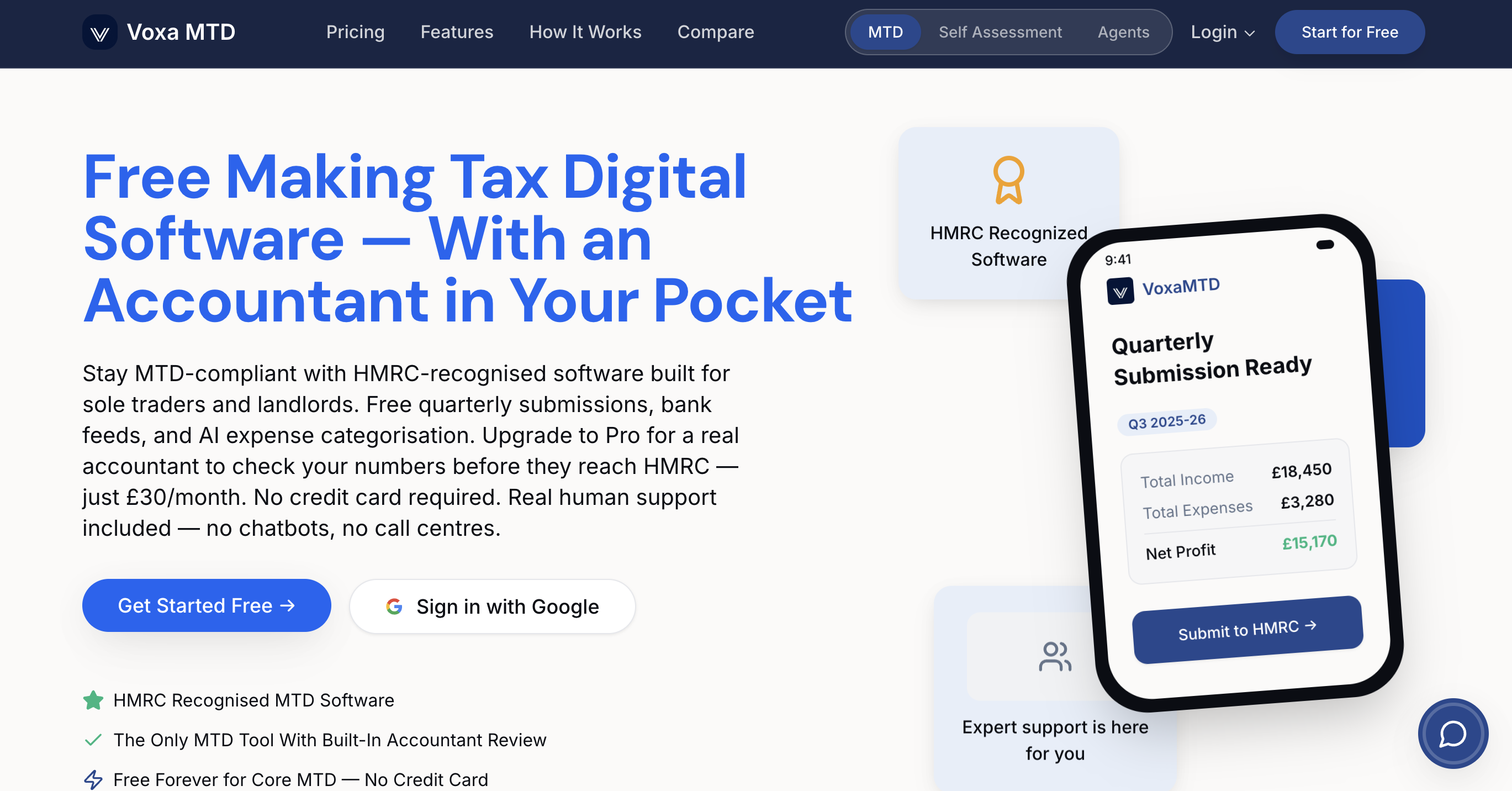
The platform handles VAT MTD and MTD for Income Tax quarterly submissions directly to HMRC via production API, with AI-powered transaction categorisation at 95% accuracy. Landlords get Section 24 calculations and a dedicated dashboard. Sole traders get mileage tracking and home office tools. And if you are an accountant managing multiple clients, the MTD tools for accountants portal lets you handle submissions at scale. Use the MTD checker tool to confirm exactly what applies to you, or head straight to the MTD software for landlords page to get started free.
Frequently asked questions
What does VAT MTD mean for landlords in 2026?
VAT-registered landlords must already be using HMRC-compatible software for their VAT returns. From April 2026, those with income above £50,000 are also subject to MTD for Income Tax, which requires quarterly digital updates to HMRC alongside the annual return.
How do I avoid VAT MTD penalties?
Submit every return on time using HMRC-recognised software, maintain unbroken digital links in your records, and check your software version regularly. The points-based penalty system means a single late return earns a point, not an immediate fine, but accumulating points leads to a £200 charge.
Can I use spreadsheets for VAT MTD?
Yes, provided you use HMRC-approved bridging software to transmit your return. The data must flow digitally from your spreadsheet to the bridging tool without manual re-entry.
What counts as a 'digital record' under VAT MTD?
A digital record includes all VAT-relevant transaction data held in compatible software or linked spreadsheets, with digital links maintained throughout the chain from data entry to final submission to HMRC.