

TL;DR:
- Accountants act as main or supporting agents, managing different levels of MTD responsibilities.
- Their expertise helps sole traders comply, avoid penalties, and handle complex scenarios.
- Combining technology with accountant support ensures efficient, accurate MTD reporting and ongoing compliance.
Many UK sole traders and landlords assume Making Tax Digital simply means swapping paper records for a digital form. In reality, MTD for Income Tax Self Assessment (ITSA) introduces a layered system of quarterly updates, agent authorisations, and annual declarations that can trip up even the most organised business owner. Accountants act as agents for clients under MTD, handling tasks that go far beyond uploading receipts. This guide explains exactly what accountants do within the MTD framework, how their involvement protects you from penalties, and how to use their expertise as efficiently as possible.
Table of Contents
- Accountants as main and supporting agents under MTD
- Practical compliance: How accountants help you meet new MTD rules
- Cost-effective solutions and time-saving strategies
- Managing edge cases, exemptions, and practical challenges
- Why most MTD guides underplay accountant expertise
- Ready for MTD? How to make compliance efficient with VoxaMTD
- Frequently asked questions
Key Takeaways
| Point | Details |
|---|---|
| Accountant roles demystified | Accountants can act as main or supporting agents, handling everything from quarterly submissions to exemptions. |
| Efficient compliance tactics | Leveraging accountants’ experience with software and automation helps sole traders and landlords avoid costly errors. |
| Edge case expertise | Expert guidance is crucial for managing exemptions, digital exclusion, and special cases under MTD. |
| Cost-saving strategies | Outsourcing, automation, and careful tool selection can minimise both effort and ongoing MTD expenses. |
Accountants as main and supporting agents under MTD
Under MTD for ITSA, accountants don't just offer advice from the sidelines. They operate within a formal structure defined by HMRC, acting either as a main agent or a supporting agent through the Agent Services Account (ASA). Understanding the difference matters enormously for your compliance.
A main agent can carry out the full range of MTD tasks on your behalf. This includes signing you up for MTD, submitting quarterly updates, filing the End of Period Statement (EOPS), completing the final declaration, and contacting HMRC directly about your income tax affairs. Essentially, a main agent has the authority to act as you for all MTD purposes. This is the most powerful and protective arrangement for most sole traders and landlords.
A supporting agent has a narrower remit. They can submit quarterly updates and view certain business income data, but they cannot finalise returns, access non-business income, or interact with HMRC on the full range of tax matters. This role suits situations where a bookkeeper handles day-to-day data entry while a separate firm manages the overall tax position.
The Agent Services Account setup involves your accountant analysing your income thresholds, registering on the ASA, and formally communicating their role to you as a client. This isn't just paperwork. It creates a clear audit trail and ensures HMRC recognises who is authorised to act. For more context on HMRC agent roles, it's worth understanding how this differs from the older 64-8 authorisation process used for Self Assessment.
Here's a quick comparison of what each agent type can do:
| Task | Main agent | Supporting agent |
|---|---|---|
| Submit quarterly updates | Yes | Yes |
| View all income sources | Yes | Business only |
| File EOPS and final declaration | Yes | No |
| Contact HMRC on your behalf | Yes | Limited |
| Sign you up for MTD | Yes | No |
Key points to remember about agent roles:
- Only a main agent can complete the full MTD cycle from sign-up to final declaration
- Supporting agents are useful for bookkeeping tasks but cannot replace a main agent
- You can have both simultaneously, with clearly defined responsibilities
- Agent authorisation must be renewed if you change accountants
Pro Tip: Review your agent permissions at least once a year, especially if your income sources change or you take on a new property. Outdated authorisations can cause submission delays and HMRC correspondence going to the wrong person.
For sole traders new to this process, the MTD for sole traders guide covers the sign-up timeline in detail.
Practical compliance: How accountants help you meet new MTD rules
Knowing the agent roles is one thing. Seeing how accountants apply them in practice is where the real value emerges. MTD for ITSA is not automatic enrolment. You must actively sign up, and accountants guide clients through every stage of that process.
Here is the typical compliance journey an accountant manages for you:
- Threshold check: Confirming whether your gross income from self-employment and property exceeds £50,000 (April 2026) or £30,000 (April 2027), based on your 2024/25 tax return.
- Software selection: Recommending HMRC-compatible software that suits your record-keeping habits, whether that's a dedicated MTD platform or bridging software linked to a spreadsheet.
- Digital records setup: Helping you digitise income and expense records so every transaction is captured in a format HMRC accepts.
- Quarterly updates: Submitting summaries of your income and expenses four times a year, within one month of each quarter end.
- End of Period Statement: Filing the EOPS after the tax year ends, confirming your business figures are complete and accurate.
- Final declaration: Replacing the old Self Assessment return, pulling together all income sources for the year.
Pro Tip: Spreadsheets are still allowed under MTD, provided they are linked to HMRC-approved bridging software. Your accountant can help you set this up if you prefer not to switch to a full MTD platform immediately.
Here is a summary of who handles each MTD task:
| MTD task | Client | Accountant | Software |
|---|---|---|---|
| Record daily transactions | Primary | Reviews | Stores |
| Quarterly update submission | Rarely | Usually | Facilitates |
| EOPS filing | No | Yes | Supports |
| Final declaration | No | Yes | Supports |
| Software setup | Partial | Advises | N/A |
For landlords managing quarterly submissions, accountants also help separate allowable expenses from capital costs, which is particularly important given Section 24 mortgage interest restrictions. Choosing the right MTD software early makes every subsequent stage significantly smoother. MTD tools for sole traders can automate much of this process.
Cost-effective solutions and time-saving strategies
One concern many sole traders and landlords raise is cost. Adding accountant fees on top of software subscriptions feels like a significant outlay. But the maths often works in your favour when you factor in penalty avoidance and time saved.
The self-assessment tax gap currently stands at £5 billion annually, largely driven by error and late filing. Under MTD's points-based penalty system, a £200 penalty kicks in after four penalty points, and points accumulate quickly with missed quarterly deadlines. An accountant managing your submissions removes this risk almost entirely.
Accountants also enable cost-effective compliance by recommending free or low-cost MTD-compatible software, automating bank feeds to eliminate manual data entry, and building workflows that reduce the time you spend on bookkeeping each quarter.
Three common cost-saving strategies accountants employ:
- Bank feed automation: Connecting your business bank account directly to your MTD software so transactions are imported daily, cutting reconciliation time dramatically
- Batch processing: Grouping quarterly bookkeeping tasks so your accountant reviews everything in one efficient session rather than ad hoc throughout the year
- Software fee offsetting: Accountant and software fees are allowable business expenses, reducing your taxable profit and partially funding the cost of compliance
For landlords, MTD tools that automate rental income tracking and expense categorisation can reduce the hours spent preparing for quarterly submissions. Similarly, digital bookkeeping tips can help you build habits that make accountant reviews faster and cheaper.
The key insight here is that accountants don't just cost money. They restructure how you manage your finances so the ongoing burden is lighter and the risk of costly errors is lower.

Managing edge cases, exemptions, and practical challenges
MTD compliance becomes genuinely complex when your circumstances don't fit the standard template. This is where accountant expertise is most valuable, and where relying solely on software can leave you exposed.
Common edge cases that require specialist knowledge include:
- Multiple trades: Running two or more self-employed businesses means separate income streams that must each be tracked and reported correctly under MTD.
- Joint property lets: When a property is jointly owned, each owner may have separate MTD obligations depending on their individual income levels.
- Foreign property income: UK residents with overseas rental income face additional complexity around currency conversion and which income counts towards the MTD threshold.
- Digital exclusion: Taxpayers who genuinely cannot use digital tools due to age, disability, or remoteness can apply for an exemption, but the application process requires careful documentation.
- Averaging relief: Farmers and creative professionals may qualify for income averaging, which affects how quarterly figures are calculated and reported.
- Ceased income: If you stop trading or sell a property mid-year, you must notify HMRC promptly. Missing this step can trigger unnecessary penalty points.
Soft landing for 2026 joiners: HMRC has confirmed that taxpayers joining MTD in April 2026 will benefit from a penalty waiver during the first year, provided they are making genuine efforts to comply. However, this does not excuse missed submissions indefinitely. Penalty points still accumulate, and digital exclusion applications must be submitted before your MTD start date.
Understanding MTD terminology is a useful first step if you're navigating these scenarios independently, but an accountant who knows your full financial picture is far better placed to identify which exemptions apply and how to document them correctly.
If your circumstances change during the tax year, tell your accountant immediately. A new property purchase, a second income stream, or a change in business structure can all affect your MTD obligations in ways that aren't immediately obvious.
Why most MTD guides underplay accountant expertise
Most articles about MTD focus heavily on software. Download this app, connect your bank account, click submit. It's a compelling narrative because it's simple. But it misses something important.
Technology handles the mechanics of MTD. Accountants handle the judgement. When HMRC updates its guidance mid-year, when a new exemption is introduced, or when your income crosses a threshold unexpectedly, software doesn't adapt on your behalf. An experienced accountant does.
We've seen this pattern repeatedly. Sole traders who rely entirely on software for MTD compliance often manage the routine submissions well but struggle when something unusual happens. A disputed expense, an HMRC query, a missed quarter due to illness. These are the moments where accountant involvement pays for itself many times over.
The most resilient approach combines smart, automated technology with proactive accountant oversight. Not because the software isn't good enough, but because the tax landscape keeps changing and human expertise is what keeps you ahead of those changes. MTD is not a one-time setup. It's an ongoing relationship with HMRC, and having an experienced advocate in your corner makes that relationship far less stressful.
Ready for MTD? How to make compliance efficient with VoxaMTD
If this guide has made one thing clear, it's that MTD compliance works best when good technology and good advice work together.
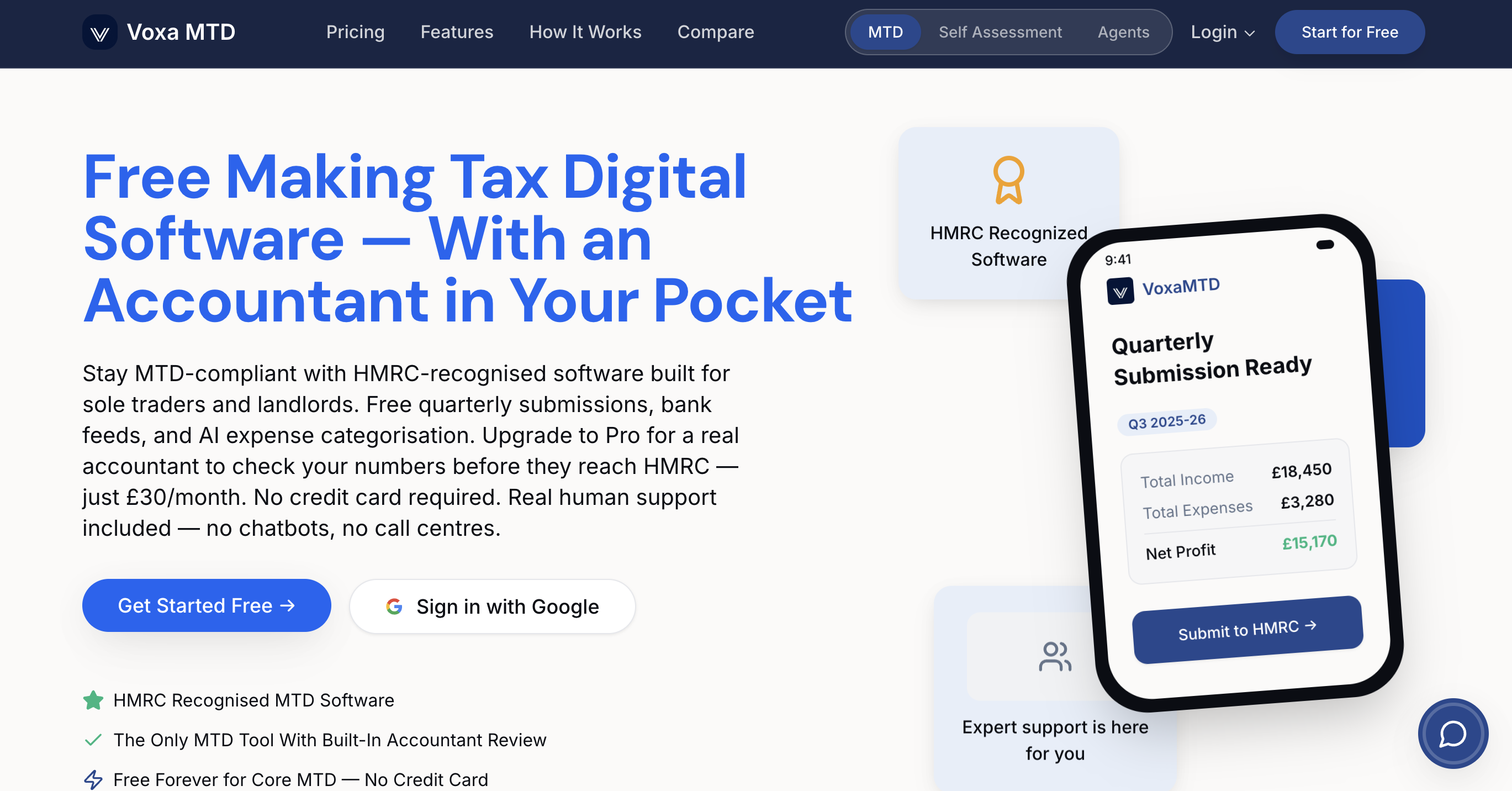
VoxaMTD is built exactly for that combination. It's a free, HMRC-recognised platform that handles quarterly submissions directly to HMRC, with AI-powered categorisation at 95% accuracy and FCA-regulated open banking through Finexer. For landlords, free MTD tools include Section 24 calculations and rental income tracking. For those who want human support, the Professional tier (£30/month) pairs you with a dedicated partner accountant. Check your MTD status to see when you need to join, and explore the full features to find the right plan for your situation.
Frequently asked questions
Do I need an accountant for Making Tax Digital if I use compatible software?
While software handles submissions, an accountant is invaluable for complex cases, exemption applications, and HMRC liaison. Accountants as MTD agents offer expertise that no software can fully replicate.
What's the difference between main and supporting MTD agents?
Main agents can manage the full MTD cycle including final declarations and HMRC contact; supporting agents are limited to quarterly updates and cannot access non-business income.
Can I outsource all MTD reporting to my accountant?
Yes. With main agent authorisation, your accountant can manage sign-up, quarterly updates, and the final declaration entirely on your behalf.
Does MTD mean more tax payments throughout the year?
No. MTD is about reporting, not new payment deadlines. Your payment schedule remains unchanged; only the frequency of income and expense updates increases.
How do I know if my property or rental income is in scope for MTD in 2026?
If your combined gross income from self-employment and property exceeds £50,000 from April 2026, you are required to join MTD for ITSA.