

TL;DR:
- Making Tax Digital for Income Tax applies to sole traders and landlords with combined income over set thresholds starting April 2026.
- The requirements include digital record-keeping and quarterly updates using compliant software, with no penalties in the soft-landing year.
- Affordable software options, including free tools and dedicated platforms like VoxaMTD, help simplify compliance and reduce stress.
Millions of UK sole traders and landlords are approaching April 2026 with a nagging sense that they should be doing something differently with their taxes, but aren't quite sure what. The confusion is understandable. Making Tax Digital for Income Tax (MTD for ITSA) has been delayed, revised, and reannounced so many times that many people assumed it would never actually arrive. It has. This guide cuts through the noise to explain who is affected, what the new rules genuinely require, when every deadline falls, and which software options give you the best value for money, so you can act with confidence rather than anxiety.
Table of Contents
- Who must follow MTD for Income Tax?
- What MTD for Income Tax actually requires
- Quarterly updates and deadlines explained
- Cost-effective software options for MTD compliance
- The reality of MTD for Income Tax: An honest perspective
- Meet MTD for Income Tax with less stress and lower cost
- Frequently asked questions
Key Takeaways
| Point | Details |
|---|---|
| April 2026 is crucial | MTD for Income Tax is mandatory for UK sole traders and landlords with £50,000+ income from April 2026. |
| Digital records and quarterly updates | You must keep digital records and submit quarterly summaries using approved software; the tax payment process stays the same. |
| Start early for stress-free compliance | Begin digital record-keeping now to build habits and avoid future penalties when the soft-landing period ends. |
| Software costs are manageable | Affordable MTD software options exist, and their costs are typically tax-deductible business expenses. |
Who must follow MTD for Income Tax?
The first question most people ask is simple: does this actually apply to me? The answer depends on your gross income from self-employment and UK property, combined, not per source.
864,000 sole traders and landlords with qualifying income over £50,000 must comply from April 2026. The rollout then continues in phases:
| Phase | Start date | Income threshold |
|---|---|---|
| Phase 1 | April 2026 | Over £50,000 |
| Phase 2 | April 2027 | Over £30,000 |
| Phase 3 | April 2028 | Over £20,000 |
The key word in that table is combined. MTD applies to combined income from self-employment and UK property over the relevant threshold. So if you earn £30,000 from freelancing and £25,000 from a rental property, your combined total of £55,000 puts you in scope from April 2026, even though neither source alone crosses the line.
Some common scenarios that do qualify:
- A sole trader with trading profits above the threshold
- A landlord with gross rental income (before expenses) above the threshold
- Someone with both trading and property income that together exceed the threshold
- Joint property owners, where each owner's share of rental income counts individually toward their own threshold
Some scenarios that are currently exempt:
- Partnerships and limited companies (not yet mandated)
- Individuals whose only UK income is employment via PAYE
- Those with income below the relevant threshold for their phase
- People who qualify for a digital exclusion exemption (for example, due to age, disability, or lack of internet access)
It is also worth understanding MTD terminology for sole traders before you start, because terms like "qualifying income" and "gross income" have specific meanings that affect whether you are in or out of scope. If you are unsure, the quickest way to get clarity is to check if MTD applies to your situation directly.
Landlords face some additional nuances. The rules around furnished holiday lets, overseas property, and jointly owned properties each carry their own considerations. A dedicated look at MTD changes for landlords covers those specifics in full.
What MTD for Income Tax actually requires
Once you know you are in scope, the next step is understanding what compliance actually looks like day to day. It is not as burdensome as many fear, but it is genuinely different from the old annual Self Assessment routine.
The core requirements are:
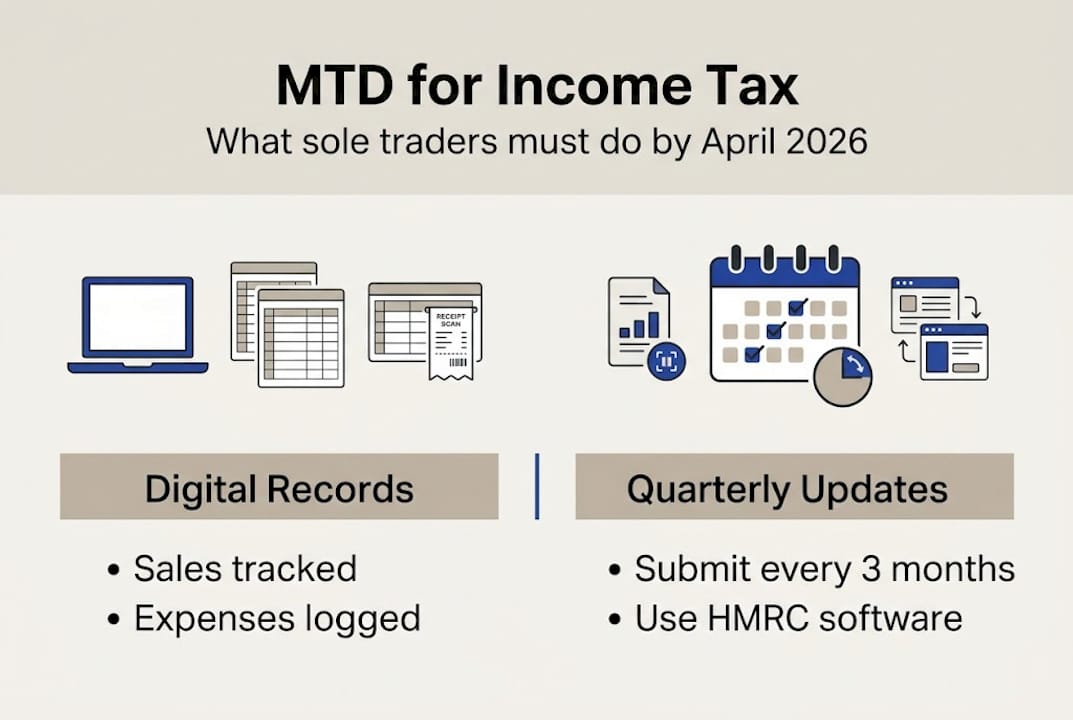
- Digital record-keeping: Every income and expense transaction must be recorded digitally using MTD-compatible software. Paper records and manual spreadsheets alone will not suffice.
- Quarterly updates: A summary of your income and expenses must be submitted to HMRC four times a year. These are not full tax returns; they are lightweight summaries that keep HMRC informed of your position throughout the year.
- Final declaration: By 31 January each year, you submit a final declaration that replaces the old Self Assessment tax return. This is where you confirm your figures, claim reliefs, and settle your tax bill.
Importantly, your tax payment deadlines and amounts do not change. MTD changes how you report, not when or how much you pay.
The quarterly update is a summary, not a full tax return. Think of it as a progress report rather than an exam.
For landlords, digital record-keeping means tracking rental income and allowable expenses property by property. You can read more about digital record-keeping for landlords and what categories HMRC expects you to maintain.
For sole traders, the process is similar: record sales, purchases, and allowable business costs digitally throughout the quarter, then submit the summary. A broader guide to tax digitisation explains how this fits into the wider HMRC digital strategy.

Pro Tip: Start keeping digital records now, even if your compliance date is April 2027 or later. Building the habit before penalties begin is far less stressful than scrambling to reconstruct months of transactions in a rush.
Software handles the submission automatically once your records are in order. If you prefer human support, an accountant can file on your behalf using their own MTD-compatible tools. Either way, the key is getting your records into a digital format from the outset. Find out how to submit tax returns digitally using compliant platforms.
Quarterly updates and deadlines explained
One of the most common misconceptions about MTD is that you will be filing four full tax returns a year. You will not. The quarterly update is a light-touch summary, but it does need to arrive on time.
Each quarter covers a specific period, and submissions are due roughly five weeks after the quarter ends:
| Quarter | Period | Deadline |
|---|---|---|
| Q1 | 6 April to 5 July | 7 August |
| Q2 | 6 July to 5 October | 7 November |
| Q3 | 6 October to 5 January | 7 February |
| Q4 | 6 January to 5 April | 7 May |
Quarterly periods and deadlines can also be aligned to calendar quarters if you prefer simpler dates. HMRC allows this option to make record-keeping more intuitive for people who already work to calendar months.
Here is a practical step-by-step plan to stay on top of MTD deadlines each year:
- Set up your MTD-compatible software before your start date
- Connect your bank account via open banking for automatic transaction imports
- Categorise transactions weekly or at least monthly, not in a last-minute rush
- Review your quarterly summary a week before the deadline
- Submit the update and note your running tax estimate
- Complete your final declaration by 31 January
The good news for 2026 to 2027 is that no penalty points apply for late quarterly updates during the soft-landing period. HMRC has confirmed this first year is designed to give businesses time to adjust. From April 2027, however, a points-based penalty system kicks in. Miss enough updates and the points accumulate into a £200 fine, with further penalties for continued non-compliance.
This is why using the soft-landing year to streamline quarterly reporting is genuinely valuable. Treat 2026 to 2027 as a practice run with no consequences for minor slips, and you will enter the penalty regime already in good habits. A detailed quarterly reporting guide can help you build that routine.
Cost-effective software options for MTD compliance
The software market for MTD compliance ranges from free to over £200 a year. Knowing what each tier actually offers helps you avoid overpaying for features you will never use.
| Software type | Examples | Approximate annual cost |
|---|---|---|
| Free/bridging | VitalTax, HMRC tools | £0 to £30 |
| Entry cloud | FreeAgent (via bank) | Free with some bank accounts |
| Mid-range cloud | QuickBooks, FreeAgent | £100 to £180 |
| Full-suite cloud | Xero, Sage | £150 to £300+ |
According to an MTD software comparison, bridging software like VitalTax costs around £30 a year and is a legitimate option if you are disciplined about maintaining spreadsheets. It connects your spreadsheet to HMRC and handles the submission. The catch is that all the record-keeping discipline falls on you.
Paid cloud software automates bank feeds, categorises transactions, and sends reminders. Some banks, including NatWest and Royal Bank of Scotland, offer FreeAgent free to business account holders, which is worth checking before you pay for anything.
A checklist for choosing your solution:
- DIY with spreadsheets: Choose bridging software if you are comfortable with Excel and have simple finances
- Sole trader with moderate complexity: An entry or mid-range cloud tool with bank feeds saves hours each quarter
- Landlord with multiple properties: Look for property-specific dashboards and expense tracking by property
- Prefer human oversight: Opt for a platform that includes accountant access or a professional review tier
All software costs are allowable business expenses, so they reduce your tax bill. Explore the MTD software features available through VoxaMTD, which is free at its core and includes AI-powered categorisation at 95% accuracy.
Pro Tip: The time you save through automated bank feeds and smart categorisation is worth far more than the subscription cost. Even at £15 a month, if it saves you two hours of admin per quarter, the maths is firmly in your favour.
The reality of MTD for Income Tax: An honest perspective
Here is something most articles about MTD will not tell you plainly: the delays were not a sign that HMRC might abandon this. They were a sign that HMRC was determined to get it right before enforcing it. Every postponement bought time for the software market to mature, not for the mandate to disappear.
The soft-landing year in 2026 to 2027 is a genuinely rare gift. HMRC is offering you a full twelve months to build digital habits with no penalty consequences for late quarterly updates. That is not a loophole. It is an invitation to get comfortable before the stakes rise. Most people who struggle with MTD in 2027 and beyond will be those who treated the soft-landing year as an extension of the old approach.
Building a monthly digital routine, spending twenty minutes categorising transactions rather than facing a mountain of receipts every January, is the single most effective thing you can do. The admin burden of MTD is not the quarterly submission itself. It is the record-keeping that feeds it. Get that right, and the submission becomes almost automatic.
For most sole traders and landlords, the real cost of non-compliance is not the fine. It is the stress. Understanding MTD terms and acting early removes that entirely.
Meet MTD for Income Tax with less stress and lower cost
VoxaMTD was built specifically for the 864,000 sole traders and landlords facing this mandate. Unlike legacy accounting software that charges £30 to £65 a month, VoxaMTD is free at its core, connecting directly to HMRC via production API and handling quarterly submissions without the price tag.
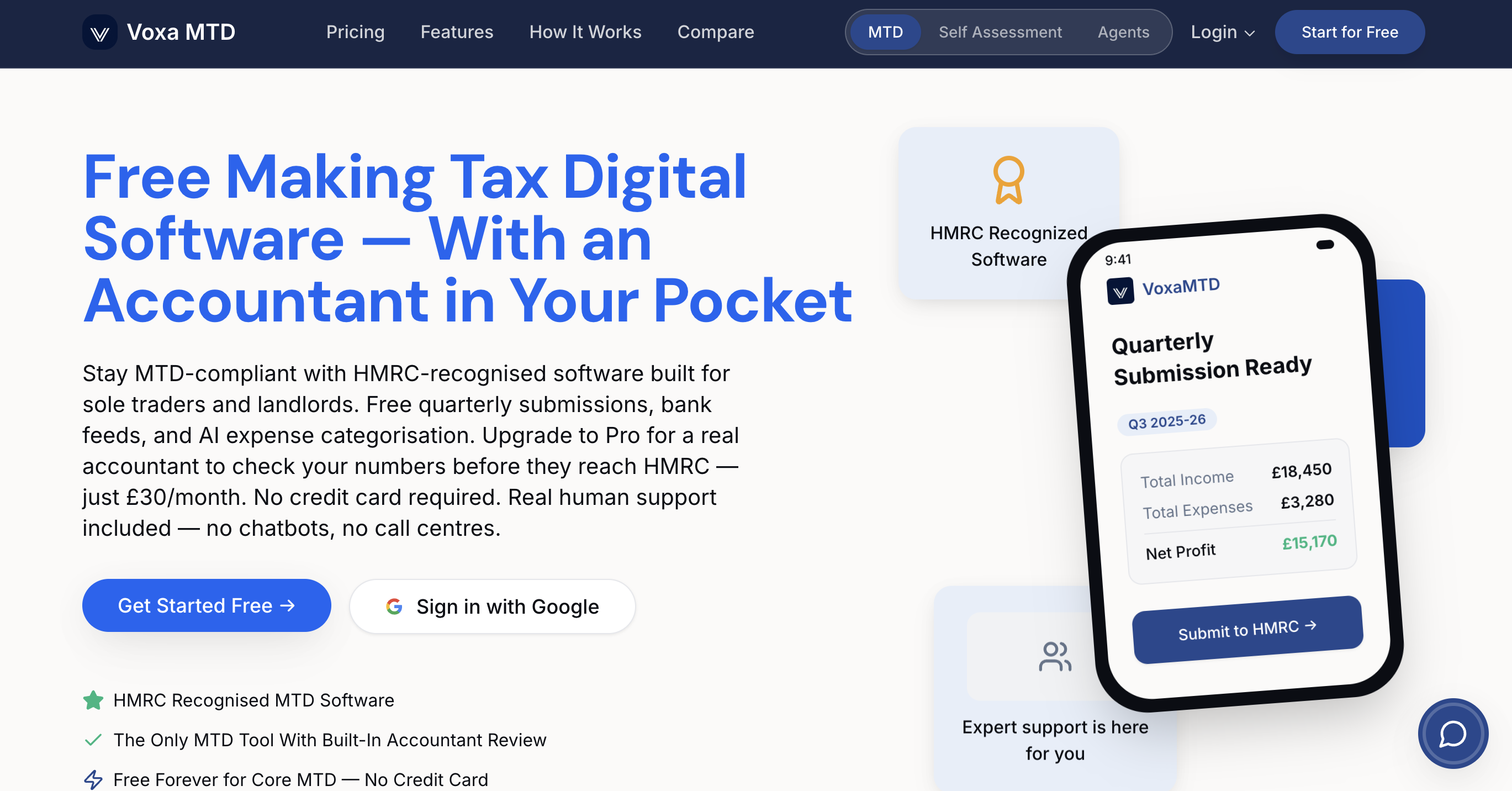
Not sure if you are in scope? The MTD checker tool gives you a clear answer in under a minute. Landlords get a dedicated dashboard with Section 24 calculations and property-level expense tracking. Sole traders get mileage tracking, home office calculators, and payments on account projections. And if you want a human in your corner, a dedicated partner accountant is available for just £30 a month. Explore all features or go straight to the free MTD software for landlords to get started today.
Frequently asked questions
Does MTD for Income Tax apply if I earn below £50,000?
Not until at least April 2027, unless your combined self-employment and property income exceeds £50,000 in the 2024 to 2025 tax year. The threshold applies to gross combined income, not profit.
Can I use spreadsheets and bridging software for MTD?
Yes. Bridging software such as VitalTax costs around £30 a year and makes spreadsheet-based record-keeping fully MTD-compliant by handling the submission to HMRC.
What are the deadlines for quarterly MTD updates?
Updates are due five weeks after each quarter ends. Common deadlines are 7 August, 7 November, 7 February, and 7 May, with a final declaration due by 31 January.
What if I miss a quarterly update in the first year?
During 2026 to 2027, no penalty points apply for late quarterly submissions. The soft-landing period means you will not be penalised for missing updates in your first year of compliance.
Do partnerships and limited companies need to comply?
Not yet. Only sole traders and individual landlords are mandated to follow MTD for Income Tax from April 2026. Partnerships and companies remain outside the current scope.