

The biggest mistake sole traders and landlords are making right now is treating Making Tax Digital as a software problem. It is not. It is a reporting rhythm, a record-keeping discipline, and a financial planning shift that will affect 864,000 sole traders and landlords from April 2026. Miss a quarterly update, combine two income sources without realising you've crossed a threshold, or pick the wrong software, and you face penalties before you've had time to adjust. This guide cuts through the confusion with practical, evidence-based steps so you can prepare efficiently and avoid the most common traps.
Table of Contents
- What is Making Tax Digital and who's affected in 2026?
- How digital record-keeping works: tools, timelines and practical rules
- Tricky cases and common pitfalls: combined incomes, exemptions and the points system
- Cost, workload and trends: what the evidence and surveys really show
- Practical steps: how to prepare and minimise disruption
- Explore free MTD solutions for landlords and sole traders
- Frequently asked questions
Key Takeaways
| Point | Details |
|---|---|
| Eligibility is income-based | MTD rules start with incomes over £50,000 in 2026, expanding to £20,000 by 2028. |
| Quarterly updates are mandatory | You must submit digital quarterly updates and an annual Final Declaration for each income source. |
| Combined incomes count | Multiple income sources may trigger obligations even if each is below the threshold. |
| Penalties incentivise compliance | Missing deadlines leads to penalty points and fines; late quarterly updates are easier in the first year. |
| Prepare early for efficiency | Trial software, join pilots, and consult accountants to streamline transition, reduce cost and avoid pitfalls. |
What is Making Tax Digital and who's affected in 2026?
With the context set, let's clarify exactly how the new rules apply and which groups need to act first.
Making Tax Digital for Income Tax Self Assessment (MTD for ITSA) requires eligible taxpayers to keep digital records and submit quarterly updates to HMRC using HMRC-compatible software. It replaces the single annual Self Assessment return with four quarterly updates plus a Final Declaration each year. The MTD mandate is phased by income threshold, not by business type.
Here is how the rollout works:
| Tax year | Income threshold | Who is affected |
|---|---|---|
| April 2026 | Over £50,000 | Sole traders and landlords |
| April 2027 | Over £30,000 | Sole traders and landlords |
| April 2028 | Over £20,000 | Sole traders and landlords |
The threshold applies to qualifying income, which means gross business turnover plus gross UK property income combined. This is where many people get caught out. If you earn £40,000 from your trade and £15,000 from a rental property, your qualifying income is £55,000. You are over the threshold for April 2026, even though neither source individually crosses it. Understanding MTD terminology early saves a lot of confusion later.
Key groups affected and excluded:
- Sole traders with qualifying income above the relevant threshold must comply
- Landlords with UK property income count that income towards the threshold
- Hybrid earners (trade plus property) must add both sources together
- Partnerships and limited companies are not included in the first phase
- Digitally excluded individuals (due to age, disability, or remote location) can apply for an exemption, but must do so proactively
"Qualifying income includes gross business and UK property income, even where individual sources fall below the threshold separately." This is the rule that surprises most hybrid earners.
If you are unsure whether you qualify, check the [MTD regulations for sole traders](https://blog.voxamtd.com/blog/understand-mtd-regulations-uk-sole traders) before assuming you are exempt.
How digital record-keeping works: tools, timelines and practical rules
Once you know you are affected, the next challenge is understanding the new digital processes and timelines.
Paper records and standalone spreadsheets are no longer sufficient on their own. HMRC guidance requires you to use compatible software that can store digital records and submit updates directly to HMRC. If you currently use a spreadsheet, you will need a bridging tool that connects it to HMRC's systems.

Here is a comparison of record-keeping approaches:
| Method | MTD compliant? | Notes |
|---|---|---|
| HMRC-compatible software | Yes | Preferred route |
| Spreadsheet with bridging tool | Yes | Extra step required |
| Spreadsheet alone | No | Does not meet requirements |
| Paper records | No | Not acceptable |
The quarterly update deadlines follow a fixed pattern. Each update is due one month after the quarter ends:
- Quarter 1 (6 April to 5 July): deadline 5 August
- Quarter 2 (6 July to 5 October): deadline 5 November
- Quarter 3 (6 October to 5 January): deadline 5 February
- Quarter 4 (6 January to 5 April): deadline 5 May
- Final Declaration: due 31 January following the end of the tax year
If you have multiple income sources, you must keep separate records for each one and submit separate updates. A landlord who also runs a sole trader business will have two sets of quarterly updates. Review the tax deadlines for landlords to map out your specific schedule.
Pro Tip: Start trialling your chosen software at least three months before your mandation date. Running it alongside your current system lets you spot gaps in your record-keeping before they become compliance failures.
For landlords managing multiple properties, the landlord digital submission process consolidates all property income into one set of records, which simplifies things considerably. The digital tax deadlines overview is also worth bookmarking for a full calendar view.
Tricky cases and common pitfalls: combined incomes, exemptions and the points system
Now that you know the basic mechanics, let's tackle the nuances and hidden risks that trip people up.
The combined income rule is the single biggest source of unexpected obligations. Many sole traders with a small rental property assume they are safely under the threshold. They are not, once both income streams are added together. Check your 2024/25 figures now, not in March 2026.
Here are the scenarios most likely to catch people out:
- Two trades: if you run two separate businesses, both count towards your qualifying income total
- Property plus trade: even a modest rental income can push a sole trader over the £50,000 threshold
- Jointly owned property: your share of rental income counts, not the full property income
- Digitally excluded: if you genuinely cannot use digital tools, apply for exemption early. HMRC does not grant these automatically
The penalties guidance uses a points-based system. Each missed submission earns one point. Reach four points and you receive a £200 fine. Points do not expire once you hit the threshold, and they only reset after a sustained period of full compliance.
Statistic to note: There is a soft landing in 2026/27, meaning no penalties for late quarterly updates in the first year. However, the Final Declaration is penalised from day one. Do not confuse the two.
Pro Tip: Even during the soft landing period, submit your quarterly updates on time. Building the habit early means you will not struggle when penalties do kick in. Review the HMRC's role in MTD to understand how enforcement will evolve.
For a deeper look at the terminology around points, thresholds, and exemptions, the MTD terminology guide is a useful reference.
Cost, workload and trends: what the evidence and surveys really show
Understanding the financial impact is key. Let's see what official and independent data reveal.
HMRC estimates a one-off transition cost of £280 to £350 per business, with ongoing annual costs of £110 to £115. Those figures sound manageable. Independent surveys tell a different story. Research by Tide found the average annual cost is closer to £753, with some businesses spending significantly more in the first year. The same research found that sole traders spend an average of 114 extra hours per year on MTD-related administration.
Here is a summary of the cost evidence:
| Source | One-off cost | Annual ongoing cost |
|---|---|---|
| HMRC estimate | £280 to £350 | £110 to £115 |
| Independent surveys | £465 (first year) | £753 average |
The gap between official and independent figures is significant. It likely reflects the hidden costs of learning new software, reorganising records, and seeking accountant support during the transition.
On the benefits side, HMRC argues that MTD will help close the 4.8% tax gap and give businesses real-time insight into their tax position. Critics, including TaxWatch, point out that the VAT gap actually rose after MTD for VAT was introduced, and that HMRC's digital interfaces remain largely untested at scale for income tax.
Key takeaways from the evidence:
- Most businesses expect costs to rise, at least initially
- Workload increases are real but can be reduced with the right tools
- Real-time data does create genuine cashflow planning benefits once the system is running
- Choosing well-tested, HMRC-recognised software reduces the risk of interface failures
The tax digitisation guide covers the broader context of why HMRC is pushing this change and what it means for long-term compliance.
Practical steps: how to prepare and minimise disruption
With evidence in hand, here is how to turn insight into efficient, low-stress compliance.
Preparation is not complicated, but it does require action now rather than in January 2026. Follow these steps in order:
- Check your 2024/25 income using HMRC's eligibility tool. Add all qualifying sources together before concluding you are below the threshold.
- Choose and trial your software at least three months before your mandation date. Look for tools that handle both sole trader and property income if you have both.
- Set up separate records for each income source from the start. Mixing them creates problems at the quarterly update stage.
- Consider joining the voluntary MTD pilot if you are eligible. It gives you practice runs before penalties apply and smooths the transition considerably.
- Speak to an accountant if you have multiple income sources or complex expenses. The setup cost is worth it to avoid errors in your first year.
The HMRC step-by-step guide walks through each stage of registration and submission in detail.
One finding worth highlighting: 69% of sole traders see no benefits from MTD yet. That figure will shift once digital tools start delivering real-time cashflow data and proactive tax planning insights. The businesses that invest in setup now will be the ones who benefit most later.
Pro Tip: Use your quarterly updates as a prompt to review your tax position every three months. Spotting a large tax bill in July is far less stressful than discovering it in January.
For a full breakdown of what the regulations require, the MTD regulations guidance](https://blog.voxamtd.com/blog/understand-mtd-regulations-uk-sole traders) is worth reading alongside the HMRC materials. And if you are looking for a [free MTD software option that handles submissions directly, there are now HMRC-recognised platforms built specifically for sole traders and landlords.
Explore free MTD solutions for landlords and sole traders
If the steps above feel like a lot to manage alone, you do not have to. VoxaMTD is a free, HMRC-recognised platform built specifically for sole traders and landlords navigating the 2026 mandate.
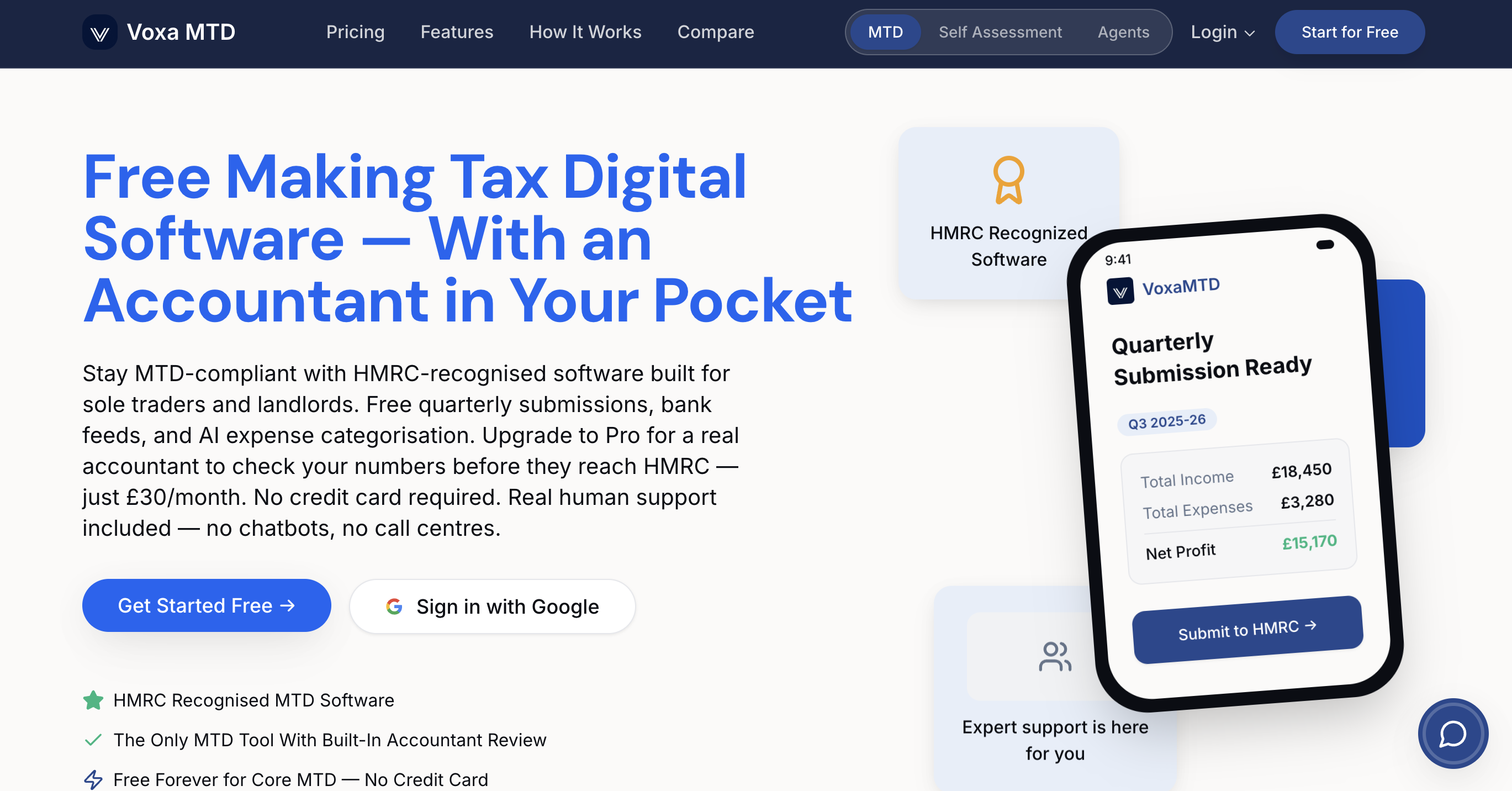
The platform handles quarterly submissions directly to HMRC via production API, imports bank transactions automatically through open banking, and uses AI-powered categorisation to sort your expenses without manual effort. Landlords get a dedicated dashboard with a Section 24 mortgage interest calculator and capital allowances tracking. Sole traders get mileage tracking, home office calculators, and payments on account projections. For accounting firms managing multiple clients, the agent portal for accountants offers a full client management suite with a revenue share model. Sign up free and start building the habits that make April 2026 straightforward rather than stressful.
Frequently asked questions
Who is affected by Making Tax Digital in 2026?
Sole traders and landlords with qualifying income over £50,000 must comply from April 2026. Lower income thresholds of £30,000 and £20,000 follow in 2027 and 2028.
What software is needed for MTD digital record-keeping?
You need HMRC-compatible software that can store digital records and submit updates directly to HMRC. Spreadsheets alone do not qualify unless paired with a bridging tool.
Do I need to submit separate updates for different income sources?
Yes. HMRC requires separate records and updates for each qualifying business and each UK property income source you hold.
What happens if I miss a digital tax deadline?
Each missed submission earns one penalty point, and four points triggers a £200 fine. Quarterly updates have a soft landing in 2026/27, but the Final Declaration is penalised from the outset.
How much will digital compliance cost me?
HMRC estimates a one-off transition cost of £280 to £350 per business, but independent surveys put the average annual cost closer to £753 depending on software choice and level of accountant support.