

TL;DR:
- Making Tax Digital for Income Tax Self Assessment requires digital records and quarterly submissions.
- Early compliance helps sole traders gain financial clarity and build good record-keeping habits.
- Using HMRC-recognised software simplifies the process and reduces errors for accurate tax filing.
April 2026 is not a distant deadline anymore. For the 864,000 sole traders and landlords now required to comply with Making Tax Digital for Income Tax Self Assessment, the shift is immediate and real. Miss it, and you face penalties, confusion, and the stress of catching up mid-year. Get ahead of it, and you gain something unexpected: genuine clarity over your finances. This guide walks you through exactly what MTD compliance means, what tools you need, how to complete your obligations step by step, and how to avoid the mistakes that trip up even experienced sole traders.
Table of Contents
- What sole trader tax compliance means under Making Tax Digital
- What you need to get started: tools and skills for digital compliance
- Step-by-step: completing your digital tax obligations
- Avoiding pitfalls: common mistakes and what good compliance looks like
- Why early, proactive compliance gives sole traders the advantage
- Make tax digital compliance easier with the right software
- Frequently asked questions
Key Takeaways
| Point | Details |
|---|---|
| Mandatory from April 2026 | Sole traders with over £50,000 income must use digital records and HMRC-approved software by April 2026. |
| Quarterly and annual deadlines | MTD requires four quarterly updates and a final annual declaration, all with strict submission dates. |
| Test MTD early | Voluntary sign-up allows you to practise with digital tools before mandatory compliance starts. |
| Penalties from 2027 | The first year is a soft landing but late declarations or payments still incur penalties. |
| Choose the right software | Selecting recognised MTD software makes compliance simpler and helps avoid mistakes. |
What sole trader tax compliance means under Making Tax Digital
For most sole traders, tax compliance used to mean one thing: a Self Assessment return filed by 31 January each year. That model is changing fundamentally. Under Making Tax Digital for Income Tax Self Assessment, you are now required to keep digital records throughout the year and submit quarterly updates directly to HMRC using recognised software.
From 6 April 2026, sole traders and landlords with qualifying gross income over £50,000 must comply with MTD for ITSA. Those earning between £30,000 and £50,000 follow in April 2027, and the £20,000 threshold group joins in April 2028. This is a phased rollout, but if you are in the first wave, the clock has already started.
864,000 sole traders and landlords are now required to use MTD-compatible software to submit quarterly income and expense updates to HMRC, with phased thresholds bringing in more taxpayers through to 2028.
Understanding digital tax trends 2026 helps put this in context. This is not just a software upgrade. It is a shift in how HMRC monitors income, and it changes the rhythm of your entire financial year.
Here is what changes under MTD compared to the traditional approach:
| Requirement | Traditional Self Assessment | MTD for ITSA |
|---|---|---|
| Record-keeping | Paper or spreadsheet acceptable | Digital software required |
| Submission frequency | Once per year | Quarterly plus final declaration |
| Transaction detail | Summary totals acceptable | Individual transactions required |
| Software | Optional | Mandatory (HMRC-recognised) |
| Deadline | 31 January annually | Four quarterly deadlines plus 31 January |
The consequences of non-compliance are not trivial. A penalty points system applies from 2027/28, with financial penalties triggered once you accumulate enough late submissions. Even in the first year, late payment penalties and a late final declaration penalty still apply.
Key facts to know:
- Income threshold for 2026: Gross qualifying income over £50,000
- Quarterly deadlines: 7 August, 7 November, 7 February, and 7 May
- Final declaration deadline: 31 January each year
- Who is exempt: Those below the threshold, partnerships (for now), and those with certain digital exclusions
For a thorough grounding in record-keeping requirements, the sole trader bookkeeping guide covers the practical side in detail.
What you need to get started: tools and skills for digital compliance
Before you submit a single quarterly update, you need the right setup. HMRC-recognised software is not optional. It must record every individual income and expense transaction, not just summaries, and it must be capable of submitting quarterly updates and a final end-of-year declaration directly to HMRC.
Here is what you need to have in place:
- HMRC-recognised MTD software that connects directly to HMRC's systems
- A Government Gateway account linked to your Unique Taxpayer Reference
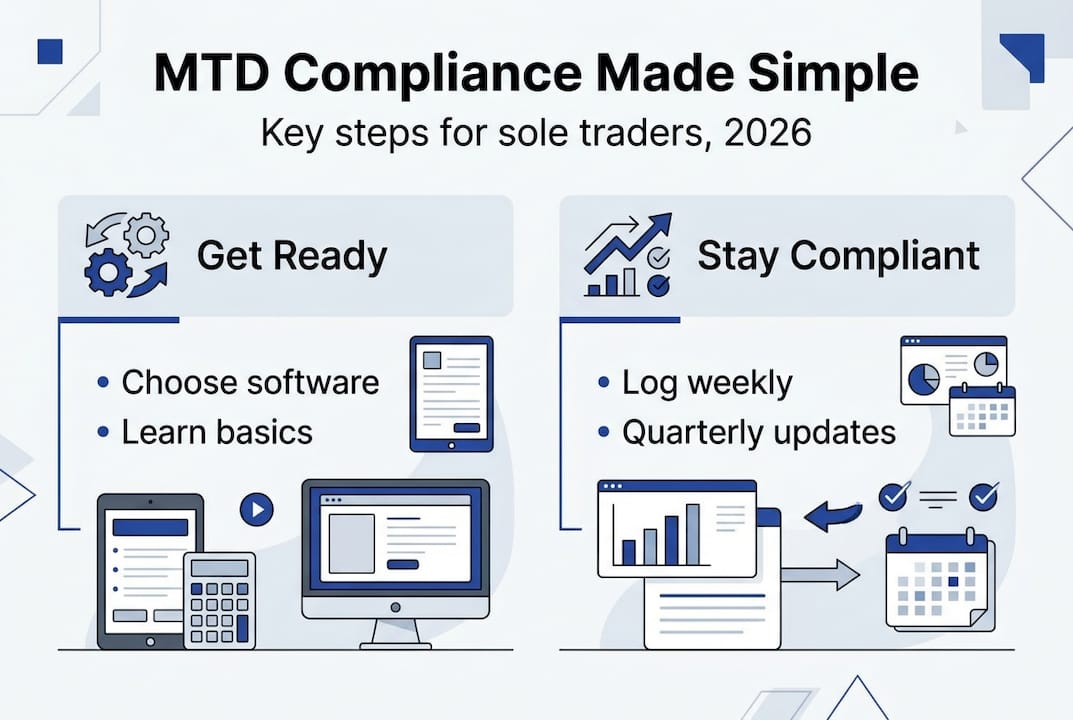
- A consistent digital record-keeping habit, ideally updated weekly or after every transaction
- Reliable internet access for submissions and real-time record updates
- Basic understanding of expense categories, so transactions are coded correctly from the start
When it comes to choosing software, not all tools are equal. Some cover the minimum; others offer features that save hours each month.
| Feature | Minimum required | Useful extra |
|---|---|---|
| Individual transaction recording | Yes | |
| Quarterly HMRC submission | Yes | |
| Expense categorisation | Basic | AI-powered automatic categorisation |
| Bank feed integration | No | Automatic open banking import |
| Receipt capture | No | OCR-powered scanner |
| Tax guidance | No | Voice AI accountant |
| Mileage tracking | No | Built-in calculator |
The skills you need are more straightforward than you might expect. You do not need to be an accountant. You need to be consistent, organised, and willing to log transactions as they happen rather than in a frantic end-of-year catch-up.
For those already registered for VAT under MTD for VAT, the process will feel familiar. Aligning your VAT and income tax digital records in one system reduces duplication and makes quarterly submissions far less time-consuming. The tax digitisation basics article explains how both regimes connect.
Pro Tip: You do not have to wait until April 2026 to start. Voluntary sign-up is open now, and testing your chosen software before the mandate begins means you will be confident and fluent when it counts. Many sole traders who trialled early report that the first quarter feels daunting, but by the second it becomes routine. Start now and remove the learning curve entirely.
For a detailed walkthrough of bookkeeping for MTD, including how to structure your records from day one, that guide is worth bookmarking.
Step-by-step: completing your digital tax obligations
Once your software is chosen and your records are set up, the process itself is logical. Here is the full journey from sign-up to year-end filing.
- Sign up for MTD for ITSA via your Government Gateway account, or ask your accountant to do this on your behalf.
- Choose and connect your HMRC-recognised software, ensuring it links to your Government Gateway credentials.
- Import or enter your opening financial records, including any income and expenses from the start of the tax year.
- Log every transaction as it occurs, categorised by income type or expense category. No summaries.
- Review your records at the end of each quarter to check for missing entries or miscategorised items.
- Submit your quarterly update by the relevant deadline. Quarterly deadlines are 7 August, 7 November, 7 February, and 7 May.
- Complete any adjustments after the tax year ends, including claiming allowances and reliefs.
- Submit your final declaration by 31 January, replacing the old Self Assessment return.
The quarterly tax submissions guide breaks down each submission in further detail if you want a deeper look at what each update should contain.
The results of early adoption are encouraging. Over 20,000 sole traders are already trialling quarterly updates voluntarily, and 48% of early MTD VAT adopters report feeling more in control of their finances as a direct result of quarterly reporting. The rhythm of regular submissions actually makes tax less stressful, not more.
Pro Tip: Every transaction matters. HMRC requires individual records, not category totals. If you log a £45 client lunch as "entertainment" rather than as a specific entry with date and supplier, you are not meeting the requirement. Use software that captures the detail automatically, whether through bank feeds or receipt scanning, so the burden stays low.
For sole traders exploring purpose-built tools, MTD software for sole traders is worth reviewing to understand what full-featured compliance looks like in practice.
Avoiding pitfalls: common mistakes and what good compliance looks like
Even well-intentioned sole traders make avoidable errors in their first year of MTD compliance. Knowing what these are in advance is half the battle.
Common mistakes to avoid:
- Submitting summaries instead of individual transactions. HMRC requires transaction-level records. Totals are not sufficient.
- Missing a quarterly deadline. Even in the soft landing year, habits form early. A missed submission in year one often leads to another in year two.
- Using non-recognised software. Not every accounting app is HMRC-approved for MTD. Check the official list before committing.
- Mixing personal and business transactions. This creates categorisation errors and makes reviews far more time-consuming.
- Leaving record updates until the end of the quarter. Bulk entry leads to errors and missing receipts.
The penalty system is worth understanding clearly. The MTD penalty regime works on a points-based model from 2027/28 onwards: one point per late quarterly submission, with a £200 financial penalty triggered at four points. In 2026/27, there is a soft landing period where no penalty points are issued for late quarterly updates. However, late payment penalties and a late final declaration penalty still apply even in that first year.
| Trigger | 2026/27 (soft landing) | 2027/28 onwards |
|---|---|---|
| Late quarterly update | No penalty points | 1 point per late submission |
| 4 accumulated points | N/A | £200 penalty |
| Late final declaration | Penalty applies | Penalty applies |
| Late payment | Penalty applies | Penalty applies |
Good compliance looks like this: records updated at least weekly, every transaction categorised correctly, a calendar reminder set for each quarterly deadline, and a brief review session before each submission. It is not complicated. It is consistent.

Pro Tip: Set a recurring monthly calendar reminder titled "MTD record review." Spend 20 minutes checking your software for uncategorised transactions, missing receipts, and any bank feed errors. This small habit prevents the quarterly scramble entirely.
For more on staying ahead of navigating tax trends as they evolve, that resource covers what is coming beyond 2026 as well.
Why early, proactive compliance gives sole traders the advantage
Most of the fear around MTD comes from the unfamiliar. A new system, new deadlines, new software. That is understandable. But here is what we have observed: sole traders who engage early do not just meet the compliance bar. They end up with a genuinely better understanding of their own business finances.
The 48% of early MTD VAT adopters who feel more in control did not achieve that by accident. Quarterly reporting forces a regular financial check-in that most sole traders never had before. You start to see patterns, spot overspending, and understand your cash flow in real time rather than in a January panic.
Waiting until 2027 or later does not just mean catching up on compliance. It means missing a full year of financial clarity. Those who start now are building habits and fluency that will serve them well beyond the mandate itself.
The bookkeeping for sole traders guide is a practical starting point for building those habits today, before the deadline makes it compulsory.
MTD is not a burden if you treat it as a tool. The sole traders who will struggle are those who wait, rush, and resent the change. The ones who thrive will be those who saw it coming and used it to their advantage.
Make tax digital compliance easier with the right software
Understanding the rules is one thing. Having the right tool to execute them effortlessly is another. The good news is that you do not need to spend a fortune to get started.
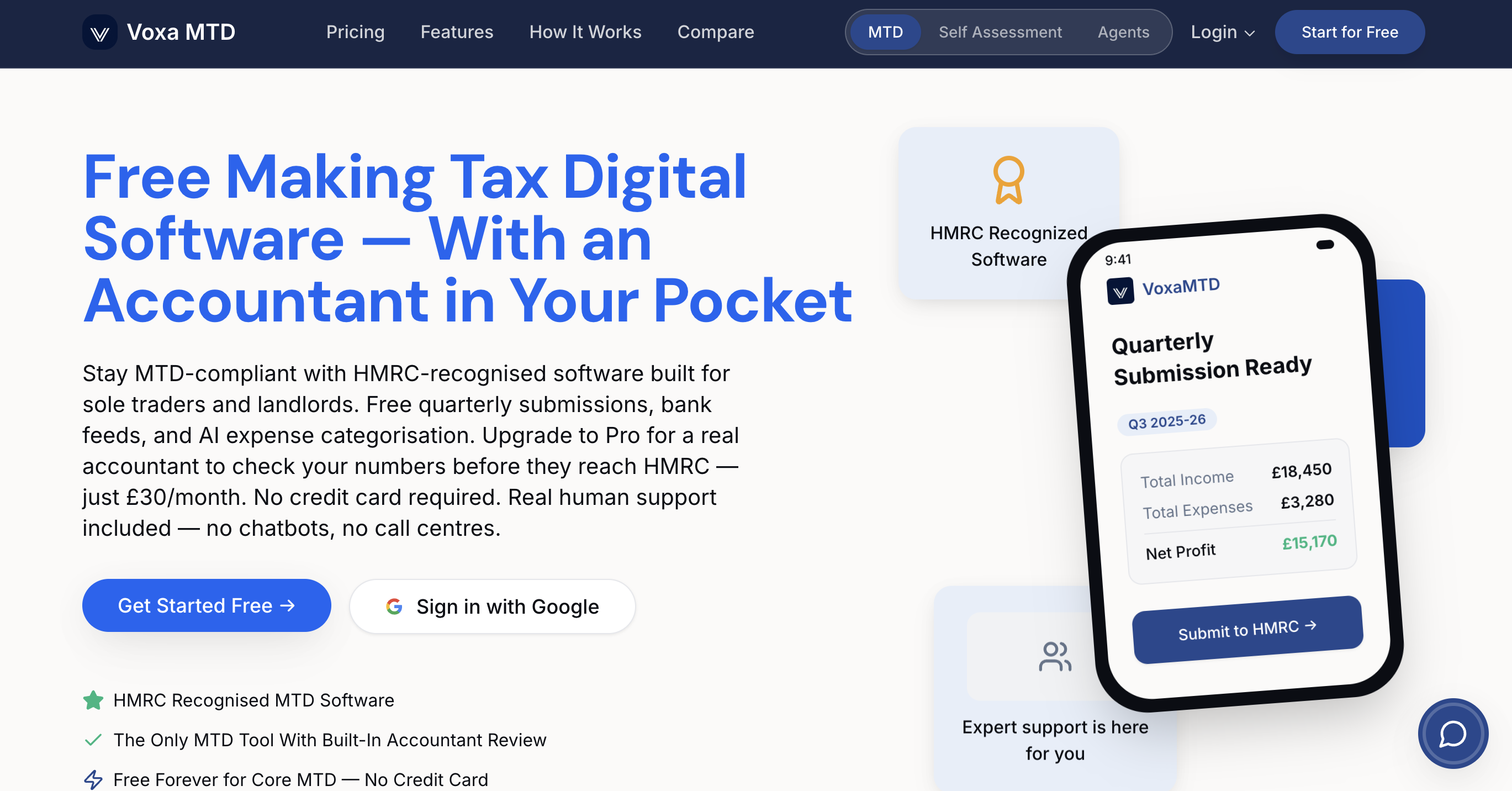
VoxaMTD is a free, HMRC-recognised MTD platform built specifically for UK sole traders. It connects directly to HMRC via production API, imports your bank transactions automatically through open banking, and uses AI to categorise your expenses without manual effort. The built-in receipt scanner, mileage tracker, and home office calculator mean every allowable expense is captured. For those who want more support, the Professional tier adds a real human accountant for quarterly reviews. Explore free MTD software for sole traders and see how straightforward digital compliance can be.
Frequently asked questions
When does Making Tax Digital become mandatory for sole traders?
From 6 April 2026, sole traders with qualifying gross income over £50,000 must follow MTD rules using recognised digital software. Lower income thresholds follow in 2027 and 2028.
What happens if I miss a quarterly MTD update?
In the first year (2026/27), no penalty points are issued for late quarterly submissions, but final declaration and payment penalties still apply from day one.
Can I try Making Tax Digital before it's mandatory?
Yes, voluntary sign-up and software testing are available now, allowing you to begin digital record-keeping and practise quarterly submissions well before the deadline.
What software do I need for MTD compliance?
You must use HMRC-recognised software that records each individual transaction and submits both quarterly updates and the annual final declaration directly to HMRC.