

TL;DR:
- Making Tax Digital requires millions of UK sole traders and landlords to use compliant software.
- Software must digitally track transactions, send quarterly updates, and support digital data transfer.
- Full digital tools offer significant time savings, error reduction, and ongoing financial insights.
If you think tax software is something only accountants or large companies need, Making Tax Digital (MTD) is about to change your mind. Under new HMRC rules, compatible software is now a legal requirement for millions of UK sole traders and landlords, not an optional upgrade. This article explains exactly who is affected, what the software must do, how to compare your options on cost and features, and why choosing the right tool now could save you far more than just a tax penalty later.
Table of Contents
- Why software is essential for MTD tax compliance
- What MTD-compliant software actually does
- Comparing affordable software options for sole traders and landlords
- Benefits beyond compliance: From reduced errors to time savings
- The hidden advantage most miss: Software as a business asset, not just a compliance tool
- Start your digital compliance journey with the right tools
- Frequently asked questions
Key Takeaways
| Point | Details |
|---|---|
| MTD makes software mandatory | If your self-employed or property income exceeds £50,000, you'll need compliant tax software from April 2026. |
| Choose the right tool | Bridging is cheap and best for simple needs; full software offers automation and is better for mixed or growing incomes. |
| Software cuts errors and saves time | Switching to digital tax tools means more accurate returns and less admin—up to 96 hours saved each year on average. |
| Start early for a smooth transition | Testing and selecting your software ahead of deadlines ensures you avoid last-minute compliance problems. |
Why software is essential for MTD tax compliance
Most sole traders and landlords have managed perfectly well with spreadsheets and a shoebox of receipts. That era is ending. Making Tax Digital for Income Tax Self Assessment (ITSA) means that keeping digital records and filing quarterly updates with HMRC is no longer a choice. You must use compatible software. Full stop.
The rollout follows a phased schedule based on your gross qualifying income, which means the total of your self-employment turnover plus any UK property income before expenses:
- April 2026: Gross qualifying income over £50,000. Around 864,000 people affected.
- April 2027: Gross qualifying income over £30,000. Roughly 1.077 million people brought in.
- April 2028: Gross qualifying income over £20,000. A further 975,000 affected.
If your income sits near any of these thresholds, do not assume you are safe. Income can fluctuate, and HMRC calculates eligibility based on your previous tax year's figures. Understanding the basics of UK tax digitisation now puts you well ahead of the curve.
Software must handle three core tasks under MTD: keeping digital records of every income and expense transaction, sending quarterly summary updates directly to HMRC via an approved API connection, and submitting a final end-of-year declaration. Manual entry or copy-pasting from a spreadsheet into a government portal does not satisfy the rules.
"MTD is not just a reporting change. It is a fundamental shift in how tax records must be created and maintained throughout the year."
Pro Tip: Even if your income is currently below the £50,000 threshold, starting with MTD-compatible software now gives you time to build good habits and test the process without deadline pressure. Use this income tax checklist for sole traders to get organised before the mandate hits.
What MTD-compliant software actually does
Now that you know MTD software is compulsory, let us break down what it actually does for your business or rental income. The term "MTD-compatible" has a precise legal meaning. Not every accounting app qualifies.
Here is what genuinely compliant software must deliver:
- Digital record creation: Every transaction must be logged with a date, amount, and category. Income and allowable expenses must be recorded digitally at source, not reconstructed at year end.
- Quarterly submissions via API: The software sends a summary of your income and expenses directly to HMRC four times a year. There is no government portal you log into manually. The quarterly update process happens through a direct API connection between your software and HMRC's systems.
- End-of-year finalisation: After the fourth quarterly update, you submit a final declaration that pulls together all your income sources, including any employment income, savings interest, or dividends, and confirms your tax position for the year.
- Digital links: If you use more than one piece of software, data must flow between them digitally. Manually re-keying figures from one system to another breaks the digital chain and puts you out of compliance.
"The requirement for digital links means you cannot simply export a spreadsheet, edit it, and re-import it. The data must transfer without human intervention."
For landlords, the MTD deadlines add an extra layer of planning, particularly if you have both rental and self-employment income. Agents and accountants also have specific obligations, as outlined in guidance for tax agents preparing clients for the change.
Comparing affordable software options for sole traders and landlords
With a grasp of what MTD software does, let us compare the options on features and price to help you choose the right fit. The market broadly divides into two categories: bridging software and full accounting software.
Bridging software sits between your existing spreadsheet and HMRC. It reads your spreadsheet data and submits it. Cost is low, typically around £20 to £36 per year for tools like Absolute Excel or 123 Sheets. The trade-off is that you still do all the manual data entry yourself. There is no automation, no bank feeds, and no categorisation help.
Full accounting software connects directly to your bank, categorises transactions automatically, and handles submissions without you touching a spreadsheet. Affordable full-software options include FreeAgent at £14.50 per month, QuickBooks at £12, Xero at £15, and Sage at £12. Specialist landlord tools include Hammock at £7 to £8 per month and LandlordOS, which is free for one to two properties.

| Software | Type | Monthly cost | Bank feeds | Landlord features |
|---|---|---|---|---|
| VoxaMTD | Full | Free | Yes (open banking) | Yes (dedicated dashboard) |
| FreeAgent | Full | £14.50 | Yes | Limited |
| QuickBooks | Full | £12 | Yes | Limited |
| Hammock | Landlord specialist | £7 to £8 | Yes | Yes |
| 123 Sheets | Bridging | ~£3/month | No | No |
| LandlordOS | Landlord specialist | Free (basic) | Limited | Yes |
For landlords with multiple properties or mixed income, a dedicated MTD solution for landlords will save considerably more time than a generic bridging tool. The key questions to ask any provider are: Does it connect directly to HMRC via API? Does it support both self-employment and property income? And what happens at year end?
- Look for HMRC recognition on the official MTD software list
- Check whether the free tier covers quarterly submissions or only record-keeping
- Confirm the software handles your specific income type, property, trade, or both
Benefits beyond compliance: From reduced errors to time savings
Price and features are important, but the real value of good software lies in how much easier and more accurate it makes your tax duties. Evidence from the MTD VAT rollout, which started in 2019, gives us a clear picture of what happens when businesses switch from manual to digital.
Full MTD-compatible software reduces errors, increases how often records are updated, and generates measurable time savings. Bridging software, by contrast, delivers almost none of these benefits because the underlying manual process remains unchanged.
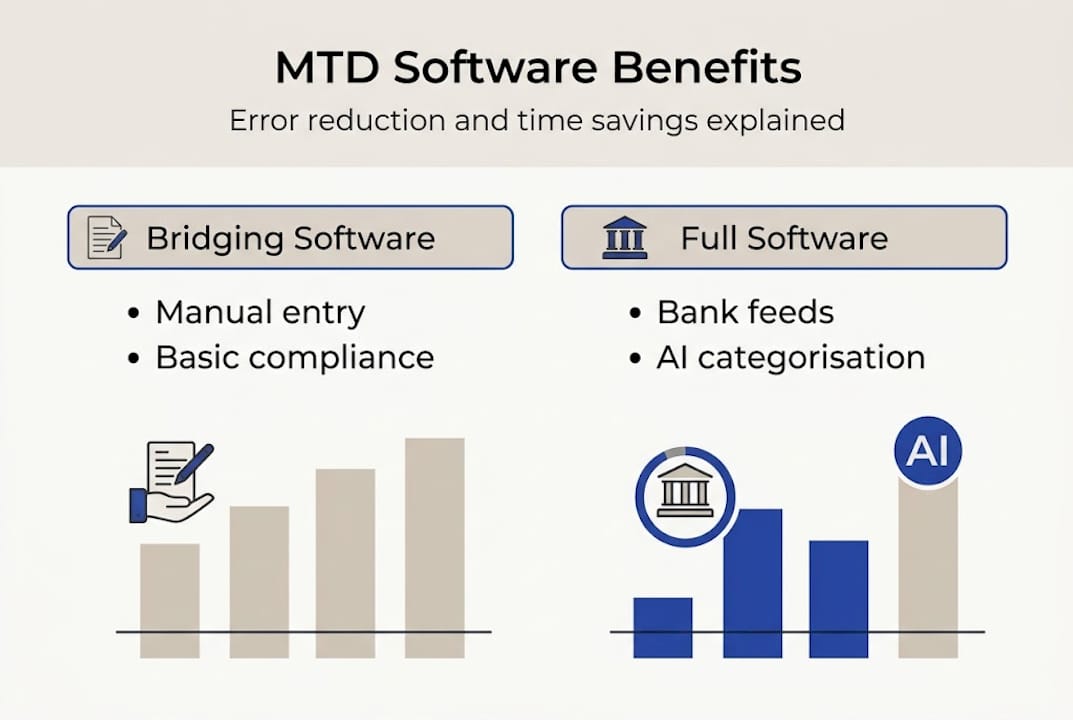
| Benefit | Bridging software | Full software |
|---|---|---|
| Automatic bank feeds | No | Yes |
| Error reduction | Minimal | Significant |
| Record update frequency | Periodic (manual) | Continuous |
| Time saved per year | Low | Up to 96 hours |
| HMRC revenue improvement | Negligible | Measurable |
The 96-hour figure is striking. That is the equivalent of more than two full working weeks handed back to you every year, time you can spend on your trade, your properties, or simply not worrying about tax. After the MTD VAT rollout, 48% of businesses reported updating their records continuously rather than in annual batches, which dramatically reduces the risk of forgotten transactions or miscategorised expenses.
The knock-on effect for tax accuracy is significant. When records are updated weekly or even daily, you catch errors while the transaction is still fresh. You are not trying to remember in January whether a payment in March was a business expense or a personal purchase.
Pro Tip: Prioritise software that includes automatic bank feeds and AI-powered transaction categorisation. These two features alone account for the majority of time savings and error reductions reported by businesses that switched to full MTD software. Explore digital tax trends for sole traders to understand where the tools are heading.
The hidden advantage most miss: Software as a business asset, not just a compliance tool
Most guides treat MTD software as a box to tick before the deadline. We think that framing undersells the opportunity significantly. When you connect your bank account, categorise transactions in real time, and receive quarterly summaries of your financial position, you are not just satisfying HMRC. You are building a live picture of your business or property portfolio that most small operators have never had before.
The sole traders and landlords who will benefit most from MTD are not the ones who scramble to comply at the last minute. They are the ones who use the mandate as a reason to finally get their finances organised year-round. Spotting a dip in rental yield, noticing that one income stream is growing faster than another, or realising your payments on account are going to be higher than expected: these insights come from having current data, not from a spreadsheet you update once a year.
The digitisation guide for sole traders makes this point well. Software chosen thoughtfully, rather than grabbed in a panic, becomes a genuine financial tool. The compliance deadline is only the beginning.
Start your digital compliance journey with the right tools
The MTD deadline is real, and the right software makes the difference between a stressful scramble and a smooth, automated process. VoxaMTD is built specifically for UK sole traders and landlords who want full MTD compliance without the £30 to £65 monthly bills that legacy accounting software charges.
The core platform is free, connects directly to HMRC via production API, and includes open banking through Finexer, AI-powered categorisation at 95% accuracy, and Alex AI Accountant for 24/7 tax questions by voice, SMS, or WhatsApp. Landlords get a dedicated dashboard with Section 24 calculations. Sole traders get mileage tracking and payments on account projections. Check whether you need MTD now, then explore the free landlord tools or free sole trader platform to get started before the April 2026 deadline.
Frequently asked questions
Who must use software for Making Tax Digital (MTD) for Income Tax?
UK sole traders and landlords with gross qualifying income over £50,000 must use MTD-compatible software from April 2026, with phased inclusion for lower incomes through to April 2028.
What features must tax software have for MTD compliance?
It must create digital records, file quarterly updates directly with HMRC via API, and submit a final declaration that includes all other relevant income sources.
Is free bridging software enough for MTD tax compliance?
Bridging software meets the legal minimum for simple cases, but it lacks automation and bank feeds; full software is better for anyone with growth plans, multiple income streams, or a need to save time.
What are the main benefits of switching to digital tax software?
You gain greater accuracy, fewer errors, and significant time savings: up to 96 hours per business based on evidence from the MTD VAT rollout, plus continuous record updates that reduce year-end stress considerably.