
TL;DR:
- UK sole traders earning over £50,000 must comply with Making Tax Digital for Income Tax from April 2026.
- Compliance involves registering, choosing HMRC-recognised software, maintaining digital records, and submitting quarterly updates.
- Early adoption offers better financial oversight and reduces long-term time and penalty risks.
From April 2026, many UK sole traders must follow Making Tax Digital for Income Tax rules, and the shift is bigger than most people realise. Paper records and spreadsheets alone will no longer satisfy HMRC. Instead, you must keep digital records and submit quarterly updates through recognised software. If you are self-employed and earning above the qualifying threshold, this is not optional. The good news is that getting compliant does not have to be overwhelming. This article gives you a clear, step-by-step checklist covering eligibility, software choices, allowable expenses, and key deadlines, so you can approach MTD with confidence rather than dread.
Table of Contents
- Understand MTD: who needs to comply and when
- Step-by-step income tax checklist for MTD compliance
- Choosing the right MTD software for digital records
- What expenses are allowed? Expense tracking explained
- Quarterly updates and key deadlines every sole trader must know
- What most guides miss: real-world MTD insights for sole traders
- Streamline your MTD journey with VoxaMTD
- Frequently asked questions
Key Takeaways
| Point | Details |
|---|---|
| MTD begins April 2026 | If your sole trader income exceeds £50,000, you must follow Making Tax Digital for Income Tax rules from April 2026. |
| Digital records and reports | MTD requires using approved software to keep income and expense records, and to submit quarterly and annual updates online. |
| Get expenses right | Track all business costs digitally and claim only those that meet HMRC’s ‘wholly and exclusively’ test to maximise deductions. |
| Quarterly deadlines matter | Submit income and expenses reporting by the 7th of August, November, February, and May every tax year to avoid penalties. |
| First-year penalty relief | There are no fines for missing quarterly submissions in 2026/27, but it pays to build your digital routine from the start. |
Understand MTD: who needs to comply and when
Let us start by clarifying whether and when you must comply, before tackling your actionable checklist. Making Tax Digital for Income Tax Self Assessment (MTD ITSA) is being rolled out in stages, and your qualifying income determines when you must join. Qualifying income means your gross income from self-employment and property combined, before any expenses are deducted.
The staged rollout works as follows:
- Sole traders earning over £50,000 must join from April 2026
- Those earning over £30,000 must join from April 2027
- Those earning over £20,000 must join from April 2028
- Partnerships are not yet included in the current mandate
This means if your turnover sits just below £50,000, you have a window to prepare, but that window closes faster than you think. Understanding the digital tax trends for sole traders shaping the next few years will help you plan ahead rather than scramble at the last minute.
Some sole traders are exempt. HMRC may grant exemptions for digital exclusion, which covers situations where age, disability, or remote location makes digital tools genuinely inaccessible. Foster carers and certain religious communities may also qualify. If you believe you are exempt, you must apply to HMRC directly. Do not simply assume you are off the hook.
Key stat: Approximately 780,000 sole traders and landlords are expected to fall into the first wave of MTD compliance by April 2026.
It is also worth noting that digital tax deadlines explained in full detail can help you map out your year. Check your MTD eligibility criteria on the government website if you are unsure where you stand.
Step-by-step income tax checklist for MTD compliance
Now you know if and when you qualify, here is the essential checklist to stay compliant:
- Confirm your qualifying income. Review your last Self Assessment return. Add together your gross self-employment income and any property income. If the combined figure exceeds the relevant threshold, you must act now.
- Register for MTD ITSA. Sign up through the government portal before your mandated start date. Do not wait until the deadline, as processing can take several weeks.
- Choose HMRC-recognised software. You must use MTD-compatible software to keep digital records and file your updates. More on this in the next section.
- Keep digital records from day one. Every sale, every expense, every invoice must be recorded digitally and in real time. Backdating records at year-end is not acceptable under MTD rules.
- Submit quarterly summaries on time. You will send four updates per year to HMRC, summarising your income and expenses for each quarter.
- Submit your final declaration by 31 January. This replaces the old Self Assessment return and must be completed online each year.
Following these sole trader tax compliance steps in order gives you a structured path through what can otherwise feel like a maze of requirements.
Pro Tip: Set a calendar reminder three months before your mandated start date. This gives you enough time to choose software, migrate your records, and run a test quarter without the pressure of a live deadline.
Choosing the right MTD software for digital records
With your checklist in hand, the next vital step is choosing the software that simplifies your tax tasks. Under MTD ITSA, sole traders must use compatible software for digital records and filing. Not every accounting tool qualifies, so checking the HMRC software list before committing is essential.
Here is what to look for in any MTD-compatible platform:
- Direct HMRC API integration for quarterly submissions
- Automatic bank transaction imports
- AI-powered or automated expense categorisation
- Receipt scanning and storage
- Mileage and home office calculators
- Clear audit trail for digital records
To help you compare your options, here is a quick overview of leading platforms:
| Software | MTD compatible | Free tier | Bank import | AI features | Support |
|---|---|---|---|---|---|
| Xero | Yes | No | Yes | Limited | Email/chat |
| QuickBooks | Yes | No | Yes | Limited | Email/chat |
| FreeAgent | Yes | No | Yes | No | |
| VoxaMTD | Yes | Yes | Yes (Finexer) | Full AI (Alex) | AI + human |
VoxaMTD stands out because it offers a genuinely free tier with direct HMRC API submissions, automatic bank imports via Finexer open banking, and an AI-powered receipt scanner. For sole traders who want more support, the Professional tier at £30 per month includes quarterly reviews with a real human accountant.
A good bookkeeping guide for MTD will also help you understand how to structure your records within whichever platform you choose. And if you want to maximise tax deductions, choosing software with smart categorisation makes a measurable difference.
Pro Tip: Free does not mean limited. VoxaMTD's free tier handles quarterly MTD submissions directly to HMRC, which is exactly what most sole traders need to start with.
What expenses are allowed? Expense tracking explained
Accurate expense tracking is essential for compliance and for maximising your deductions. Here is what you can and cannot claim:
The golden rule is that allowable expenses must be 'wholly and exclusively' for business purposes. If an expense has both personal and business use, you can only claim the business portion. Simplified flat rates are available for certain costs, such as home office use and vehicle mileage.
Here is a breakdown of common expense categories:
| Category | Allowable | Simplified rate available |
|---|---|---|
| Office costs (rent, bills) | Yes | Yes (home office) |
| Travel and mileage | Yes | Yes (45p/mile up to 10,000) |
| Marketing and advertising | Yes | No |
| Professional subscriptions | Yes | No |
| Client entertainment | No | No |
| Clothing (non-uniform) | No | No |
| Food and drink (general) | No | No |
Common pitfalls include claiming for clothing that is not a uniform or protective gear, mixing personal and business phone bills without splitting them, and failing to keep receipts. HMRC can and does challenge expense claims, and without digital records, your defence is weak.
For more detail on structuring your records correctly, the sole trader bookkeeping tips guide covers the practical side in full. You can also check the allowable expenses explained resource for a broader list of claimable costs.
Keep a digital record of every expense at the point of purchase. A photo of a receipt taken the same day is far stronger evidence than a bank statement reviewed months later.
Quarterly updates and key deadlines every sole trader must know
With your digital records sorted and expenses logged, you need to stay on top of reporting deadlines to avoid penalties. Under MTD ITSA, quarterly updates are due on 7 August, 7 November, 7 February, and 7 May, with your final declaration due by 31 January each year.
Here is the full deadline sequence for the 2026/27 tax year:
- 7 August 2026 — First quarterly update (April to June)
- 7 November 2026 — Second quarterly update (July to September)
- 7 February 2027 — Third quarterly update (October to December)
- 7 May 2027 — Fourth quarterly update (January to March)
- 31 January 2028 — Final declaration for 2026/27
After the first year, HMRC operates a points-based penalty system. Each missed quarterly submission earns one penalty point. Reach four points and you face a £200 fine, with further charges for continued non-compliance. The first year (2026/27) carries penalty relief for late quarterly submissions, giving you breathing room to adapt, but this does not apply to the final declaration.
Key stat: A £200 fine triggers at four penalty points, and each point stays on your record for 24 months.
Common mistakes include submitting the wrong period, forgetting to include all income sources, and missing the final declaration deadline entirely. The quarterly tax submission guide walks through each step in detail.
Pro Tip: Automate your quarterly submissions through your MTD software wherever possible. Most platforms, including VoxaMTD, can send reminders and pre-populate your summaries from your digital records, cutting submission time to minutes.
What most guides miss: real-world MTD insights for sole traders
Having covered the compliance essentials, let us look at what is not always obvious in official checklists. The first-year penalty relief is genuinely useful, but it carries a hidden risk: it can make procrastination feel safe. Sole traders who delay setting up their software and digital records until late 2026 often find themselves rushing to backfill months of transactions, which is exactly the kind of chaotic catch-up that MTD was designed to eliminate.
The real advantage of early adoption is not just avoiding fines. It is the data. When you have clean, categorised, real-time financial records, you can see your profit margins, your biggest expense categories, and your tax liability at any point in the year. That is information that used to require an accountant's quarterly visit.
As tax digitisation explained shows, the MTD setup process does require upfront effort, but sole traders who commit early consistently report that the ongoing time cost drops dramatically after the first quarter. The disruption is real but short-lived. The procrastination trap, on the other hand, compounds over time.
Streamline your MTD journey with VoxaMTD
Ready to make MTD compliance as simple as ticking this checklist? Here is your next step.
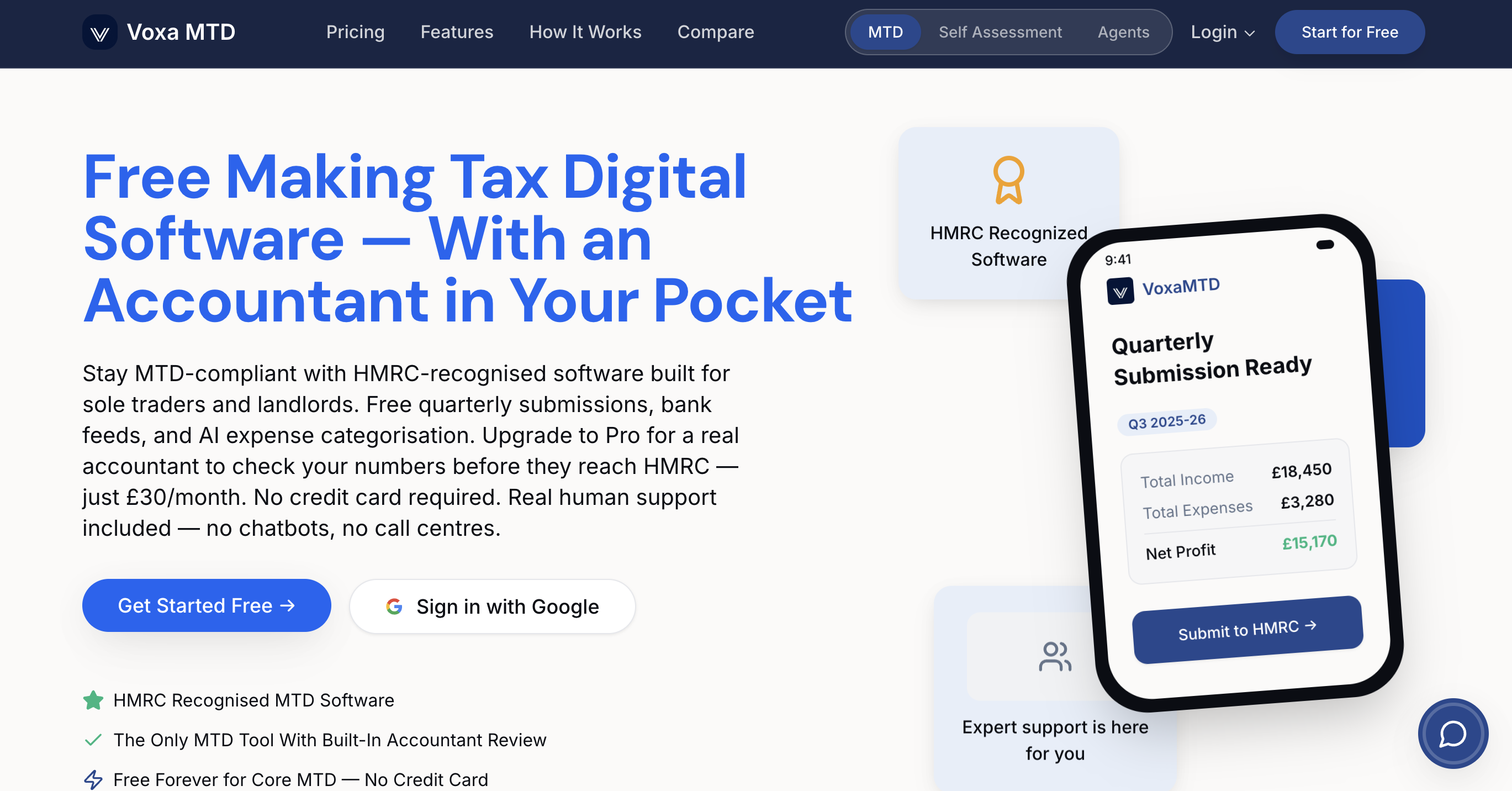
VoxaMTD is a free, HMRC-recognised platform built specifically for UK sole traders. It handles quarterly submissions directly to HMRC, imports your bank transactions automatically through Finexer open banking, and uses AI to categorise your expenses in seconds. You do not need an accounting degree to use it.
Visit the free MTD software for sole traders page to get started at no cost. If you are unsure whether you need to comply right now, the MTD checker tool gives you a clear answer in under a minute. Whether you are just starting out or already overdue on your setup, VoxaMTD puts professional-grade compliance within reach for every sole trader in the UK.
Frequently asked questions
Do I have to use MTD for Income Tax if I earn under £50,000?
Not until at least April 2027, when the threshold drops to £30,000, and then to £20,000 from April 2028. Use the time now to prepare your digital records.
What happens if I miss a quarterly MTD submission?
In the first year (2026/27) there are no penalties for late quarterly updates, but after that a points-based system applies and four points triggers a £200 fine.
Which expenses can I claim as a sole trader for tax?
You can claim costs wholly and exclusively for business, such as office, travel, and marketing, but not general clothing, client entertainment, or personal food and drink.
Can I stay on spreadsheets or paper for MTD?
No. MTD ITSA requires you to use compatible MTD software to keep digital records and submit your quarterly updates directly to HMRC.
Are there any exemptions from MTD for sole traders?
HMRC may grant exemptions for digital exclusion cases such as age, disability, or remote location, and foster carers may also qualify, but you must apply and receive confirmation from HMRC.