

TL;DR:
- Nearly 42% of sole traders are unclear on upcoming digital tax rules, risking non-compliance.
- Making Tax Digital requires digital records, quarterly updates via HMRC-approved software, and an annual final declaration.
- Choosing easy-to-use, compliant software and starting early helps sole traders stay on track and avoid penalties.
Nearly 42% of sole traders remain unclear on the new digital tax rules coming into force this year. That is a striking number when you consider that Making Tax Digital for Income Tax is the biggest shake-up to self-assessment in decades. If you are a sole trader trying to work out what applies to you, when it applies, and what you actually need to do, this guide cuts through the noise. You will find the key thresholds, deadlines, software choices, and practical steps to stay on the right side of HMRC without unnecessary stress or expense.
Table of Contents
- What is Making Tax Digital and how does it affect sole traders?
- The key rules, deadlines and penalties you need to know
- Choosing the right software: your options and what to look for
- Common mistakes and how to stay compliant: practical tips for sole traders
- A fresh perspective: what most articles aren't telling you about digital tax compliance
- How VoxaMTD can help UK sole traders stay compliant
- Frequently asked questions
Key Takeaways
| Point | Details |
|---|---|
| MTD applies in phases | MTD rules roll out by income bracket, starting at £50,000 in 2026 and gradually including more sole traders by 2028. |
| Use HMRC-approved software | You must keep digital records and submit tax updates using compatible digital software listed by HMRC. |
| New deadlines and penalties | Quarterly updates and a final declaration are mandatory, with a soft landing on penalties until 2027. |
| Start early for compliance | Preparing now helps avoid last-minute confusion and ensures your systems work smoothly. |
What is Making Tax Digital and how does it affect sole traders?
Making Tax Digital for Income Tax Self Assessment (MTD for ITSA) is HMRC's initiative to move tax recordkeeping and reporting fully online. Instead of filing one annual Self Assessment return, you will keep digital records throughout the year and submit quarterly updates directly to HMRC via MTD-compatible software. A final annual declaration then confirms your figures.
The rollout is phased by income level. If your gross self-employment or property income exceeds certain thresholds, you must comply from the relevant date. According to HMRC's phased mandates, the schedule looks like this:
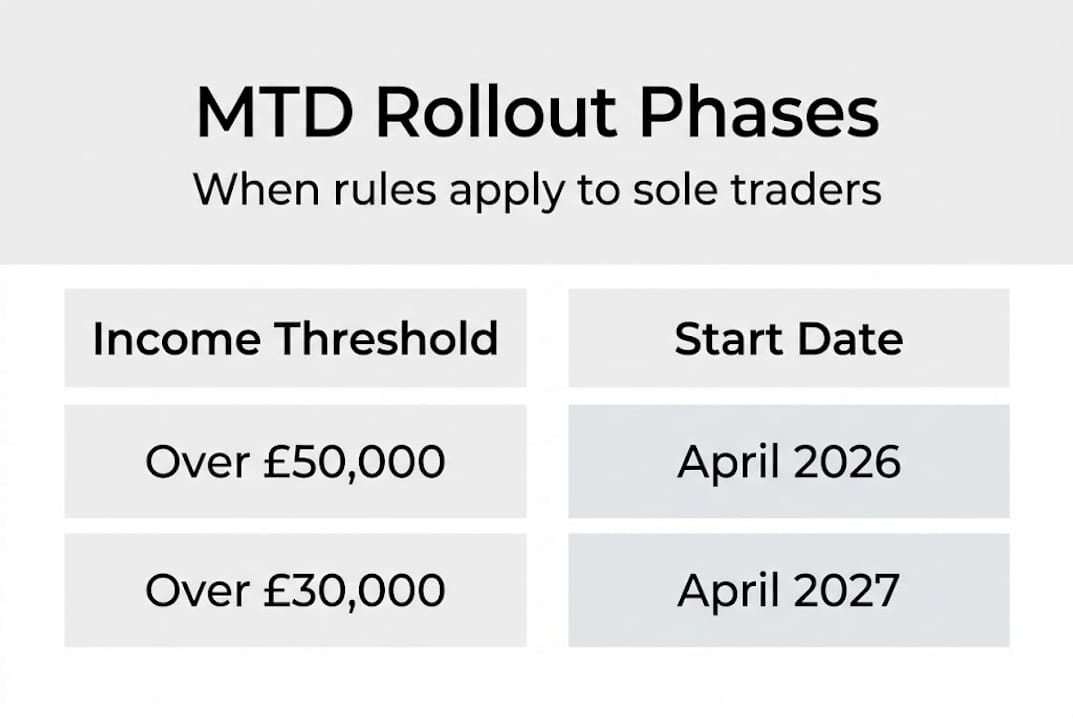
| Income threshold | Mandatory from | Estimated traders affected |
|---|---|---|
| Over £50,000 | April 2026 | ~780,000 |
| Over £30,000 | April 2027 | ~900,000 |
| Over £20,000 | April 2028 | ~1,220,000 |
In total, 2.9 million sole traders and landlords will eventually fall under MTD for ITSA. Understanding the key MTD terms early will help you prepare with confidence.
The core requirements are straightforward once you know them:
- Digital records: All income and expenses must be kept in digital form, not spreadsheets or paper.
- Quarterly updates: Four updates per tax year submitted to HMRC via approved software.
- Compatible software: Only tools on HMRC's approved list qualify.
- Annual finalisation: A year-end declaration confirming your total income and claiming any allowances.
Some sole traders are exempt. Grounds include age, disability, religious objection, or living in an area with no reliable internet access. Foster carers and those with very low digital capability can also apply. You must formally request an exemption from HMRC rather than simply opting out.
"MTD is not optional for those above the threshold. It is a legal obligation, and the phased approach means many sole traders will need to act sooner than they realise."
The key rules, deadlines and penalties you need to know
Understanding who must comply is the first step. Now let's break down what the rules require, when deadlines hit, and what happens if you fall behind.
Each tax year is divided into four quarterly update periods. Quarterly submissions must be made within one month of each quarter ending. The final annual declaration is due by 31 January, the same deadline as the current Self Assessment return. HMRC confirms that all updates must be submitted via compatible software, not manually.

Here is how the new regime compares to the old one:
| Feature | Old Self Assessment | MTD for ITSA |
|---|---|---|
| Filing frequency | Annual | Quarterly + final declaration |
| Recordkeeping | Manual or digital | Digital only |
| Submission method | HMRC portal or paper | MTD-compatible software |
| Penalty system | Fixed fines | Points-based system |
The penalty structure is a meaningful change. Under the new points-based system, each missed quarterly update earns one penalty point. Accumulate four points and you receive a £200 fine. Points reset after a period of full compliance. Critically, no penalties apply for late quarterly submissions during the soft landing period covering 2026 and 2027. From 2027 onwards, the full points regime kicks in.
Your annual compliance calendar in brief:
- April: New tax year begins. Ensure software is active and connected.
- May: Submit Q4 update for the previous tax year.
- August: Submit Q1 update for the current tax year.
- November: Submit Q2 update.
- February: Submit Q3 update.
- 31 January: Submit Q4 update and complete final annual declaration.
The soft landing period is genuinely useful breathing room, but do not let it breed complacency. Building good habits now means the full penalty regime will never catch you off guard.
Choosing the right software: your options and what to look for
Once you know what is needed and by when, the next critical step is picking digital tools that do the hard work for you.
HMRC's approved software list includes a wide range of options, from established names like Xero, FreeAgent, QuickBooks, and Sage, through to free tools and bridging software for those already using spreadsheets. The list is regularly updated, so always check it directly rather than relying on a provider's own claims. Reviewing sole trader MTD compliance tips can also help you shortlist tools suited to your specific business type.
When evaluating software, consider these factors:
- Cost: Prices range from free to over £60 per month. Free options exist and are fully HMRC-compliant.
- Ease of use: Look for a clean interface and mobile access, especially if you are managing finances on the go.
- Automation: AI-powered categorisation and bank feeds save significant time each quarter.
- Support: Access to help via chat, phone, or a built-in AI assistant matters when deadlines loom.
- Agent access: If you work with an accountant, confirm they can log in and submit on your behalf.
- Integration: Check it connects with your bank and any invoicing tools you already use.
Pro Tip: Do not assume your current accounting system is MTD-compatible. Many popular tools require an upgraded plan or a separate bridging solution. Always verify against the HMRC software list before committing.
The 2026 digital tax landscape has created a genuinely competitive software market. That is good news for sole traders, because it means better tools at lower prices than ever before. Do not default to the most advertised product. Compare a few options using free trials and choose what fits your workflow.
Common mistakes and how to stay compliant: practical tips for sole traders
Having the right software is one part of the equation. Now let's tackle the common mistakes that trip up even experienced sole traders and your best strategies to avoid them.
The awareness gap is real. Only 10% of eligible sole traders had signed up by March 2026, despite the April mandate. That means the vast majority are starting late, which increases the risk of rushed decisions and avoidable errors.
"With 42% of sole traders still unclear on the rules and sign-up rates in single digits, the compliance gap is not a minor admin issue. It is a widespread readiness problem that could result in thousands of unnecessary fines."
The most common mistakes include:
- Missing quarterly filing deadlines because reminders were not set up.
- Using software that is not on the HMRC-approved list.
- Failing to communicate with an accountant or agent about who is responsible for submissions.
- Waiting until the last minute to test software, then discovering bank connections or data imports do not work.
- Mixing personal and business transactions in the same account, making categorisation messy and time-consuming.
Practical steps to stay on track:
- Set calendar reminders one week before each quarterly deadline.
- Connect your business bank account to your MTD software now, even before you are legally required to.
- Run a test submission during the soft landing period to confirm everything works end to end.
- Use a quarterly checklist: income recorded, expenses categorised, bank reconciled, submission confirmed.
- Agree in writing with your accountant who handles each submission.
Pro Tip: Start mastering MTD compliance by switching to digital recordkeeping immediately, even if your threshold date is 2027 or 2028. Spotting gaps in your records now is far less stressful than discovering them under a live deadline.
A fresh perspective: what most articles aren't telling you about digital tax compliance
Most guides present MTD as a simple technical upgrade. Log in, connect your bank, submit quarterly. Done. But for the average sole trader juggling clients, invoices, and everything else, the reality is more demanding than that framing suggests.
The official narrative focuses on error reduction and tax gap closure. Those are real goals. But agents and advisers have flagged that while accountants are broadly prepared, client-side readiness is a serious concern. The burden of change falls disproportionately on sole traders who have no finance team and limited time.
What actually works? Starting earlier than you think necessary. Choosing software you find genuinely easy to use, not just the one your accountant recommends by default. And treating the quarterly rhythm as a positive habit rather than a compliance chore. Traders who engage with broader digital trends in tax management tend to find the transition far smoother.
Pro Tip: Use the free trial periods of two or three tools side by side. Real-world usability matters far more than feature lists. The best software is the one you will actually open every month.
How VoxaMTD can help UK sole traders stay compliant
After weighing all the rules, tips, and pitfalls, the right tool makes compliance genuinely manageable rather than a source of dread.
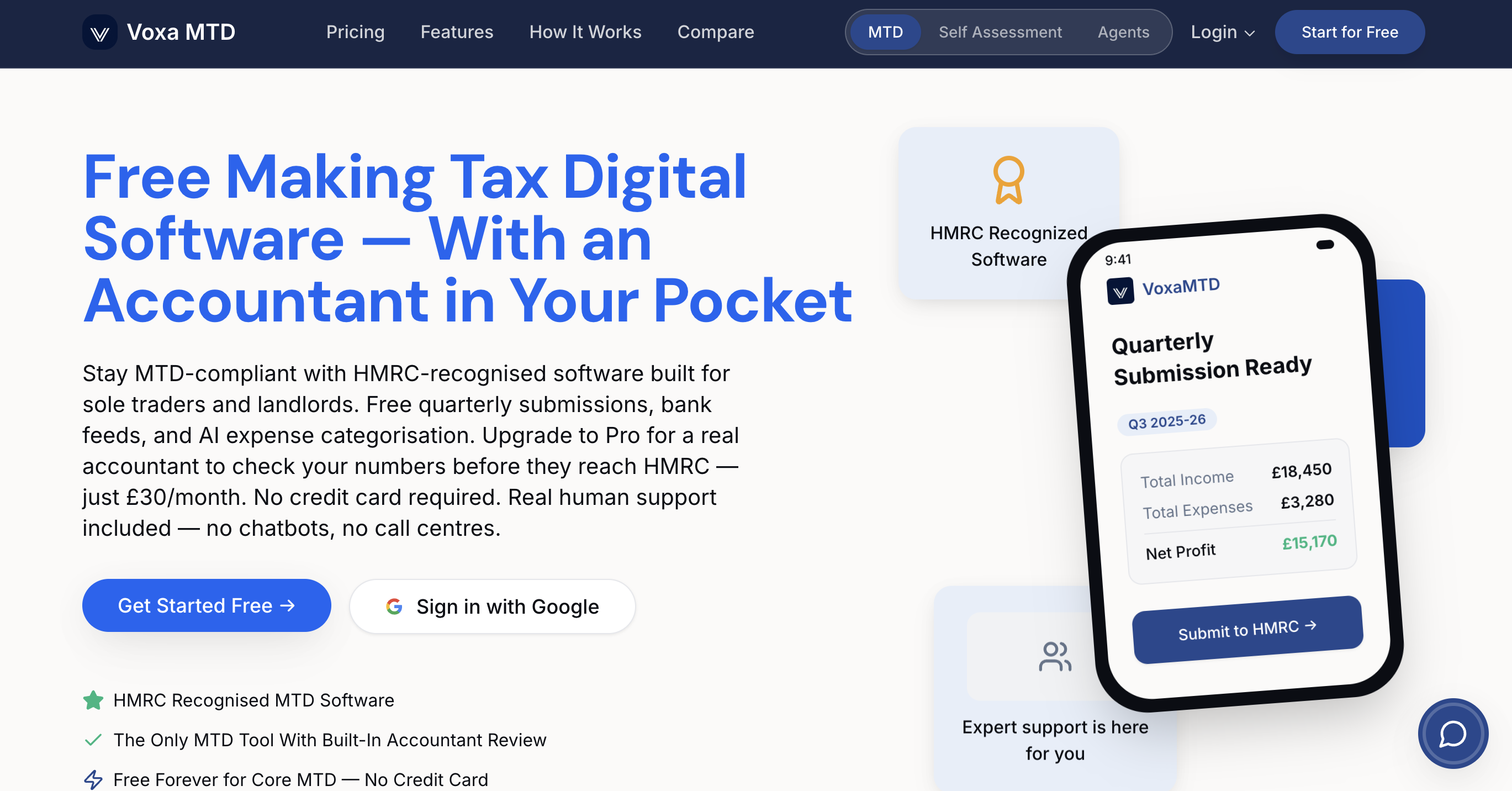
VoxaMTD is a free, HMRC-recognised MTD platform built specifically for sole traders and landlords. Unlike legacy software charging £30 to £65 per month, VoxaMTD's core plan is free and handles quarterly submissions directly to HMRC. It includes AI-powered transaction categorisation at 95% accuracy, FCA-regulated open banking, mileage tracking, and home office calculators. Alex AI Accountant answers your tax questions in plain English, 24/7, by voice, SMS, or WhatsApp. Use the MTD Checker to confirm your obligations instantly, explore the full VoxaMTD features list, or get started with free MTD software today.
Frequently asked questions
What are the income thresholds for MTD and when do they apply to sole traders?
Sole traders must comply if gross self-employment and property income exceeds £50,000 from April 2026, £30,000 from April 2027, and £20,000 from April 2028.
What counts as compatible software for Making Tax Digital?
Compatible software means tools listed on the HMRC site that let you keep digital records and submit quarterly updates directly, covering both free and paid options.
Will there be penalties for missing a quarterly update?
There are no penalties during the soft landing period covering 2026 and 2027, but a points-based system with fines applies from 2027 onwards.
Are any sole traders exempt from MTD requirements?
Exemptions are available for reasons including age, disability, location, or religion, and you must apply formally to HMRC rather than simply opting out.
Do I need an accountant for digital tax compliance under MTD?
No, you can complete all submissions yourself using approved software, though many sole traders choose to use an agent or accountant for added support and peace of mind.