

TL;DR:
- Making Tax Digital for Income Tax becomes mandatory from April 2026 for qualifying UK self-employed individuals and landlords.
- Obligations depend on phased income thresholds: £50,000, £30,000, and £20,000, with quarterly updates replacing annual returns.
- Early testing, using compatible software, and understanding deadlines help avoid penalties and ensure smooth compliance.
Making Tax Digital for Income Tax Self Assessment becomes mandatory from 6 April 2026 for qualifying self-employed individuals and landlords across the UK. If your gross income from self-employment or property exceeds the relevant threshold, you will need to submit quarterly updates to HMRC using compatible software, replacing the familiar annual Self Assessment return. Many people are still unclear on exactly who qualifies, what the submission deadlines look like, and what happens if they miss one. This guide walks you through the phased thresholds, the critical dates, practical record-keeping requirements, and the new penalty system, so you can approach April 2026 with confidence rather than last-minute panic.
Table of Contents
- Understanding the phased MTD deadlines and eligibility criteria
- Key MTD tax submission deadlines and reporting requirements
- Record keeping, software and practical compliance tips
- MTD penalty system: How to avoid fines and late points
- Expert perspective: Why preparing early is your best defence against MTD disruption
- Get help with MTD: Tools and support for seamless compliance
- Frequently asked questions
Key Takeaways
| Point | Details |
|---|---|
| MTD starts April 2026 | Eligible self-employed and landlords must comply with Making Tax Digital from 6 April 2026 if income exceeds £50,000. |
| Quarterly updates required | You must submit cumulative digital tax summaries every quarter and a final declaration by 31 January after the tax year ends. |
| Penalties for late submission | Late updates earn penalty points, with fines triggered at four points and additional charges for overdue payments. |
| Digital record keeping essential | Spreadsheets alone are not allowed; you need HMRC-compliant software for all record keeping and submissions. |
| Prepare before the deadline | Testing software and organising records in advance helps avoid penalty points and ensures stress-free compliance. |
Understanding the phased MTD deadlines and eligibility criteria
Now that you know what the Making Tax Digital mandate covers, let's break down who must act by the 2026 deadline and how phased thresholds impact you.
MTD for Income Tax does not hit everyone at once. HMRC has designed a phased rollout based on gross qualifying income, which means your obligations depend on how much you earn from self-employment and property combined. The phased income thresholds are:
| Phase | Start date | Income threshold |
|---|---|---|
| Phase 1 | 6 April 2026 | £50,000 or more |
| Phase 2 | 6 April 2027 | £30,000 or more |
| Phase 3 | 6 April 2028 | £20,000 or more |
The income figure that matters is your gross income, not your profit. So if you earn £55,000 from freelance work before expenses, you fall into Phase 1 even if your taxable profit is much lower. The same applies to landlords: rental income before deductions is what HMRC uses to assess eligibility.
For landlords, the MTD deadlines for landlords follow the same phased structure, but there are a few important nuances. If you have both a sole trader business and rental income, HMRC combines both figures to determine which phase applies to you.
Here is a quick eligibility checklist:
- Check your 2024/25 Self Assessment return for total gross income from self-employment and property
- If the combined figure exceeds £50,000, you must be compliant from 6 April 2026
- HMRC will write to you if you are in scope, but do not wait for that letter
- Limited companies are not affected by MTD for Income Tax
- Partnerships will be brought in at a later date, not covered by the current mandate
- Non-UK residents with UK income sources may still qualify, depending on their filing obligations
Around 780,000 to 900,000 individuals are expected to fall into Phase 1. That is a significant number, and many of them have never used dedicated tax software before. For digital tax deadlines for sole traders, the shift from annual filing to quarterly reporting is the single biggest practical change to understand.
If you run more than one business or own multiple properties, each income source requires a separate submission. You cannot bundle everything into one quarterly update.
Key MTD tax submission deadlines and reporting requirements
Once you confirm your eligibility, the next step is to understand the submission deadlines and requirements MTD imposes, so you never miss a critical date.
The MTD system replaces the single annual Self Assessment return with a series of quarterly updates followed by a final declaration. Here is how the submission calendar works:
- Quarter 1 update (April to June): due by 7 July
- Quarter 2 update (July to September): due by 7 October
- Quarter 3 update (October to December): due by 7 January
- Quarter 4 update (January to March): due by 7 April
- Final declaration: due by 31 January following the end of the tax year
The quarterly updates required are cumulative summaries of your income and expenses, not itemised transaction logs. You are reporting totals for the period, not attaching receipts or invoices. HMRC uses these updates to build a running picture of your tax liability throughout the year.

For landlord digital tax submission, each rental property business is treated as a separate income source with its own submission stream. If you have a buy-to-let portfolio and a freelance income, you are managing two separate quarterly reporting obligations.
Payments on account remain unchanged. You still pay:
- First payment on account: 31 January (during the tax year)
- Second payment on account: 31 July (after the tax year)
- Balancing payment: 31 January (alongside the final declaration)
What changes is how HMRC calculates what you owe. Because quarterly updates give them real-time income data, their estimates become more accurate over time. This is actually good news: it reduces the risk of a nasty surprise balancing payment in January.
For a detailed breakdown of MTD reporting requirements, including what counts as a valid update and how corrections work, it is worth reviewing HMRC's published guidance before your first submission date.
Record keeping, software and practical compliance tips
With the deadlines clear, your next priority is practical compliance: how to record, submit, and streamline digital tax management.
HMRC requires that all records are kept digitally and submitted via HMRC-compatible software. A spreadsheet on its own does not meet this requirement. You need software that can communicate directly with HMRC's systems via an Application Programming Interface, which is the technical bridge between your records and the tax authority's database.
Here is a practical compliance checklist:
- Sign up for MTD before your start date (do not wait until April 2026 if you are in Phase 1)
- Choose HMRC-recognised software and connect it to your tax account
- Import or enter transactions regularly rather than leaving it to the end of each quarter
- Keep records per business: do not mix sole trader and property income in the same ledger
- Test a submission before your first live deadline to catch any technical issues early
- Review the soft landing guidance: HMRC has indicated some flexibility for genuine errors in the early months, but this is not a licence to be careless
For landlords specifically, the free MTD software for landlords available through VoxaMTD includes a dedicated dashboard with a Section 24 mortgage interest calculator, which is critical now that mortgage interest is treated as a tax credit rather than a direct deduction. Getting this calculation wrong is one of the most common and costly mistakes landlords make.
Pro Tip: Set a recurring calendar reminder for the 1st of each deadline month (July, October, January, April) to review and reconcile your records. Doing a monthly check means your quarterly update takes minutes rather than hours.
For a broader overview of obligations, the landlord tax reporting guide covers capital allowances, allowable expenses, and how to structure your digital records for maximum clarity. The Landolio MTD guide also offers a useful independent perspective on software choices and practical setup steps.
MTD penalty system: How to avoid fines and late points
Finally, let's tackle the most stressful part for many: the new penalty regime and how to ensure you stay compliant, plus expert strategies for minimising risks.
MTD introduces a points-based penalty system where each late quarterly update or final declaration earns you one penalty point. Accumulate four or more points and you face a £200 fine. Points expire after a period of good compliance, but the threshold resets only once you have submitted on time for a consecutive period.
Here is a comparison of the key penalty scenarios:
| Scenario | Points impact | Financial penalty |
|---|---|---|
| One missed quarterly update | +1 point | None (below threshold) |
| Four missed updates | 4 points | £200 fine |
| Late final declaration | +1 point | Separate fixed penalty |
| Late payment | No points | Interest plus surcharge |
"The points-based system is designed to be more forgiving of occasional mistakes than the old fixed penalty regime, but it catches persistent non-compliance quickly. Four late submissions in a row means an automatic fine."
For HMRC's MTD penalties, the key strategies to avoid accumulating points are straightforward:
- Submit on time even if the figures are estimates (you can amend later)
- Do not confuse the quarterly update deadline with the payment deadline: they are different dates
- If you cannot submit due to a genuine emergency, contact HMRC promptly to request a reasonable excuse consideration
- Monitor your points balance through your HMRC online account
- Use software with automated reminders so deadlines never creep up on you
Late payment interest is charged at the Bank of England base rate plus 2.5 percentage points. This applies from the day after the payment deadline, so even a few days late adds up over time. The message is simple: if you have the funds, pay on time.
Expert perspective: Why preparing early is your best defence against MTD disruption
Most articles will tell you to get your software sorted and sign up before April 2026. That is correct, but it misses the deeper point. The real risk is not missing the deadline by a day. It is arriving at your first quarterly submission having never tested the system, with three months of unreconciled transactions and no idea whether your software is correctly categorising your expenses.
We have seen this pattern repeatedly with VAT MTD when it launched in 2019. Businesses that signed up early, ran test submissions, and built a monthly reconciliation habit found the transition almost invisible. Those who waited until the last week faced software glitches, bank connection failures, and panicked calls to accountants.
The HMRC guidance recommends checking your 2024/25 Self Assessment income now and signing up before the start date to take advantage of the testing window. The soft landing period gives you room to correct errors without penalty, but only if you are already in the system. You cannot benefit from soft landing if you have not signed up yet.
Start now. Test everything. Build the habit before the mandate forces you to.
Get help with MTD: Tools and support for seamless compliance
If you are ready to act, these tools and resources can make your digital tax transition hassle-free.
VoxaMTD is a free, HMRC-recognised platform built specifically for UK sole traders, landlords, and hybrid users facing the April 2026 mandate. It handles quarterly submissions directly to HMRC via production API, with automatic bank transaction imports, AI-powered expense categorisation, and a receipt scanner that reads your documents instantly.
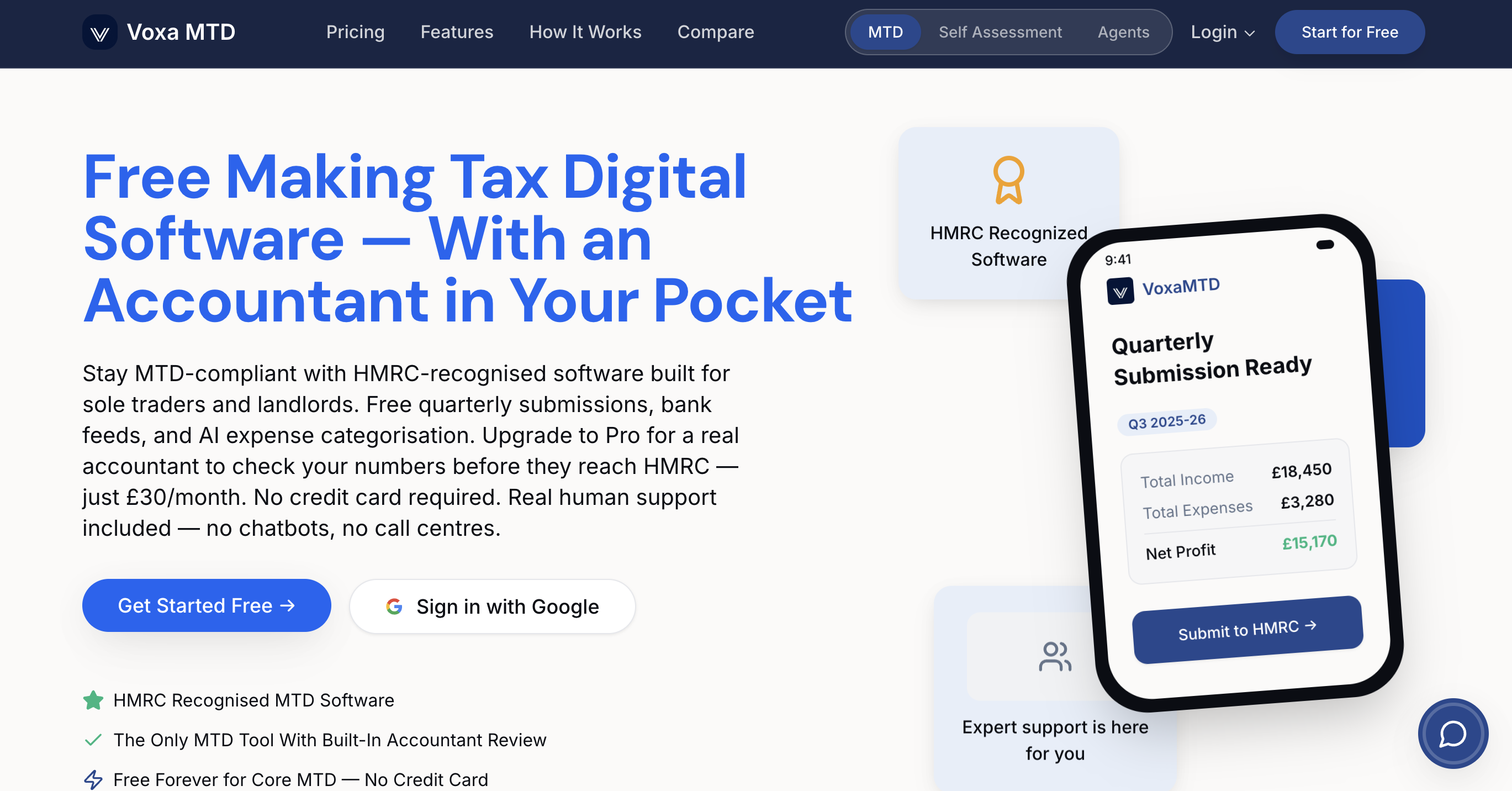
Start by visiting the MTD software for landlords page to see the dedicated landlord dashboard in action. Use the MTD eligibility checker to confirm whether you need to comply and from which date. When you are ready to choose a plan, the MTD compliance pricing page outlines every tier, from the free option through to Professional with a real human accountant included.
Frequently asked questions
What is the deadline to start Making Tax Digital for Income Tax Self Assessment in the UK?
6 April 2026 is mandatory for eligible self-employed individuals and landlords with gross income above £50,000. Lower thresholds of £30,000 and £20,000 follow in 2027 and 2028 respectively.
How do I check if I need to comply with MTD deadlines?
Review your combined self-employment and property income from your 2024/25 tax return; HMRC notifies via letter based on your prior Self Assessment return, but you should not wait for that correspondence.
If I miss a quarterly MTD update, what penalty applies?
Each late update earns one penalty point, and four or more points trigger a £200 fine, with additional interest charges applying separately to any late payments.
Are spreadsheets alone accepted for MTD record keeping?
No. You must use HMRC-compatible software that connects directly to HMRC's systems; spreadsheets on their own do not meet the digital records requirement.