

TL;DR:
- Making Tax Digital requires digital record-keeping and quarterly updates for UK sole traders and landlords.
- Early adoption of digital tools helps avoid penalties and improves time management and error reduction.
- Using compliant software offers benefits like time savings, clearer cash flow, and better business insights.
Most sole traders and landlords hear "Making Tax Digital" and picture yet another government system designed to eat up evenings and generate paperwork. That reaction is understandable, but it misses the bigger picture entirely. MTD for Income Tax Self Assessment becomes mandatory from April 2026, and for the 864,000 self-employed people it will eventually affect, the choice is not whether to comply but how to make it work in your favour. This article cuts through the noise to explain exactly who must join, why ignoring it is genuinely risky, and how the businesses that have already gone digital are quietly gaining an edge.
Table of Contents
- What is Making Tax Digital and who must comply?
- The main reasons small businesses can't ignore MTD
- Unexpected advantages: How MTD benefits small businesses
- How to get ready: Affordable tools and smart first steps
- Why embracing MTD now pays off: A practical perspective
- Next steps: Simplifying MTD compliance with VoxaMTD
- Frequently asked questions
Key Takeaways
| Point | Details |
|---|---|
| MTD is required in 2026 | From April 2026, MTD becomes mandatory for UK sole traders and landlords earning over £50,000. |
| Reduced errors, real savings | Making Tax Digital dramatically cuts mistakes and saves businesses dozens of hours annually. |
| Affordable software available | You can stay compliant with free or low-cost digital tools, many offering trials or basic plans. |
| MTD can boost your business | Quarterly updates mean more accurate tax planning and better visibility into cash flow. |
What is Making Tax Digital and who must comply?
Making Tax Digital (MTD) is HMRC's programme to move UK tax record-keeping and filing onto digital platforms. Instead of one annual Self Assessment return, you will keep digital records throughout the year and submit quarterly updates directly to HMRC via MTD-compatible software. Think of it as swapping a once-a-year sprint for four shorter, manageable check-ins.
The rollout follows a phased approach based on gross income:
| Phase | Start date | Income threshold |
|---|---|---|
| Phase 1 | April 2026 | Over £50,000 |
| Phase 2 | April 2027 | Over £30,000 |
| Phase 3 | April 2028 | Over £20,000 |
If you are a UK sole trader, a landlord receiving property income, or someone with both trading and property income that combined exceeds the threshold, you fall within scope. MTD for ITSA mandates digital records and quarterly filing, expanding across all three phases to catch progressively more taxpayers.
The key terms to understand are:
- Digital records: Transaction data stored in software rather than paper ledgers or spreadsheets that are not linked to a recognised platform
- Compatible software: A programme approved by HMRC that can send quarterly updates and end-of-period statements directly to HMRC systems
- Quarterly updates: Four submissions per tax year summarising your income and expenses, plus a final declaration replacing the traditional Self Assessment return
"MTD is not about HMRC watching your every transaction. It is about structuring record-keeping so errors are caught in real time rather than during a panicked January filing."
Understanding why HMRC requires digital tax records helps frame this correctly. The tax gap, which is the difference between tax owed and tax actually collected, stood at £39.8 billion in 2022 to 2023. A significant portion comes from avoidable errors made by self-employed individuals, not deliberate fraud. MTD is HMRC's structural fix for that problem.
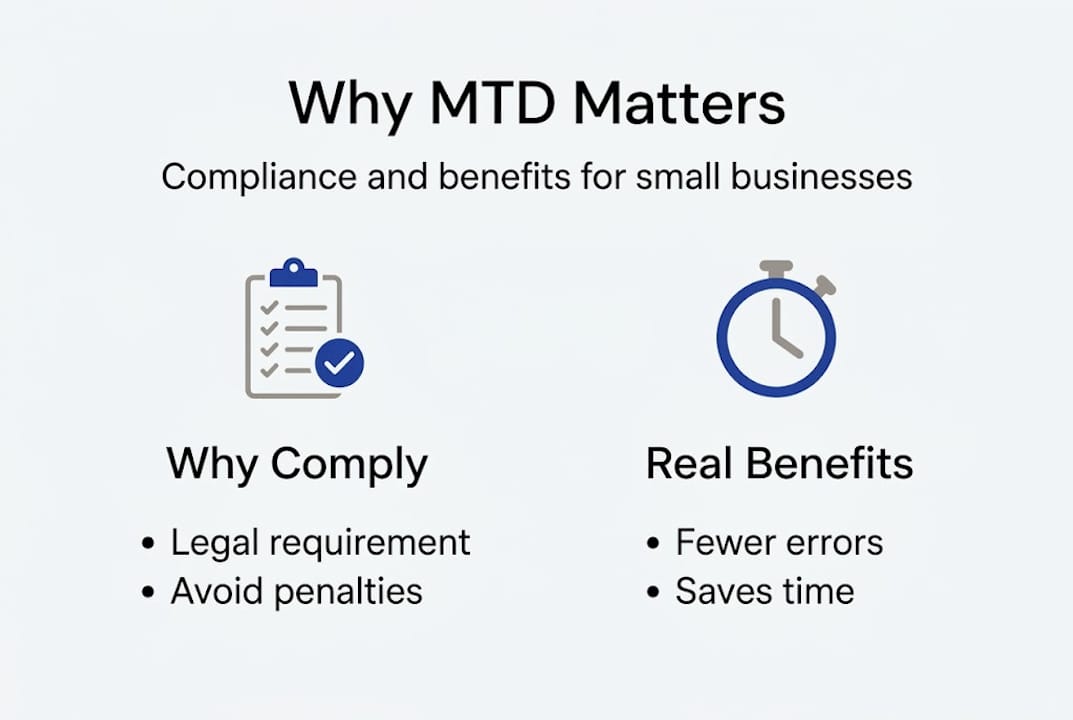
The main reasons small businesses can't ignore MTD
Once you know who is affected, the next question is obvious: what actually happens if you do nothing? The answer involves real financial consequences that grow over time.
HMRC is introducing a points-based penalty system for MTD. Each missed quarterly submission earns one point. Reach four points and you receive a £200 penalty on top of any further points accumulated. Crucially, penalties apply after the first year grace period, so 2026 is effectively your rehearsal year.
Here is how the penalty exposure compares between a proactive and a passive approach:
| Scenario | Year 1 | Year 2 onward |
|---|---|---|
| Compliant, all submissions on time | No penalty | No penalty |
| 1 to 3 missed filings | Warning points only | Points accumulate, no fine yet |
| 4+ missed filings | Points only (grace period) | £200 fine plus ongoing points |
The most common tax errors among self-employed filers include miscategorised expenses, missed income sources, and arithmetic mistakes in manual spreadsheets. These are exactly the types of issues that digital record-keeping is designed to catch before they become formal errors on a return.
Four practical reasons to act now rather than wait:
- Software takes time to learn. Starting early means fewer surprises at your first quarterly deadline
- Connecting your bank account via open banking requires a short authorisation process that is smoother done calmly than at the last minute
- Reviewing sole trader tax compliance tips now lets you restructure your record-keeping before bad habits become ingrained
- The soft-landing in year one is a genuine opportunity to test your system without financial risk
Pro Tip: Use the 2026 grace period deliberately. Treat your first four quarterly submissions as live practice. Review each one against your expectations and refine your categorisation rules so year two runs without friction.
Unexpected advantages: How MTD benefits small businesses
Compliance is the floor, not the ceiling. The businesses that will genuinely thrive under MTD are those who use the new structure to gain clarity they never had before.
The strongest evidence comes from VAT MTD, which rolled out from 2019. According to HMRC's own evaluation, MTD for VAT saved businesses 26 to 40 hours per year on average and resulted in 67% fewer filing mistakes. Those are not trivial figures. For a sole trader already stretched for time, 30 recovered hours a year is nearly a full working week.
Cash flow clarity is the benefit most people overlook. When you file four times a year rather than once, you know your approximate tax liability every quarter. That means no more January shock when your accountant reveals a bill you did not budget for. You can set aside the right amount each month and invest the rest with confidence.
Additional advantages reported by early adopters:
- Fewer end-of-year reconciliation surprises
- Easier identification of deductible expenses throughout the year, not just in January
- Better conversation quality with accountants because records are already clean
- Reduced stress during the Self Assessment period
The productivity lift is real too. Manual bookkeeping, even in a spreadsheet, involves repetitive data entry that is both time-consuming and error-prone. MTD-compatible software connects directly to your bank, categorises transactions automatically, and flags anomalies without you lifting a finger. AI-powered tools such as VoxaMTD achieve 95% categorisation accuracy, which means the vast majority of your transactions are sorted before you even log in.

Pro Tip: Use your quarterly submissions as mini business reviews. When you can see income and expenses broken down every three months, patterns emerge that an annual review would hide: seasonality, creeping costs, and underperforming income streams.
How to get ready: Affordable tools and smart first steps
Knowing the benefits is one thing. Having a practical plan is another. Here is how to move from intention to action without overcomplicating it.
Start by working through this readiness checklist:
- Confirm your gross income from trading and/or property against the relevant threshold for your phase
- List every place your financial records currently live, whether that is a spreadsheet, a shoebox, or a bank statement folder
- Choose MTD-compatible software and create an account. Many platforms, including VoxaMTD, offer free core plans. Legacy accounting tools can cost £30 to £65 per month, so cost comparison is worth doing before committing
- Connect your business bank account using open banking so transactions import automatically
- Categorise your most common transaction types once, and let the software remember your preferences going forward
For landlords specifically, ensure your chosen platform handles property income separately from any trading income, and that it can process prepping tax records for MTD covering both income streams in the correct HMRC format.
The case for signing up to HMRC's voluntary MTD service before your mandatory date is strong. Early voluntary adoption is recommended specifically to test your tools, surface any software compatibility issues, and build the quarterly filing habit before penalties are in play. Consider it a free insurance policy against year-two stress.
Key things to look for in MTD software:
- Direct API connection to HMRC (not just data export)
- Automatic bank feed via FCA-regulated open banking
- Categorisation support with the ability to review and override
- Clear audit trail for each quarterly submission
- Support for both sole trader and property income if relevant to you
Why embracing MTD now pays off: A practical perspective
Here is the uncomfortable truth most articles gloss over: the businesses that struggled most with VAT MTD were not those with complex finances. They were the ones who waited, rushed the setup, and spent months correcting categorisation errors under time pressure.
The pattern is predictable. Resistance followed by a scramble followed by grudging acceptance. But the businesses that treated the VAT MTD rollout as a genuine opportunity to modernise their record-keeping came out ahead. They discovered that navigating 2026 digital tax trends early is not about being a technology enthusiast. It is about removing friction from something you have to do anyway.
MTD will not transform your business on its own. But the discipline of quarterly digital records creates a foundation. From that foundation, you can spot trends, plan ahead, and have genuinely productive conversations with accountants or advisers rather than spending that time reconstructing receipts. The compliance box is just the start. What you do with the visibility it creates is the real opportunity.
Next steps: Simplifying MTD compliance with VoxaMTD
If you are ready to take action today, affordable and fully compliant solutions are already available.
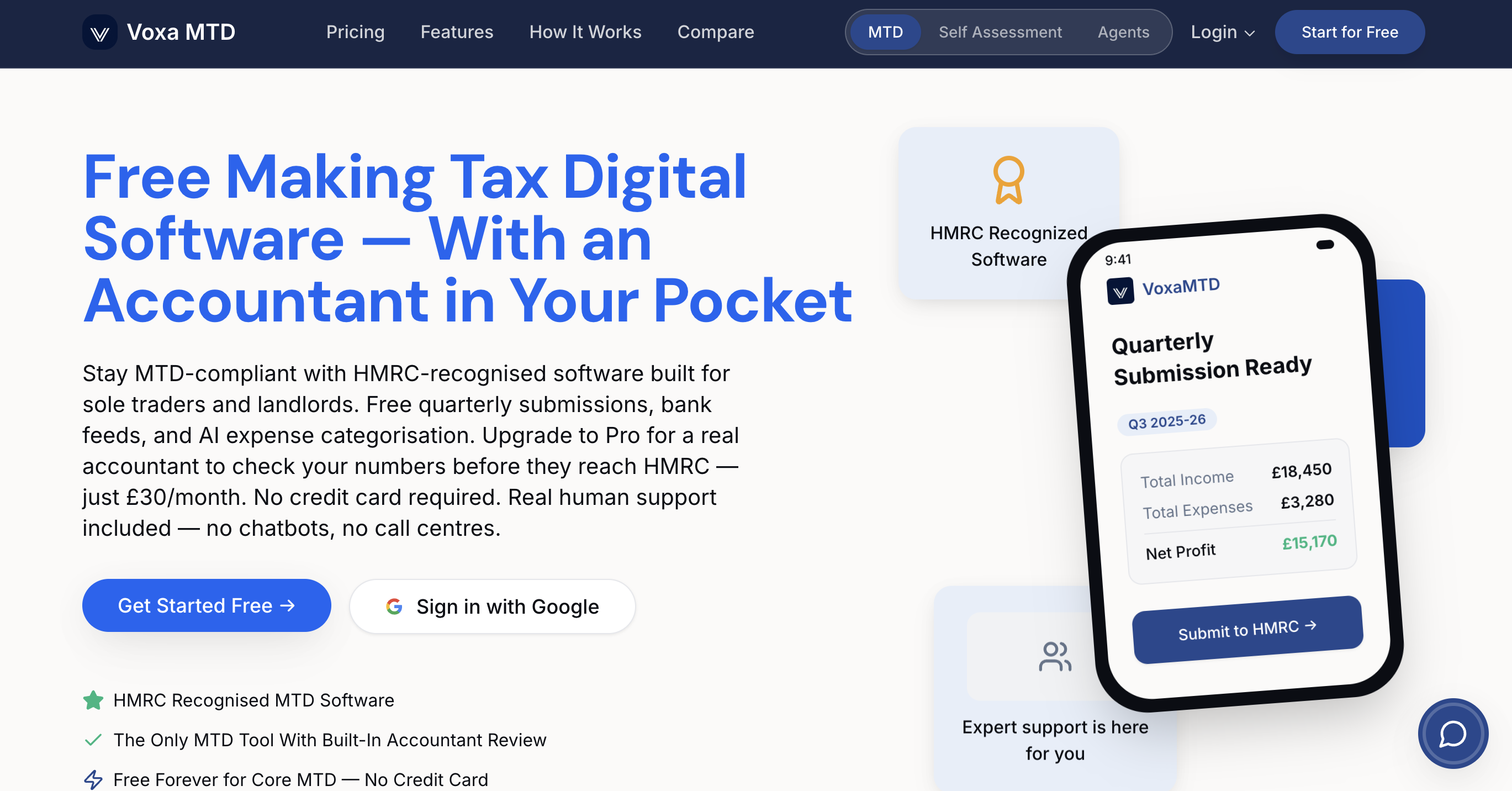
VoxaMTD is a free, HMRC-recognised MTD platform built specifically for UK sole traders and landlords. It handles quarterly submissions directly to HMRC via production API, uses FCA-regulated open banking for automatic bank feeds, and gives you access to Alex AI Accountant, a voice AI that answers your tax questions in plain English, 24/7. Whether you need MTD software for landlords with Section 24 calculations, or MTD tools for sole traders including mileage tracking and home office calculators, VoxaMTD covers it without the monthly fee. Start by using the MTD checker tool to confirm your eligibility and find the right plan.
Frequently asked questions
Is Making Tax Digital compulsory for all small businesses in 2026?
No. Only UK sole traders and landlords with qualifying income over £50,000 must join from April 2026, with the lower thresholds of £30,000 and £20,000 phased in during 2027 and 2028 respectively.
What happens if I miss an MTD quarterly filing deadline?
There is no financial penalty during the first year, but after that, missed filings accumulate points and four points triggers an immediate £200 fine under the points-based system.
Does MTD really save time and reduce errors?
Yes. The HMRC evaluation of VAT MTD found businesses saved 26 to 40 hours annually and experienced 67% fewer filing mistakes after adopting digital tools.
How can I try MTD with minimal cost or risk?
Free and trial versions of MTD-compatible software are widely available, and HMRC's voluntary sign-up lets you test quarterly submissions in real conditions before your mandatory start date.