

TL;DR:
- Open banking simplifies financial management for self-employed individuals through secure, real-time data sharing.
- It enhances Making Tax Digital compliance by automating transaction import, categorization, and direct HMRC submissions.
- Early adopters gain better financial insights, reduce admin time, and improve decision-making, giving them a competitive edge.
Open banking has a reputation problem. Many self-employed people assume it's a tool built for finance teams, accountants, or tech-savvy entrepreneurs running multi-staff operations. The reality is quite different. Open banking is arguably most useful for sole traders, freelancers, and micro-business owners who want less admin, fewer errors, and a cleaner path through Making Tax Digital compliance. This guide breaks down exactly what open banking offers the self-employed, how it connects to HMRC's MTD requirements, and what practical steps you can take today to start benefiting.
Table of Contents
- What is open banking and who does it help?
- How does open banking work for the self-employed?
- Open banking, Making Tax Digital, and HMRC: How they fit together
- Top benefits of open banking for UK sole traders
- Common pitfalls and how to avoid them
- Our take: Open banking is the self-employed advantage few embrace
- Next steps: Simplify your tax compliance with open banking
- Frequently asked questions
Key Takeaways
| Point | Details |
|---|---|
| Open banking demystified | Open banking is secure, user-friendly, and saves time for self-employed people managing tax. |
| Seamless MTD compliance | Connecting your bank to approved software automates digital records and HMRC submissions. |
| Boosted cashflow control | Real-time data gives you up-to-date cashflow and tax estimates for wiser business decisions. |
| Avoid common pitfalls | Review permissions and choose MTD-ready apps to get the most from open banking. |
What is open banking and who does it help?
Open banking is a system that allows you to securely share your bank account data with authorised third-party apps and software, using regulated application programming interfaces (APIs). Think of it as giving a trusted app a secure window into your transactions, without handing over your login details or passwords.
In the UK, open banking is regulated by the Financial Conduct Authority (FCA) and governed under rules introduced following the Revised Payment Services Directive (PSD2). That regulatory backbone matters. It means any provider you authorise must meet strict security standards and can only access the data you specifically permit.
Who benefits most? The short answer is: anyone managing money without a dedicated finance department.
- Sole traders who need to track income and expenses across one or two accounts
- Freelancers juggling multiple clients and irregular payment dates
- Small business owners who want real-time clarity on cash position
- Landlords managing rental income alongside other self-employment
- Accountants who want automated data feeds from clients rather than chasing spreadsheets
The scale of opportunity here is significant. The Yapily-TaxHeaven partnership targets 2.9 million sole traders and landlords for MTD Phase 1 alone, and roughly 4.2 million self-employed people across the UK stand to be affected by digital tax changes.
The common misconception is that open banking requires technical know-how or expensive software. It doesn't. Modern platforms built around digital tax for sole traders have made the experience straightforward enough that most users are set up within minutes. The HMRC open banking guide outlines clearly how these integrations reduce the burden of manual record-keeping.
How does open banking work for the self-employed?
The process is simpler than most people expect. Here is what the practical journey looks like from start to finish.
- Choose an MTD-compatible app that supports open banking, such as VoxaMTD or similar HMRC-recognised software.
- Connect your business bank account by selecting your bank within the app and following the secure authorisation prompt. No passwords are shared.
- Grant specific permissions, such as read-only access to transactions from a chosen date. You choose what the app can and cannot see.
- Review and categorise transactions as the app imports them automatically. AI-powered tools can categorise the vast majority instantly.
- Submit directly to HMRC from within the same platform, without logging into a separate government portal or entering figures manually.
In the background, the app communicates with your bank through a regulated API. Your bank verifies your identity directly. The app never stores your banking credentials. All data transferred is encrypted.

The biggest time-saving comes from automated account reconciliation, which eliminates the manual matching of transactions to invoices. The benefits of Making Tax Digital include reduced manual entry errors, real-time cashflow visibility, and direct HMRC submission without extra logins.
Pro Tip: When you first link your account, spend five minutes reviewing the permission scope. Many users accept defaults and miss the option to limit access to a specific account or date range. Tighter permissions mean cleaner data and fewer irrelevant transactions cluttering your records.
Open banking, Making Tax Digital, and HMRC: How they fit together
Making Tax Digital (MTD) for Income Tax requires self-employed individuals and landlords with qualifying income to keep digital records and submit quarterly updates to HMRC. From April 2026, this applies to anyone earning above £50,000 from self-employment or property. The threshold drops to £30,000 in April 2027.
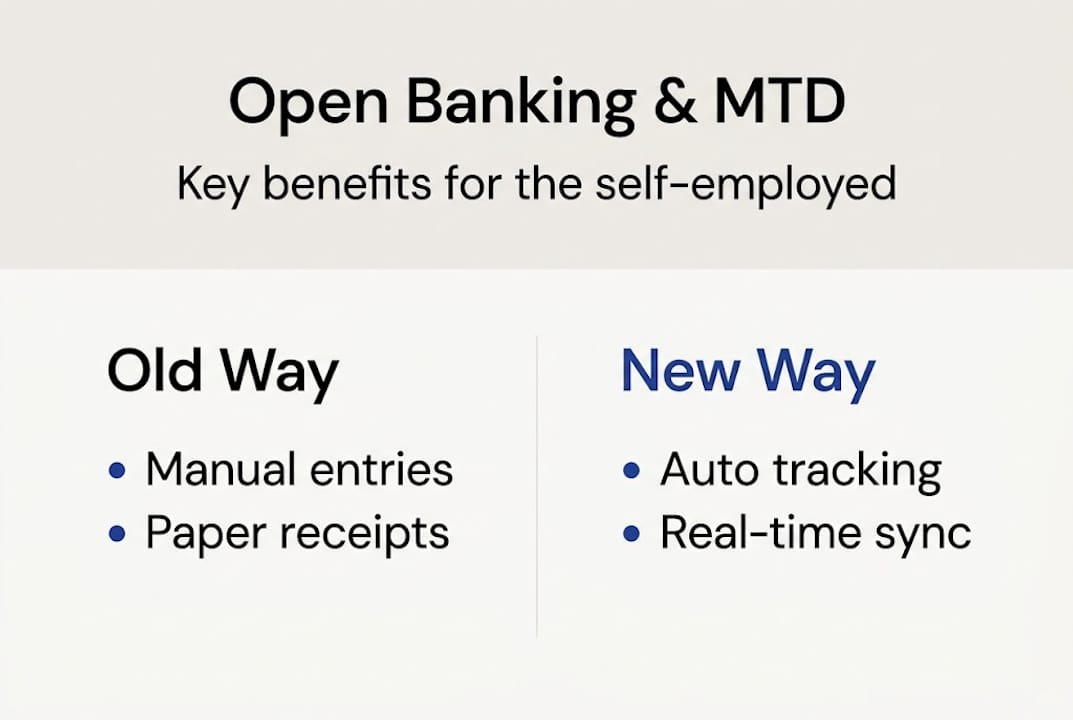
Open banking is not legally required for MTD compliance, but it is the most efficient path to it. Here is why.
| Traditional method | Open banking and MTD approach |
|---|---|
| Manual transaction entry into spreadsheets | Automatic import via bank feed |
| Monthly or quarterly reconciliation sessions | Continuous, real-time reconciliation |
| Risk of missing or duplicating entries | AI categorisation reduces errors significantly |
| Separate HMRC login for submission | Direct API submission from your platform |
| Time-consuming at quarter-end | Ongoing, low-effort maintenance |
The Yapily-TaxHeaven partnership is one example of how fintech companies are building open banking directly into MTD workflows to serve the 4.2 million self-employed individuals affected.
"The integration of open banking into MTD-compatible tools means sole traders can move from reactive tax filing to proactive financial management, with submissions handled automatically throughout the year."
For practical guidance on what quarterly reporting involves, the quarterly tax submissions overview covers the full process. You can also browse MTD tax guides for topic-specific breakdowns. Missing MTD deadlines can result in penalty points under HMRC's new system, so getting your digital infrastructure in place early is genuinely important. The official MTD guidance sets out the full requirements clearly.
Top benefits of open banking for UK sole traders
Let's move past the theory and into what this actually changes in your working week.
| Old workflow | New open banking workflow |
|---|---|
| Log receipts manually or photograph them ad hoc | Transactions auto-imported and categorised daily |
| Quarterly scramble to find missing expenses | Expenses tracked in real time throughout the quarter |
| Tax estimate only at year-end | Live tax liability estimate updated continuously |
| Risk of underclaiming deductions | Fewer missed deductions with categorised transaction history |
The benefits of Making Tax Digital go well beyond simple compliance. Automated bank reconciliation reduces manual entry errors and saves hours each month. Real-time cashflow data helps you plan payments on account accurately rather than guessing.
Here are five benefits sole traders consistently report after switching:
- Less admin time. Bank feeds replace manual data entry, freeing up hours every month.
- Fewer missed deductions. Transactions are captured continuously, so allowable expenses like tax deductions for self-employed are less likely to slip through.
- Real-time tax estimates. You know roughly what you owe before the quarter ends, avoiding bill shock.
- Simpler quarter-end submissions. With records already in order, filing becomes a review rather than a rebuild.
- Better financial decisions. Live cashflow data means you can make pricing, spending, and investment choices based on current facts rather than last month's spreadsheet.
For a broader look at what's shifting in tax technology this year, the digital tax trends 2026 guide is worth reading.
Common pitfalls and how to avoid them
Open banking does not work perfectly on autopilot. There are several mistakes that reduce its value significantly.
- Skipping the onboarding tutorial. Most MTD platforms include guided setup. Users who skip it often miss automated categorisation features and end up doing more manual work than necessary.
- Choosing a non-compatible platform. Not all accounting tools are HMRC-recognised for MTD submissions. Check before committing. The benefits of Making Tax Digital are only fully realisable with a compliant tool.
- Assuming a bank feed is enough. A live bank feed imports transactions, but it does not automatically create the digital records HMRC requires. You still need a platform that formats and submits data correctly.
- Setting permissions and forgetting them. Permissions granted to an app can become outdated. If you open new accounts or switch banks, old connections may stop working or pull incomplete data.
- Mixing personal and business transactions. Running both through the same account creates noise that even good AI categorisation struggles to clean up reliably.
Pro Tip: Set a reminder to review your open banking permissions and connected accounts every six months. Banks regularly update their APIs, and platforms add new features. A quick check ensures nothing has silently broken and you are getting the full benefit of each update.
For questions about where professional advice fits into this picture, the accountants and compliance guide explains how open banking-enabled platforms and human accountants can work together rather than replace each other.
Our take: Open banking is the self-employed advantage few embrace
Most conversations about open banking frame it as a compliance tool. Meet MTD requirements, avoid penalties, keep records tidy. That framing is accurate but it undersells what is actually available.
The self-employed people who gain the most from open banking are not the ones scrambling to stay compliant. They are the ones who use real-time financial data to make sharper decisions. When you know your current cash position, your approximate tax liability, and your biggest expense categories at any moment, you run your business differently. You price more confidently. You chase late payments sooner. You do not overspend before a tax bill arrives.
Most sole traders ignore this because the habit of doing things the old way is deeply ingrained. Fear of new technology plays a part too. But the practical barrier is almost nonexistent now. A proper reconciliation guide takes less than an hour to follow. Setup is measured in minutes, not days.
The self-employed who move early on open banking are not just ticking a box. They are quietly building a financial clarity that most of their peers will not have for years.
Next steps: Simplify your tax compliance with open banking
If this article has shifted your thinking about what open banking can actually do for your finances, the next step is to try a platform built specifically for self-employed people in the UK.
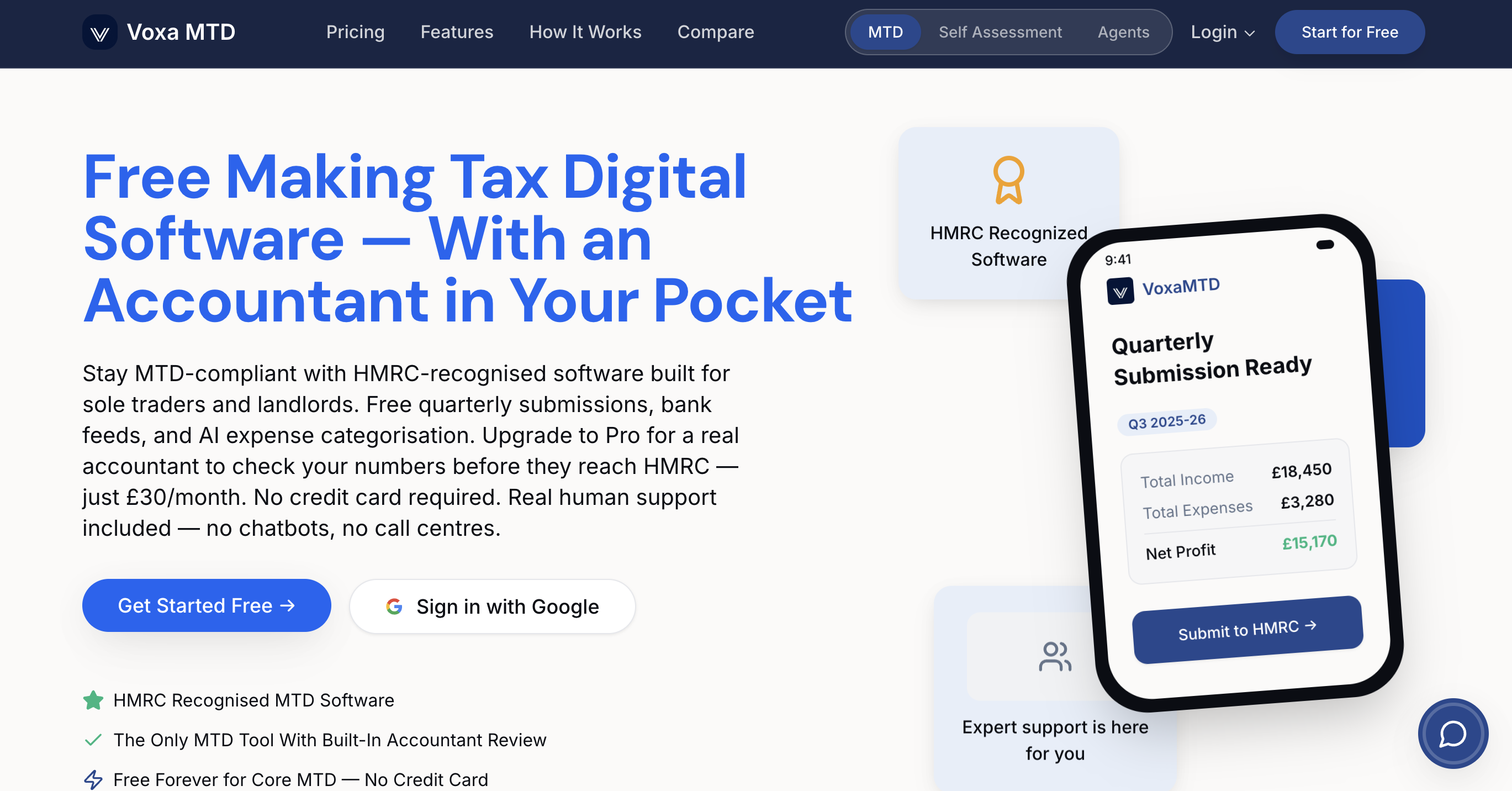
VoxaMTD's free MTD tools for sole traders handle quarterly submissions, automated categorisation, and open banking connections through FCA-regulated Finexer, all at no cost. If you are a landlord, the dedicated MTD for landlords dashboard includes Section 24 calculations and capital allowances tracking. Not sure whether you are already within the MTD threshold? Check your MTD status in under a minute to see where you stand ahead of the April 2026 deadline.
Frequently asked questions
Is open banking safe for self-employed users?
Yes. Open banking providers must meet strict UK security standards set by the FCA, and regulated protocols ensure your bank login details are never shared with third-party apps.
How do I connect my business account to an MTD-compatible tool?
Choose an HMRC-recognised platform, select your bank within the app, and follow the secure authorisation steps. The integration process is streamlined for most UK banks and takes only a few minutes.
What are the main advantages of open banking for tax returns?
Automated records, real-time tax estimates, and direct HMRC submissions reduce errors and save time compared to traditional manual methods.
Do I need separate open banking accounts for business and personal use?
It is strongly recommended that you use a dedicated business account. Keeping personal and business transactions separate makes categorisation cleaner and MTD compliance considerably simpler.