
TL;DR:
- UK sole traders must adapt to quarterly digital tax submissions by 2026, with accountants acting as key partners.
- Accountants help with tax filing, expenses, payments on account, and navigating Making Tax Digital requirements.
- Professional support reduces time, stress, and errors, making ongoing compliance more manageable.
Most sole traders assume an accountant is something you call once a year, hand over a shoebox of receipts, and wait for a tax bill. That assumption is quietly becoming one of the most expensive mistakes in self-employment. The UK's tax landscape is shifting fast, with Making Tax Digital (MTD) for Income Tax arriving in April 2026, bringing quarterly digital submissions and new compliance demands that go far beyond an annual Self Assessment return. Accountants are no longer just number-crunchers at year-end. They are becoming year-round partners, helping sole traders stay compliant, avoid penalties, and make smarter financial decisions in real time.
Table of Contents
- Understanding the accountant's role for sole traders
- Navigating Making Tax Digital: Why accountants matter in 2026
- Proactive advice: From annual returns to real-time support
- Choosing and working with your accountant: Maximising benefits
- What most guides miss: The uncomfortable truth about sole trader accounting
- Next steps: Making compliance easier with the right tools
- Frequently asked questions
Key Takeaways
| Point | Details |
|---|---|
| Year-round support | Accountants provide ongoing advice and management, not just annual tax returns. |
| MTD expertise | Accountants guide sole traders through the new digital compliance requirements for 2026. |
| Penalty prevention | Professionals help avoid costly mistakes and late HMRC penalties with timely submissions. |
| Strategic insights | Accountants now offer forecasting and growth planning using real-time digital tools. |
| Smart collaboration | Choosing the right accountant and software maximises benefits for UK sole traders. |
Understanding the accountant's role for sole traders
The phrase "getting an accountant" can feel vague, so let's be specific about what they actually do for sole traders. At the core, accountants assist sole traders with preparing and submitting Self Assessment tax returns, calculating profits as income minus allowable expenses, handling National Insurance (NI) contributions, and managing payments on account to prevent unwelcome surprises.
That last point is worth pausing on. Payments on account are advance payments towards your next tax bill, due in January and July each year. Many new sole traders are blindsided by a bill that is effectively one and a half years' worth of tax in a single payment. A good accountant flags this early and helps you budget accordingly.
Here is a breakdown of the core tasks an accountant handles for you:
- Self Assessment preparation and filing: Calculating your taxable income and submitting your return to HMRC before the deadline.
- Allowable expenses: Identifying every legitimate business cost you can deduct, from equipment to travel, to reduce your tax bill legally.
- National Insurance contributions: Class 2 and Class 4 NI contributions are both relevant for sole traders, and getting these wrong can affect your state pension entitlement.
- Payments on account: Forecasting your liability so you are never caught short.
- HMRC correspondence: Handling enquiries or investigations on your behalf.
"The best accountants do not just file your return. They tell you what is coming before it arrives."
Pro Tip: Start keeping digital records from day one, even if you are not yet required to. Good record-keeping is the single biggest factor in reducing your accountancy bill, because less time spent sorting your records means lower fees for you. Our sole trader bookkeeping guide walks you through the essentials.
Navigating Making Tax Digital: Why accountants matter in 2026
MTD for Income Tax is the most significant change to UK tax administration in decades. From April 2026, sole traders earning above £50,000 must keep digital records and submit quarterly updates to HMRC through approved software. Those earning above £30,000 follow from April 2027.
Under this regime, accountants act as agents for their clients: they select suitable MTD software, maintain digital records with proper links between systems, submit quarterly updates, finalise end-of-period declarations, forecast tax liabilities, and help sole traders avoid penalties. The penalty system is points-based, and reaching four late points triggers a £200 fine, with further charges for continued non-compliance.
Here is how the responsibilities compare when you go it alone versus working with an accountant:
| Task | DIY approach | With an accountant |
|---|---|---|
| Software selection | Research and trial yourself | Recommended and configured for you |
| Quarterly submissions | Your responsibility, your risk | Managed and checked before filing |
| Penalty avoidance | Relies on your own awareness | Proactively monitored |
| Tax forecasting | Manual estimates | Professional projections |
| HMRC queries | Handle alone | Accountant responds on your behalf |
To get ahead of the changes, follow these steps:
- Confirm whether your income puts you in the April 2026 or April 2027 cohort.
- Choose MTD-compatible software and begin using it now, not at the deadline.
- Appoint an accountant as your MTD agent so they can submit on your behalf.
- Review your record-keeping habits and move to fully digital processes.
- Check the digital tax deadlines for traders so you know exactly when each quarterly update is due.
The quarterly submission model means there is no longer a single annual crunch. Instead, your financial data must be accurate and up to date throughout the year. Staying informed about digital tax trends for sole traders will help you understand what is coming next.
Proactive advice: From annual returns to real-time support
The shift to MTD is not just a compliance change. It is an opportunity. When your financial data flows digitally and continuously, your accountant can offer advice that was previously impossible without a full year of records in hand.
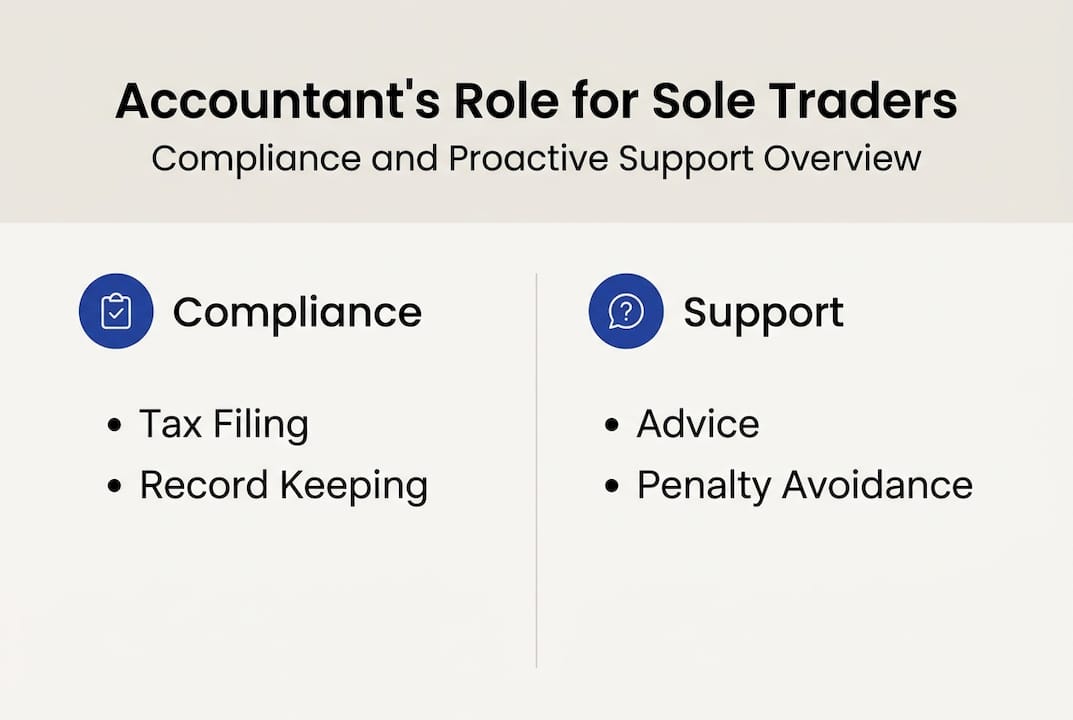
Accountants evolve under MTD from annual filers into proactive partners, providing real-time insights, penalty avoidance, and strategic advice. For sole traders who are growing, this shift is genuinely valuable.
Here is what modern advisory support looks like in practice:
| Service | What it means for you |
|---|---|
| Cash flow forecasting | Know when tight months are coming before they arrive |
| Profit planning | Structure your income to reduce your tax bill legally |
| Expense strategy | Maximise allowable deductions throughout the year |
| Growth planning | Understand when incorporating as a limited company makes sense |
| Pension planning | Use contributions to reduce your Self Assessment liability |
Real-time support also means your accountant can flag issues before they become problems. If your income spikes in one quarter, they can adjust your payments on account projection immediately rather than leaving you with a shock bill in January.
Pro Tip: Ask your accountant for a mid-year review, not just an end-of-year one. With MTD data flowing quarterly, there is no reason to wait until January to understand your tax position. Understanding UK tax digitisation helps you have more informed conversations with your accountant about what is possible.
The benefits of ongoing support extend beyond tax. Accountants who understand your business can advise on pricing, timing of purchases, and whether expenses qualify for capital allowances. To understand HMRC's role in MTD and how the system connects to your accountant's work, it is worth reading up before your next meeting.
Choosing and working with your accountant: Maximising benefits
Accountants save time and reduce stress for sole traders navigating digital compliance, but only if you choose the right one and engage them properly. Here is how to do both.
When selecting an accountant, look for these qualities:
- MTD experience: They should already be working with MTD-compliant software and have clients using it.
- Sole trader specialism: General practice accountants are fine, but one who understands self-employment nuances is better.
- Clear pricing: Fixed monthly fees are easier to budget than hourly rates that balloon at year-end.
- Proactive communication: You want someone who contacts you, not just someone who waits for your call.
- Software compatibility: Check that their preferred tools integrate with your own record-keeping systems.
Before signing up, ask these questions:
- Are you registered as an MTD agent with HMRC?
- Which MTD-compatible software do you recommend, and why?
- How often will we communicate throughout the year?
- What is included in your fee, and what costs extra?
- How do you handle HMRC enquiries if one arises?
Once you are working together, make the relationship count. Share your bank statements promptly, flag unusual transactions, and do not wait until the last minute to raise questions. The more organised you are, the more time your accountant can spend on advice rather than administration.
If you are still getting to grips with the terminology around digital tax, our guide to MTD terminology explained is a useful starting point. And if you want to explore what free MTD software for sole traders looks like in practice, it is worth seeing how digital tools can complement your accountant's work rather than replace it.
What most guides miss: The uncomfortable truth about sole trader accounting
Here is what the standard advice rarely says outright: most sole traders do not underestimate their tax bill. They underestimate the time that compliance takes, and that is where the real cost lies.
DIY tax management feels manageable when you have ten clients and a quiet inbox. It starts to crack when you are juggling thirty clients, chasing invoices, and trying to remember whether that laptop was 100% business use or not. The digital tax trends for sole traders point clearly in one direction: compliance is getting more frequent, not less.
DIY is possible with software, but accounting professionals save time and reduce stress for growing businesses. That is not a sales pitch. It is a practical observation about where your energy is best spent. Every hour you spend reconciling transactions is an hour you are not spending on the work that actually earns you money.
The hidden risk of DIY is not usually a dramatic error. It is the slow accumulation of small mistakes: a missed expense here, a miscategorised receipt there, a payment on account that was not adjusted after a good quarter. None of these are catastrophic alone. Together, they add up to an unnecessarily large tax bill and a stressful January.
Next steps: Making compliance easier with the right tools
If this article has made one thing clear, it is that sole trader accounting in 2026 is a year-round commitment, not an annual chore. The good news is that the right combination of professional support and smart software makes it genuinely manageable.
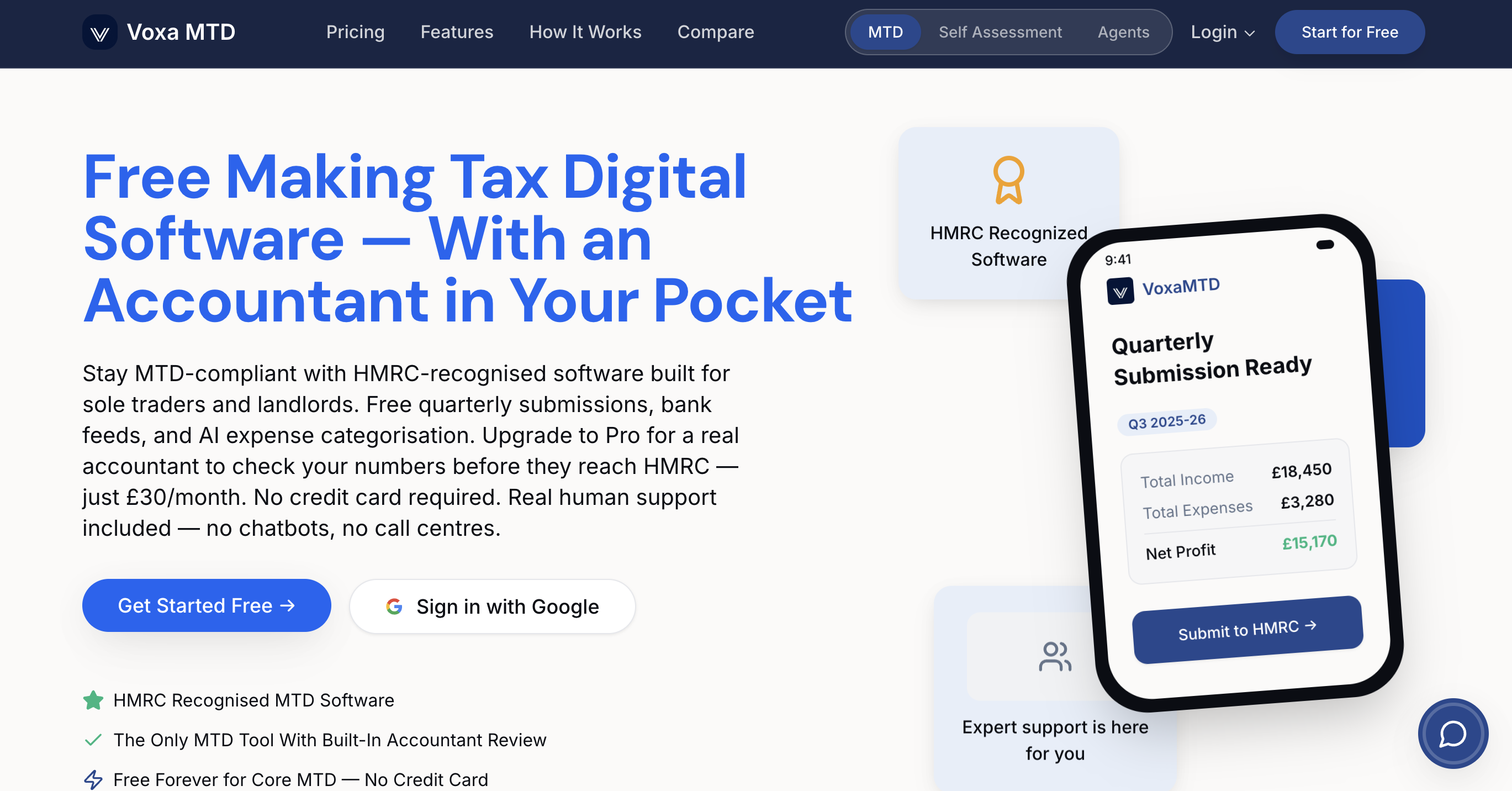
VoxaMTD is a free, HMRC-recognised MTD platform built for sole traders that handles quarterly submissions directly to HMRC, imports bank transactions automatically, and includes AI-powered expense categorisation. The Professional tier gives you access to a real human accountant for quarterly reviews at £30 per month. If you are an accounting firm looking to manage client submissions efficiently, the accountants partner programme offers a revenue-share model with a dedicated portal. Visit VoxaMTD to explore how professional-grade compliance can work for your business without the traditional price tag.
Frequently asked questions
Do sole traders need an accountant for Making Tax Digital in 2026?
MTD requires digital record-keeping and quarterly submissions, and while DIY is possible, an accountant helps you select software, stay compliant, and avoid MTD penalties that begin at £200 after four late points.
What taxes do accountants help UK sole traders with?
Accountants help you calculate profits, file Self Assessment returns, manage Class 2 and Class 4 National Insurance contributions, and plan payments on account so you are never caught short.
Can a sole trader do everything themselves or is an accountant essential?
Self-management is possible using MTD-compatible software, but pros save time and stress for growing businesses, and the value of professional advice increases significantly as your income and complexity grow.
How does an accountant help avoid HMRC penalties?
Accountants acting as your MTD agent ensure quarterly updates are submitted on time and records are accurate, protecting you from the points-based penalty system that applies under the new regime.